In 2010 I published a book that outlines one way of teaching with works of art – a thematic, inquiry-based approach. Although my ostensible audience for this book was teachers, this book was developed from practice in the museum field, and is used by museum practitioners. Since then, although I still use this approach, I find myself very interested in other methods of teaching with objects, and a number of Museum Questions posts have explored alternate approaches to talking about objects, or using objects to spark conversation. These include:
- Ariel Sykes on Philosophy for Children
- Jackie Delamatre on strategies that help children become independent museum goers
- Claire Bown on Thinking Routines
In January I had the pleasure of talking to Sarah Pharaon, Principal, Dialogic Consulting. Prior to launching Dialogic Consulting in 2020, Sarah worked at the Lower East Side Tenement Museum and the International Coalition of Sites of Conscience.
Sarah, what is dialogic questioning, and why might museums want to use it?
Dialogic interpretation is a way of communicating that is uniquely equipped to address two important contemporary museum issues.
First, over the last few decades we’ve seen a steady increase in museums willing to take on the challenging portions of their own histories as institutions. But nonprofit institutions that don’t have a history of strong activism tend to be conflict avoidant, and Boards tend to be conflict avoidant. And so that movement to confront our own institutional histories, and also larger histories within our world, has pushed institutions towards something like dialogue as a result.
The other issue is a more focused interest in community engagement. In order to be more community-driven, we need to look at our communication styles, and redefine them in order to shift the power hierarchies that have been in place for decades.
In dialogic interpretation, one of the core principles of building effective structures for dialogue is that we rely on a shared experience. Most of the time when we find ourselves in disagreement with each other, the basic facts, the information that we have that is leading us to be in disagreement is not the same. So if I’m someone who watches the BBC and you are someone who watches MSNBC, there will be differences in the way that the news is selected and narrated that have led us to believe different things. Or we might have read different historical accounts. Or we might have very different lived experiences.
Museums and cultural organizations are uniquely equipped to be venues for dialogue, because we have content. This content can become a shared experience. So in an art museum, a work of art becomes the the shared experience that people can discuss. You may never have seen a painting by, for example, Vasily Kandinsky, before coming on my tour. However, I know as a facilitator you have all seen this painting that we are looking at together. So I can start my dialogue from that space.
What does dialogic interpretation entail?
Many museums currently use Tammy Bormann & David Campt’s Arc of Dialogue, because it mirrors the way that we tell stories. At the beginning of a story we introduce our cast of characters, make sure we all know the setting, and make sure that we all understand the narrator’s voice. The story builds to an incendiary incident, and then continues until the climax. It then moves through the denouement and resolution.
Dialogue asks us to follow much the same process. In the very beginning we’re going to introduce ourselves and our role as a facilitator. Everyone who’s involved in the dialogue is going to introduce themselves in some way as well, so that we have an idea of who’s participating within the conversation.
And we’re also going to talk about setting. What are the guidelines? Guidelines are not rules about how to treat the objects or move through the galleries. Guidelines are about how we’re going to treat each other, as resources. It might include, for example, a guideline like: You are not the only one who is right. A facilitator then uses scaffolded dialogic questions and techniques to move a group through the remaining sections of the arc.
The National Park Service talks about this in four phases:
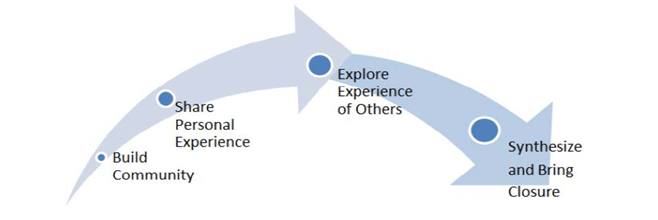
Phase 1 – Build Community. The first question should be low vulnerability “I”. These are questions in which the only right answer comes from lived experience. Everyone in the group needs to answer this question.
Phase 2: Share Personal Experience. Next, you get to questions that are high vulnerability “I”. These are questions that are a little harder to answer. They ask more of us as participants. There is a little more risk in answering them. We’re going to reveal a little bit more about ourselves and how we think.
Phase 3: Explore the Experience of Others. We talk about this as high vulnerability “we”. Now we are asking folks to think about the collective, the structures that underpin why those personal experiences that people shared in Phases 1 and 2 differ from the experiences shared by others in the group. When we’re at 3, that’s where we have the most potential for disagreement. So it’s really important that we work in the “we” in that space, looking for collective discussion around some of the challenging issues that we’re working through.
Phase 4: Synthesize and Bring Closure. This is the denouement, you’re bringing the conversation to a conclusion, through a low vulnerability “we” question. We can’t really expect agreement, but we can work towards a conclusion. In this phase we are synthesizing and bringing the conversation to a place where people can step away acknowledging where they learned something about themselves, and what they have learned from the larger group.
What does this look like in the context of a museum you’ve worked with?
One of the things I tell folks is that I shouldn’t be able to take your dialogue questions and put them anywhere else at any other institution in the country. The actual nature of the questions, the focus of the dialogues that you want to have, should be related to your unique competitive advantage.
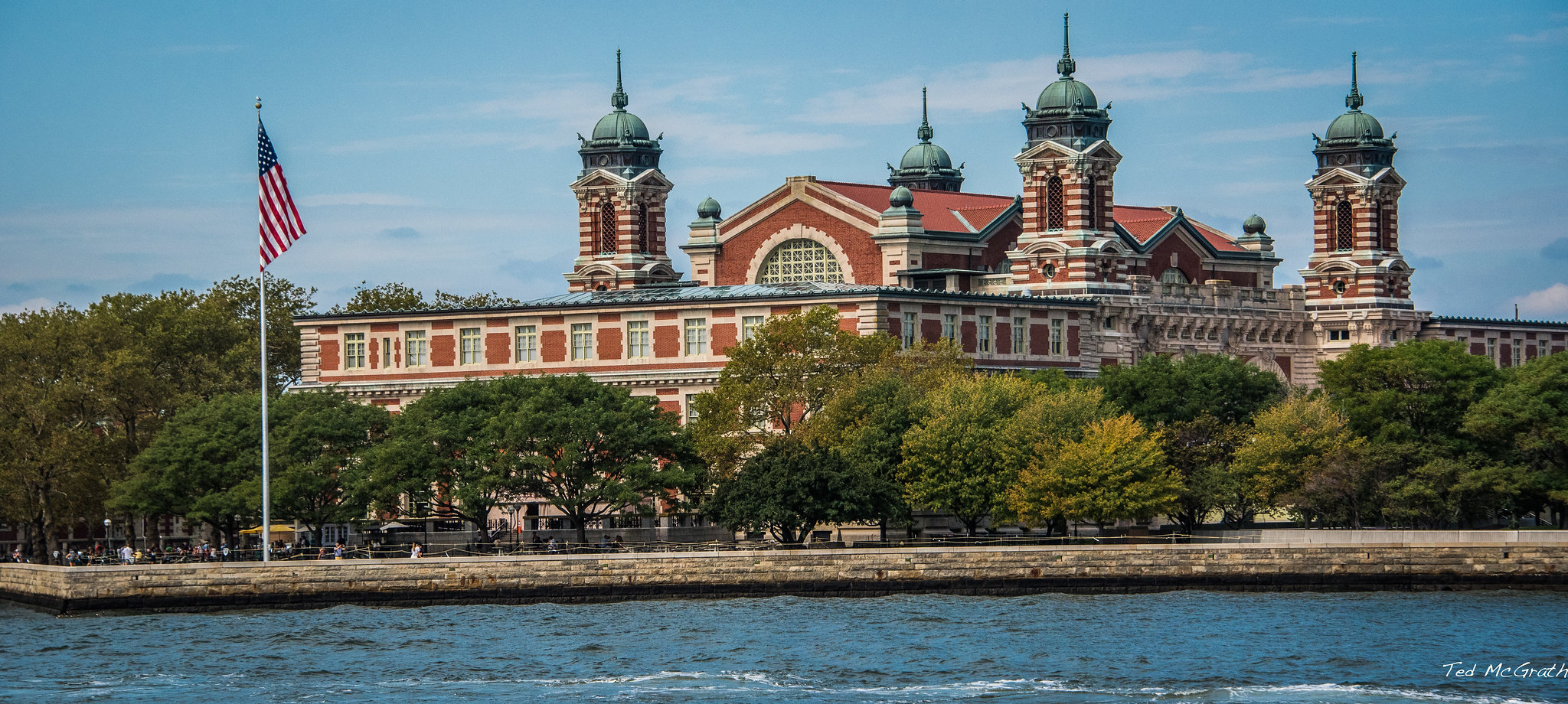
Years ago, while with the International Coalition of Sites of Conscience, I worked with staff at Ellis Island. There are a lot of museums across the country who can and should be talking about immigration – whether they’re showing art that was created by an immigrant, or have an exhibit about new immigrants to their local community in the past 20 years. But Ellis Island is a place where we as a nation determined and implemented immigration policy. This, along with other gateways to the country, like Angel Island, is their unique competitive advantage. The conversation about immigration and contemporary immigration is one that their content allows them to have in ways that not every other institution can have as authentically and with as much integrity.
At Ellis Island, a Phase 1 question is: When people ask you where you’re from, how do you answer that question? And why do you answer it the way that you do? This is a question that starts the work of surfacing deeper content. You might hear answers like, “I hate when people ask me that question,” “When they ask me that, they’re only asking because of my accent.” Everyone in the group answers the question.
In Phase 2, you might ask something like, Tell me a little bit about what immigration looks like in your community today. This is a harder question. Not everybody is going to want to answer it. This question is built to help me understand why I might have different views about contemporary immigration than you do.
The answers in Phases 1 and 2 give me as a facilitator a deeper knowledge about who’s in the room. They also help everyone understand whether this is a place where, and people with whom, they want to invest their time in dialogue.
Phase 3 is a question like, What factors, if any, should the United States be considering in determining who is allowed to enter the United States and who is not?
In Phase 4 I might ask, What value should be the driving value crafting our immigration policy? And I’m just asking participants to name the value for me. Or I might ask, What is one of your personal values that you would like to see reflected in American immigration policy? It’s not a discussion. If I were to say “belonging,” and the person next to me were to say “security,” that’s ok.
Any other tips for educators who want to try this approach?
Museums already have a wealth of valuable interpretive techniques and methodologies. So if a museum is using, for example, Visual Thinking Strategies (VTS), we would still engage visitors in VTS, but within a dialogic context. We might use VTS to help visitors describe what they see and how it makes them feel. Their shared observations and feelings then become additional shared content. I’d build the dialogic arc from those responses.
I talk a lot about dialogic interpretation as jazz. You learn all the structures, just like you do with other forms of interpretation, so that then you can riff. You know that the group may not be ready for a Phase 3 and use another Phase 2 instead. Or someone might say something at Phase 1 that pushes you immediately to Phase 3. Understanding how dialogue is built allows you to recognize visitors’ needs and make decisions in the moment with greater success. It helps reduce our fear of conflict – a boon for conflict-avoidant institutions.
 Museum Questions