
In my kids’ Brooklyn elementary school each grade included three classes of students. Of those classrooms, one was a “Gifted & Talented” classroom. Children who tested high on a set of standardized tests were placed in this classroom.
Unpacking the complications around New York City Gifted & Talented programs and this particular school is another subject for another time. For my purposes here, I want to note the impact this program had on the children enrolled at this school. They understood the unspoken message: the children in the Gifted & Talented program were smarter, and therefore arguably “better” in some way than the children in the other classes.
This is an example of a way in which the structure of an environment subtly conveys a message and communicates values. John Dewey used the phrase “collateral learning” to describe this phenomenon in schools:
“Perhaps the greatest of all pedagogical fallacies is the notion that a person learns only the particular thing he is studying at the time. Collateral learning in the way of formation of enduring attitudes, of likes and dislikes, may be and often is much more important than the spelling lesson or lesson in geography or history that is learned. For these attitudes are fundamentally what count in the future.” (Experience and Education, 1938)
The idea that we are teaching both an overt curriculum and a covert set of values is now commonly called the “hidden curriculum,” a phrase first coined by educator Philip W. Jackson. Jackson used this phrase to describe how the ways in which we structure a learning experience can communicate powerful messages:
“[T]he crowds, the praise, and the power that combine to give a distinctive flavor to classroom life collectively form a hidden curriculum which each student (and teacher) must master if he is to make his way satisfactorily through the school. The demands created by these features of classroom life may be contrasted with the academic demands – the “official” curriculum, so to speak – to which educators traditionally have paid the most attention….” (Life in Classrooms, 1968)
Think about the implied values communicated through desks arranged in rows so that students are separated and all looking at the teacher, or, conversely, through desks clustered in work groups so that students face each other. Or the message sent by grading each student with a letter between A and F in each subject each semester. Or the notion that talking to your neighbor during quiet time, or while the teacher is talking, is an action that might result in embarrassment or punishment from the teacher.
Other philosophers have taken this idea even further, expanding the idea of the hidden curriculum to explore the structures that underpin the entire education system. Ivan Illich digs into this in Deschooling Society (1971):
“The traditional hidden curriculum of school demands that people of a certain age assemble in groups of about thirty under the authority of a professional teacher from five hundred to a thousand times a year…. The hidden curriculum teaches all children that economically valuable knowledge is the result of professional teaching and that social entitlements depend on the rank achieved in a bureaucratic process.”
These encoded values permeate many aspects of our society. Our schools. Our workplaces. Our museums.
In museums they are particularly complicated, because the liberal values espoused by many people who work in museums and the traditional, elitist system in which museums are rooted are deeply at odds.
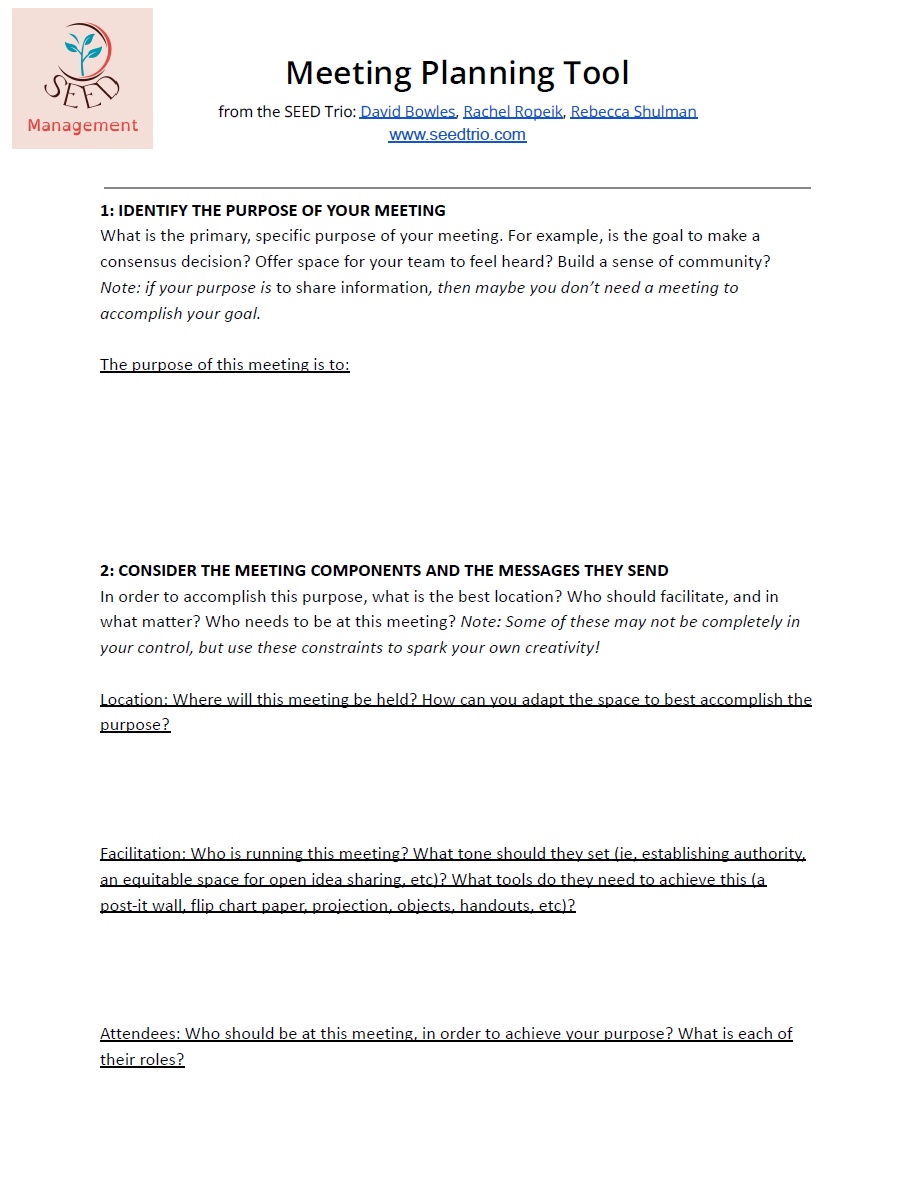
Lately, with my “SEED Trio” colleagues, I’ve been thinking about the hidden curriculum of meetings. How is the room set up? Who leads the meeting? Who sets the agenda? Is food served? Are the goals of the meeting clear? Who speaks up, whose voice is heard, and whose voice matters? Are meetings used as a way to get information from higher up (the leadership team) to lower down (the staff that does the work) on the museum food chain? Are they spaces for brainstorming? Are decisions made in meetings?
Imagine two meetings, in two departments, both taking place after a budget has been approved, with the goal of sharing what decisions were made and what the next year’s budget is.
In one department, the staff received the budget in advance, and were asked to look it over and think about if they had any questions or concerns (but knowing that the department has only this much to spend next year, and no more). The meeting takes place in a conference room with a whiteboard, and there is a bowl of candy (“brain food”) in the center of the table. Everyone sits around the table, and they are asked to share concerns and questions. The department director writes down everyone’s ideas as they share them, grouping items into questions they can immediately address, questions that need research, and issues to problem-solve around.
In another department, staff also were sent the budget in advance, and told to look it over before the meeting. The meeting is held in the department director’s office, the eight department members sitting in two rows to fit into the room, facing the desk. Once there, the department director reviews the budget, category by category, explaining where cuts were made, and what they expect will need to change for the next year. At the end of this review they look up and ask for any questions. There are none, and the meeting ends.
The subject of these meetings is identical – a review of the next year’s budget. The message, however – the hidden curriculum – could not be more different. In the first meeting, staff are learning that their voices are needed to both identify and solve problems, and that the role of a director is facilitation and support. In the second meeting, the staff are learning that choice-making happens elsewhere, and that they are receivers (not creators) of ideas and information.
Identifying these unconscious messages is a critical first step to ensuring that you are communicating what you want to, and treating people as you intend to.
What messages are you sending or receiving through the meetings you run or attend?
What do you want to change, and how will you do that?
 Museum Questions