The other day I mentioned strategic planning to a colleague, and got an eye roll in response. The eye roll (paired with some clarifying words) said, “Yes, I know, we have to do it. But is it really helpful? Is it really a good use of my time?”
Strategic planning is a systematic approach to making decisions about organizational growth or change. There are some fairly standard practices in this field, which often include:
- Starting with conversations (generally but not always exclusively with organizational leadership) that help identify a general direction for change, along with research to understand the organization, including unearthing competitors and obstacles that threaten the existing business plan;
- Engaging stakeholders (everyone from Board to staff to community members to people who don’t use an organization’s services but might) to hear their thoughts and perspectives in an ongoing way during the planning process;
- Reviewing mission, vision and values to confirm, tweak, or change them;
- The crafting of a problem statement or theory of change that will drive the strategic plan (where is this organization going? what is it you want to achieve in the next three to five years?);
- Identifying strategic priorities that will lead to envisioned change, and designing clear goals that will help realize these strategic priorities.
- Operationalizing the plan, which includes leaving the organization with clear steps for actualizing the plan.
I know that list just bored a lot of people. It doesn’t convey the excitement of engaging people in the work of envisioning, crafting generative and open questions, talking to many different people (and helping them talk with each other), coming up with a plan that brings a vision to life, and working on the nuts and bolts that can turn a plan into reality.
Many non-profit professionals have had experience with strategic planning initiatives that, during the process or later, in retrospect, have felt like a poor use of time and money. Maybe the process led to internal grumblings. Or the completed plan sat on a shelf and gathered dust. Or attempts to actually put the plan into action were frustrating and didn’t accomplish what they were supposed to.
Partly because strategic planning has become a-thing-I-know-I-need-to-do-but-doubt-it-will-get-the-results-I-want, I have been researching varied approaches to planning, and grown curious about alternative forms of planning. What are some other ways to plan that engage people in a meaningful way and lead to a plan of action? What can an organization do if it knows it needs a plan, but for some reason isn’t excited about or invested in the process outlined above?
Below are three alternate approaches to planning that I have found. If you know of others, please share them in the comments below!
Appreciative Inquiry
In Fall 2022, I took an online certification course in Appreciative Inquiry. This approach addresses a specific issue outlined by the organization, which is then transformed into a compelling question by the facilitator. It is rooted in the idea that positive ideas, stories, and conversations are critical for positive change. Through Appreciative Inquiry, the facilitator leads a team to collaboratively construct and move toward an ideal future.
The process starts with “Discovery.” What does it look like when the organization is at its best, as it relates to this issue? During this phase, participants share stories from past work situations. The focus is on collecting stories rather than facts, diagnoses, or ideas. Participants then move on to the “Dream stage. What might the organization look like in the future, when it has succeeded in the area related to this specific issue? What are specific ideas for realizing this “dream”? After they have dreamed, they begin to design. Participants decide on the most compelling ideas from the “dream” phase – ones on which they are willing to commit to immediate, team-based action. The final phase of the process is entitled “Destiny,” which is the process of sustaining this work, which looks different at different organizations.
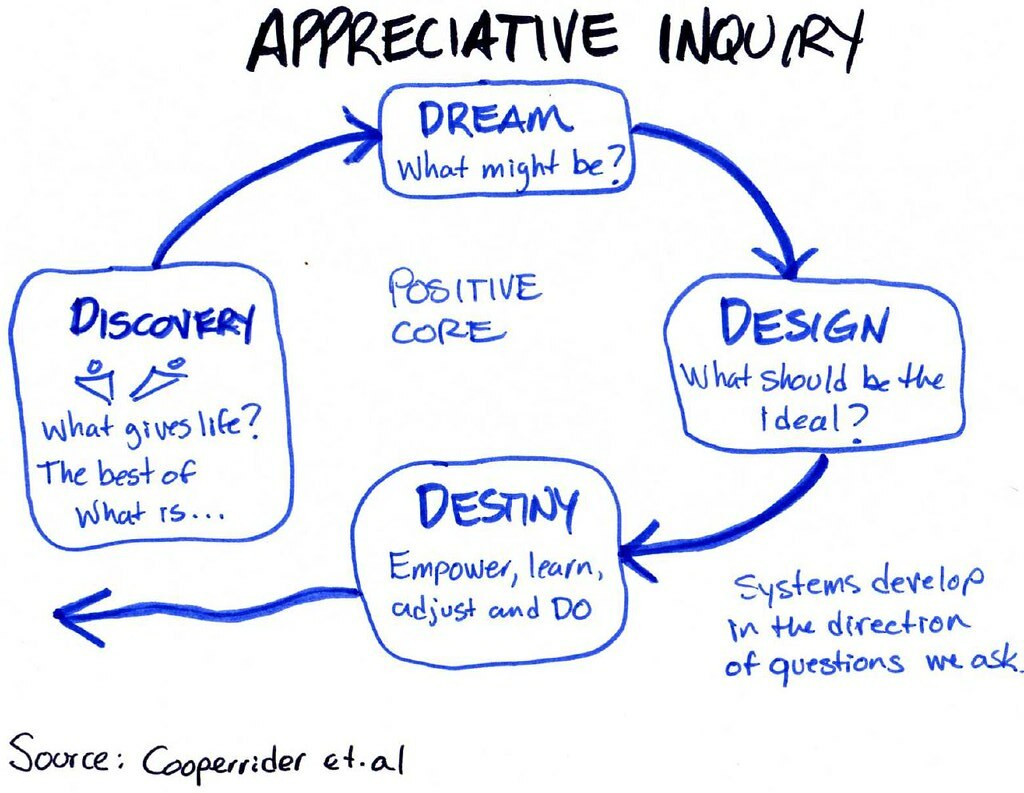
Appreciative Inquiry is different from most strategic planning approaches in that it is extremely focused: it takes one important issue or area, and engages individuals from across an organization in making change in that one area. The product does not look like a traditional strategic plan with multiple priorities, each of which branches into multiple goals. Instead, the product might include a vision of the future with stories of what the organization looks like at its best and a positive vision for how it might look in the future; experimental approaches for how to move toward this future; and lists of team members with a plan of action for their shared experiment. One of the beliefs underlying Appreciative Inquiry is that this positively-driven team action makes change, and importantly, is the change. Thus, the ultimate product of Appreciative Inquiry is to engage staff members at all levels in the work of taking it upon themselves to engage in and drive collaborative projects that lead to organizational change.
I love the emphasis Appreciative Inquiry places on positivity and narrative, and the power of people to create change; itis a great alternative to strategic planning for organizations that have big challenges that need addressing before they can move forward with other planning initiatives.
Intentional Practice
This approach was designed by Randi Korn, and it is outlined in the book Intentional Practice for Museums: A Guide for Maximizing Impact. Intentional Practice very specifically plans for audience impact. It is rooted in a number of principles about organizational work and culture that must be in place before beginning the impact-planning process: the organization wants to impact its audience in meaningful ways; that staff have articulated and know what this intended impact is and take actions to achieve it; that staff regularly evaluate the impact of their work and reflect on what they learn for the purpose of improvement; that staff across departments and up and down the organization work collaboratively (because no one person or department is responsible for achieving impact); and that staff are willing and able to listen to, understand, and accept varying points of view.
To engage in this work, the museum or organization must be willing to identify a finite number of audiences—usually three. Following that, they participate in three exercises: a passion exercise which includes identifying what about their work they are most interested (if outsiders are invited to join in the work, and often they are, the question has a caveat so they can respond); a distinct quality exercise where they are asked to brainstorm a short list of what makes them unique and relevant to audiences; and a visioning exercise where they identify the ways in which they intend to impact on the three audiences/communities . While many strategic planning processes focus early on confirming or changing the organization’s mission statement, Intentional Practice focuses on crafting an impact statement that answers the question, What impact do you want to achieve, or concretely, what positive difference do you want to make on X audience’s lives?
This impact statement is then used to drive planning for the organization as a whole, as well as at the program level. Once the organization achieves clarity about its intended impact, it can then envision more specific outcomes for the work it does and identify indicators that will show that this work has been successful. The written product of an Intentional Practice planning session differs from other strategic plans in that instead of mission, vision, values, strategic priorities, and goals, the plan includes impact statement, specified audiences and associated outcomes, and sometimes, indicators (how you will know that you have achieved success). Beyond this written product, Intentional Practice planning is designed to re-center an organization and its work so it revolves around achieving impact on its audiences, and embed a cycle of reflection that includes aligning work with impact, ongoing evaluation of impact, and build a culture of continual improvement—personal, professional, and organizational.
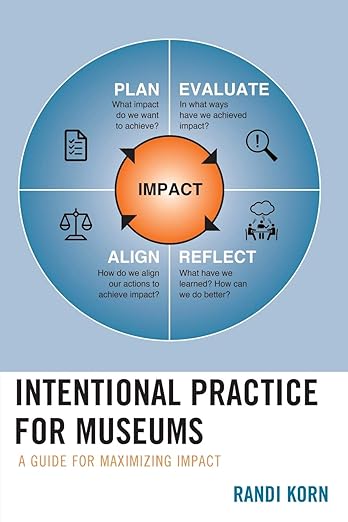
So many museums these days are struggling with who their audience is and how to best serve them. Intentional Practice is tailor-made for these museums, as long as they are willing to focus both on genuine impact and genuine investment in the internal culture that needs to be created to achieve this impact.
Question-Based Planning
I cannot find any reference to this approach through searching the internet, but I participated in it as a staff member at a small DC organization in the late 1990s. As someone invested in the power of a good question, this approach intrigues me, and I think aspects of it are valuable and could be incorporated into other approaches.
This process begins by working with the team to create an organizational vision for the next 3-5 years. It then asks, what questions do we need to answer in order to achieve this vision? Participants then brainstorm questions, which they post on the wall. Questions can be of any variety and size, as long as they are responsive to the vision – from “What hours do we need to be open to the public?” to “What expertise do we need on staff to make this happen?” to “Is a teen program really valuable in meeting this vision?” to “What benefits should we be offering staff?”
Participants then discuss and group like-questions together; sometimes three or four or more questions can be grouped into one powerful question. The goal is to end up with a manageable number of questions – perhaps 10. Once the questions are confirmed, they are placed onto a board and participants go through a process to identify which questions need addressing first. The result is a list of questions, which are really problems, that need to be worked through to achieve the vision.
In this approach questions replace priorities and goals, and the work of implementation is understood as answering questions. I like that this approach lays bare the things that need to be discussed, which are often taken for granted (“What expertise do we need on staff to make this happen?”) or only discussed by a small subset of staff (“Is a teen program really valuable?”). I like that it sets an organization up for grappling with these questions slowly, thoughtfully, and sequentially. While this approach doesn’t seem quite robust enough to do all the work of developing a plan to guide an organization forward, it could work well in combination with more traditional strategic planning exercises to engage a team in curiosity, collaborative discussion, and problem solving.
What other approaches to planning should organizations consider, when they know they need to pause and plan, but don’t think a traditional strategic plan will get them where they need to go? Please share other approaches in the comments below!
 Museum Questions
This is really nice, Rebecca. Thank you for sharing this. And breathing some life into the old corporate approach of strategic planning. I have done some horizon planning with some organizations (and I forget when I was introduced to it or by whom but I wish I could remember so I could thank them!) The idea is to have a continually moving horizon that is usually further out than the 3, 5, or 10 years many organizations use (I use 20 years). We start by doing individual then shared reflecting forward to imagine then describe what we want to see. We capture all the ideas about the horizon, then weave them together into a statement about the organization. Then, we focus on what we need to have done in 5 years to be on track to that five-year outcome (sometimes 10 years if it is a really love-to-plan group). Then we go to one year– what do we need to be doing now to move toward that future? Then, it is an annual review starting with the question: is this still what we want to see in 20 years. or have things changed? If they have changed, we look at the change and what it might mean for the organization. Or they can decide there is a newer and better version for 20 years. And then we decide if our 5-year plan is still where we need to be in five years or does it need to move. Then we look at our first-year goal and decide is it in process, is it achieved, is in a maintenance/ongoing mode, is it done and we can drop it. And we create the next set of goals of what we need to be doing now so that we are well on our way to the new (or revised or repeated) 5-year outcomes.
Thank you so much for this addition, Joe!
ah yes the strategic planning conundrum. Essential yet dreaded primarily because of the time investment factor. Participants need to see an end in sight and some action steps not just lofty goals. You have provided a nice mix of three options where elements of all can be employed depending on the situation. I have been involved in various planning processes over 45 years of experience in the interpretive, recreational and tourism planning area.
I have learned that starting with mission statement is a surefire way to get bogged down. So the mission needs to be revisited but only after exercises that focus on what success looks like to different stakeholders. You could call this vision but don’t get bogged down in semantics or wordsmithing.
Strategic planning is critical to avoid more of the same and to ensure continued relevance. Strategic planning around WHAT needs to be determined is critical to keep content manageable. A priority setting exercise will help here. Thinking about WHO should have input and who needs to be involved is also action critical. Once you know what you want to achieve for whom then the time spent on HOW you get there should excite participants involvement.
I have discovered that if you want to implement anything and have commitment going forward you need a good cross-section of stakeholders involved, not just the staff. The definition of stakeholders can vary but often will include board, volunteers, existing visitors and community at large. Inclusivity can be very beneficial.
I especially like the components of the intentional practice as I have found being outcome-driven and audience -centred in order to identify the intended impacts is key. Defining indicators of success is also fundamental.
My recent experience has been focused on interpretive planning where the above principles guide our work in what my colleagues and I call Experiential Interpretive Design (EID). We have created a blog on our website http://www.eidcoaching.com to discuss many elements of interpretive practice and we have found the book titled “Interpretive Design and the Dance of Experience” by Steve Van Matre as an inspirational guiding light in this regard.
Thank you for sharing this, Bill!