This post was co-written with Anne Bergeron, a nonprofit management and fundraising consultant who leads Anne Bergeron & Co. Consulting (ABCC), a resource development firm specializing in cultural, educational, and social benefit institutions. Through planning, organizational development, fundraising, and strategic communications, ABCC helps nonprofits to envision and create sustainable futures supported by engaged communities.
Image credit: Yes No by juicy_fish, n.d. Courtesy of Freepik.
“When I receive a program proposal, I look at how it fits with the museum’s mission and vision—and I’ve found that most of the time you can find a way to make any proposal fit with mission and vision. But with the decision-making matrix, I also look at specific criteria around stewardship, innovation, community focus, and alignment. That’s where the real decision happens: Is it actually valuable and connected to our community and stewardship ideas?”
—Kate Huffman, Director of Learning and Engagement, Biggs Museum of American Art
Every collaborative, community-based venture faces resource constraints—of people, money, time, energy, etc. How can nonprofit leaders best direct the use of limited resources in ways that further organizational objectives?
We recently helped the Biggs Museum of American Art in Dover, DE to consider this very question as we facilitated the creation of their new strategic plan shaped around a facility expansion project already in process. Perhaps not surprisingly, we first posed the resource allocation query with respect to the building, a major investment the museum had been planning for a few years. How could The Biggs ensure that the reconfigured and enlarged facility would serve as a physical manifestation of the museum’s intentions to more fully engage the community?
The architectural team proceeded in its work guided by three lists gleaned from community conversations and ordered by priority—1.) design elements considered to be essential; 2.) design features that would add value; and 3.) architectural characteristics that were aspirational and “dreaming big”—abbreviated as must haves, should haves, and nice to haves.* We were inspired by this codification to develop a different framework focused less on space and more on institutional values. As we aided The Biggs in parsing the difference between wants and needs—e.g., I desire some new window shades, but I don’t really need them, while I do need to pay my rent—we sought a framework that could be used for overall organizational decision-making.
We encouraged the museum to identify its collective values by probing, “What’s important to you personally, professionally, and institutionally?” and then listening carefully to what was expressed—by the organization as a whole reflecting its raison d’être in the region; by the board, staff, and volunteers responsible for carrying out its mission; and by the many constituents, especially artists, who champion its role in the community and support its activities. We then spent time assisting the museum in defining its chosen values to ensure widespread understanding of institutional drivers.
As with most museums, mission, vision, and values serve as guiding lights for The Biggs’s staff and board. But these public-facing statements are purposefully written broadly to allow flexibility in implementation priorities. For this reason, it was important to ask critical questions relating to mission, as well as other issues that surfaced during the planning process: concerns about community, stewardship, reputation, finances, and operational limitations. We enabled the museum to drill down and reflect on what was most pressing to them.
We framed the decision-making matrix as a series of questions that delve further than a simple checklist might. While everyone agrees that the entirety of what a museum does should align with mission, it can be easy to say, “Yes, of course this aligns.” The Biggs’s new mission statement is clear and specific about its aims, although it is general enough to resonate in a variety of situations. For example, when determining whether a new family day, exhibition, or fundraising event can “transform our community through the art of our region: rooted in discovery, guided by collaboration, and open to all”—The Biggs’s new mission statement—staff might simply nod affirmatively without due consideration.
Rather than ask only if an initiative aligns with mission, we outlined a series of clear, provocative questions drawing on ideas that emerged during strategic planning: Will this initiative aid in fostering discovery or transformation for individuals and/or communities? Does this prioritize collaboration and open access? Does this position the greater Dover region at the center of this venture? These questions ask decision-makers to more deeply explore whether a new endeavor will truly move the museum in the direction it wants to go. Here’s the result.
In future years, these queries might change even when the mission doesn’t. As The Biggs’s reputation grows and solidifies, some questions may feel less relevant and could be replaced with others. For instance, “Will this help to cement The Biggs as engaged in cultural placemaking?” could become, “Does this support The Biggs and its partners in expanding cultural placemaking?” Or the community that the Biggs aims to transform might stretch beyond the Dover area to the multi-state Mid-Atlantic region.
The values-based, decision-making matrix that we developed helps the staff to implement the strategic plan on a daily basis. Five months after the planning process concluded, we spoke with Kate Huffman, the museum’s director of learning and engagement, about how she utilizes this planning tool. She described the binder where she keeps the programming calendar and related information. The matrix lives near the front of this binder, which she consults anytime she needs to make a programming decision or explain the “why” of an activity to colleagues, funders, and other stakeholders.
Kate shared an example of how she uses the matrix. While reviewing upcoming programs, she noticed that the museum offered, “…all these one-off, art-making workshops…to the artists community.” As a result of the new strategic plan, she is now working closely with an artist advisory committee and learned that that these workshops hold limited value. “They were just revenue generating and they weren’t honoring our artist instructors. We weren’t doing things in the way this matrix outlines. So we’ve eliminated them for now and are working to rebuild our approach to creative workshops.”
Kate also uses the matrix to assess potential new programs. “Recently, a housing support organization serving the Greenville, DE community reached out to me and said, ‘We’re running a healing arts program and we really want to talk to you about displaying participants’ work or having a Biggs representative come down and teach a class.’ So I visited and had a conversation with them, then ran the opportunity through the matrix, and it fits with everything we’re doing!”
The decision-making matrix turns mission and vision into strategic action at The Biggs. What questions might you ask to do the same at your organization?
*Credit for this process goes to the cultural planning team at SmithGroup architecture and design firm.
Internal Communication Systems that foster employee engagement and motivation
This post is the result of a brainstorming session with Amy Kehs, an expert in museum communications. Amy and I met at the 2025 Small Museums Association Conference, and started a conversation about internal communications, and how a focus on improving these can help museums shine. If you don’t know Amy’s work, check out her website or her podcast!
Internal communications is how people within an organization communicate – their interactions and relationships. It is two-way, and includes both crafted, formal messaging and more informal types of interaction.
When I interviewed museum directors for my 2024 report Changing Museum Culture: Research from the Field, communication was an issue that floated to the top. What does transparency look like, and when is it problematic? How can we strengthen communications between departments?
Internal communication is two-way, and also relates to listening to staff and demonstrating that everyone’s voice matters. As Amy says, “Internal communication is like a conversation, not a monologue. When leaders listen as much as they speak, and everyone’s voice is valued, ideas move fluidly in all directions, driving stronger teamwork and growth.” The publications Current Trends and Issues in Internal Communicationopens with this paragraph highlighting the importance of internal communications:
“Nearly a century ago (1924–1932) the Hawthorne Studies of employees at Western Electric Company in Chicago revealed a then startling discovery: the positive power of internal communications. Worker performance was found to improve most when they felt more informed, involved, and valued in the organization—not when lighting or other environmental conditions were changed. Productivity was dependent on social issues and job satisfaction, in addition to monetary incentives and workplace conditions.”
Amy and I posit three goals for internal communication:
Informed staff. Internal communication is the tool that ensures everyone on your team knows what’s going on and why it matters.
Strong relationships. When communication is siloed or inconsistent, departments can end up working toward competing priorities. For example, the marketing team might be promoting an event that the education team didn’t even know was happening, or visitor services might be caught off guard by changes to the membership program. When planning happens in isolation, it’s easy for confusion or frustration to take root, even among the most dedicated teams.
Engaging and motivating staff. Strong internal communication connects daily tasks to broader organizational goals, helping staff understand how their work contributes to the museum’s success.
Building strong internal communication systems is an enormous challenge, for museums and for other organizations. There are so many challenges. The first is fear of and a lack of transparency. Leadership and managers worry about sharing “draft,” or still developing, ideas, and they worry that team members, especially entry-level team members, won’t understand aspects of the budget or other information that takes significant knowledge to unpack. Second, communication is often understood as, and implemented as, one way. Often-used internal communication tools include meetings, emails, and memos from management to team members. They are used as information-delivery tools and are often pro-forma, created and delivered so that the museum can say that everyone should know what is happening, regardless of whether they read the memo or attended the meeting. Finally, as a field, we spend a lot of time doing things (creating exhibits and programs, caring for collections, soliciting donations, etc) and not a lot of time reflecting and improving. We rarely have or use internal communications tools for reflection and improvement purposes.
So – how do you create internal communication mechanisms that are open, two-way, and reflective? Systems that inform, build relationships, and engage?
Two tools: a gathering and a pause. These tools, described below, might be understood as meetings, but too often we think of meetings as unidirectional. So instead, think of these as brainstorming spaces; living demonstrations that 20 brains are better than one. They model two-way communication in action, where listening is just as important as speaking, and every voice has the potential to shape the outcome. This shift transforms a routine meeting into a space of shared ownership and collaborative problem-solving. They are opportunities for staff to get to know each other as professionals and as humans. They require expert facilitation, and so should be led by staff who have this expertise – perhaps someone from the education team, or someone who used to facilitate retreats for a living, or just someone whose personality and interests lend them the ability to ask good questions and really listen to and capture the responses.
The Gathering
Imagine that your museum is preparing to change its schedule, to be closed Mondays and Tuesdays and have evening, free admission on Thursday evenings. Or you are creating a new exhibition. Or launching a capital campaign to renovate a gallery space. Often these projects are launched within a single department, with guidance from a leadership team where needed.
A gathering happens at the beginning of a project, and is a space where everyone can voice questions, identify potential roadblocks or concerns, and share ideas. This is where visitor services staff can share that free admission opportunities lead to really long lines, and perhaps portable check-in mechanisms and expanded staff can help move the line faster. Or education staff can propose an activity to engage people while they wait in line. This is where security staff can note that the new exhibition needs to have a different type of entryway, to avoid bottlenecks. Or a staff-member with a friend at another museum can share a related exhibition that will be concurrent, which might lead to collaboration opportunities.
Everyone comes to the table with their own expertise and their own lens, shaped by their role, responsibilities, and experience with visitors. When you create space for those perspectives early, you’re not just building buy-in—you’re heading off issues before they become problems.
While a gathering starts with sharing information about a project, the bulk of the work and time is dedicated to soliciting questions, concerns, and ideas that can inform the project. The result? A project that is much stronger, and a team that cares deeply about the project’s success.
A gathering should be followed by communication systems that will carry on throughout the project – where will information and updates live so everyone can see the project developing in real time? It could be messages, images, and information posted in a dedicated staff hallway. It could be an internal webpage. It could be a weekly email.
The Pause
At the other end of the project is the pause – a moment to reflect and improve for next time. This is the moment 3 months in where staff share the random disappointed calls they have been getting from people showing up on Mondays and Tuesdays, and make suggestions to better communicate the new schedule. Or the development team notes that the museum has collected no contact information, and the outside line provides a perfect time and way to collect information through raffling off a membership. This is where, after an exhibition closes, new exhibition ideas can be assessed and built on. Or capital campaign-motivated visitor information collection systems can be discussed in order to be improved.
Museums are often scared of the critique. The pause elevates the critique. This is how failure becomes useful. This is how we keep getting better.
After the Gathering and the Pause, it is critical to share how the team’s ideas informed the project, or led to future changes. In the words of a corporate industrial psychologist, “link and label” – make visible to the team that their ideas matter.
Internal communication isn’t just about keeping everyone informed. It’s about creating a culture where people feel connected, respected, and empowered to contribute. Tools like the Gathering and the Pause are simple in concept but powerful in practice. They help shift communication from a one-way street into a shared conversation where every staff member feels like a valued part of the mission. When museums make space to listen as well as share, they build stronger projects and even stronger teams.
A few months ago I had the opportunity to interview an industrial psychologist from a Fortune 5 company with hundreds of thousands of employees. Due to the company’s internal regulations, I cannot share the interview itself, or the name of the company or employee. However, here are ten takeaways from this individual’s experience leading a team that assesses and improves organizational culture, and how these might transfer to museums.
#1: Assessing and addressing employee engagement and wellbeing impacts the bottom line. When employees have a good experience at work, not only are they more engaged, but they do more things above and beyond their job description and they offer better customer service, which drives the bottom line and makes the company money. In addition, a good employee experience helps reduce turnover, which is very costly and very disruptive to any organization. There is a true value proposition in place for taking employee feedback seriously and doing something with it, and research backs this up.
#2: Assess regularly. They distribute two large surveys a year. On both surveys they ask 7 questions related to employee engagement, including burnout, inclusion, and employee effectiveness. In the spring they also ask questions related to employee enablement — do they have what they need to do their jobs? In the fall they ask questions about senior leadership and cross-functional collaboration (those questions generally produce less favorable feedback).
In addition, they launch smaller assessments as needed: for example, they assess the onboarding process for new staff on a regular basis, and conduct check-in surveys when they see signs of burnout.
#3: Ask focused questions. Their survey is specifically designed to assess employee experience, and is divided into two sections: “belonging” (do you feel like you belong here?) and “fit” (do you feel like you fit with the organization?). Questions are very targeted to answer these two questions.
#4: Connect responses to meaningful change. The worst thing an organization can do is ask employees for feedback and not do anything with it. It is important to “link and label” – to communicate “this is what we heard you say, and this is what we are doing in response.” Otherwise, even when you make wonderful changes based on feedback, employees don’t know that what they said informed changes.
#5: Create a library of tools to address issues. Over the past decade, they have built a robust library of training videos and plans and action steps managers can take to make change.
#6: A survey is not always the right tool for assessment. For a quantitative survey to be useful you need a large sample size. If your sample is under 50 people, in order for results to be meaningful you need a difference of 15%, which is huge. With a smaller group, a three-point difference between departments could simply reflect one person having a bad day.
Focus groups are better than interviews for organizations with smaller departments. Focus groups should be conducted by a neutral third party and kept confidential – no managers in the room with you. One challenge with focus groups is that people sometimes follow each other; a skilled facilitator knows how to solicit quieter voices, but one person can plant ideas in others’ minds.
Interviews are great but require a significant time investment. You can aim for interviewing 25% of your staff, across teams, in 20-minute interview blocks. Make sure questions are consistent and you have someone taking notes. As with focus groups, interviews should be conducted by a neutral third party and kept confidential.
#7: Whichever tool you use to assess organizational culture, make sure to plan carefully. Think about what you are really trying to learn. Is it why people are quitting? If so, you might want to ask questions about the environment, teamwork, and management.
Don’t lead with a negative statement like “we hear people are burned out.” Ask about day to day experiences, and what might prevent people from getting their jobs done in a timely, successful manner. It’s not useful to ask what people love about their job, except as an icebreaker.
The most useful data comes from the overlap in what is said between what people who are positive about their jobs and people who are negative about their jobs. For example, if they both talk about scheduling conflicts, that’s a space where you need to dig more deeply. It’s also helpful to ask people for their solution ideas (for example, “what are 1-2 things we could improve?”) and compare answers from employees who are positive and negative about their jobs.
#8: Address some (but not every) problem you uncover. When you get your results, start small, and fix something easy. For example, if lots of people complain that they run out of paper towels in the bathroom – fix that! Issues like communication take longer. But quick wins help engage everyone.
Only take action on 2-3 things total (including that early easy win) or nothing will get done.
Have employees help solve the problems that assessment identifies. Cross-functional teams can come up with multiple ideas, and present a few options to managers. These ideas should come from people doing the work on the ground, with clear deadlines and ongoing updates to keep the conversation alive. Keep the process moving, linking and labeling as you go.
Here’s an example of a success story: One of the biggest complaints that came out of survey results at this company was people saying that they didn’t know what’s going on. A group of employees met and came up with the idea to have a blog feed. This was a total game changer for the company. The feed is off to the side within their Outlook system, not in emails, and there are push notifications. This is now a way to share things like restructuring announcements — all the things leadership previously forgot to share with the entire company. That went a long way toward solving this problem.
#9: This whole process requires leadership buy-in. You need the people on the ground to do the work, but you also need the leader to do their own work supporting the process and changes.
#10: It’s generally not about pay. In general, people don’t start working somewhere unless they believe in what they are doing, and have agreed to accept a certain amount of money. When you do a correlation analysis, pay consistently ranks low among the factors that influence employee satisfaction. Autonomy, meaningful work, flexibility, and how you are managed outweigh pay, assuming you pay fairly, hiring people in at an acceptable rate and adjusting for inflation and salary trends over time.
What messages are encoded in the way this meeting is structured? Photo by Jason Goodman on Unsplash
In my kids’ Brooklyn elementary school each grade included three classes of students. Of those classrooms, one was a “Gifted & Talented” classroom. Children who tested high on a set of standardized tests were placed in this classroom.
Unpacking the complications around New York City Gifted & Talented programs and this particular school is another subject for another time. For my purposes here, I want to note the impact this program had on the children enrolled at this school. They understood the unspoken message: the children in the Gifted & Talented program were smarter, and therefore arguably “better” in some way than the children in the other classes.
This is an example of a way in which the structure of an environment subtly conveys a message and communicates values. John Dewey used the phrase “collateral learning” to describe this phenomenon in schools:
“Perhaps the greatest of all pedagogical fallacies is the notion that a person learns only the particular thing he is studying at the time. Collateral learning in the way of formation of enduring attitudes, of likes and dislikes, may be and often is much more important than the spelling lesson or lesson in geography or history that is learned. For these attitudes are fundamentally what count in the future.” (Experience and Education, 1938)
The idea that we are teaching both an overt curriculum and a covert set of values is now commonly called the “hidden curriculum,” a phrase first coined by educator Philip W. Jackson. Jackson used this phrase to describe how the ways in which we structure a learning experience can communicate powerful messages:
“[T]he crowds, the praise, and the power that combine to give a distinctive flavor to classroom life collectively form a hidden curriculum which each student (and teacher) must master if he is to make his way satisfactorily through the school. The demands created by these features of classroom life may be contrasted with the academic demands – the “official” curriculum, so to speak – to which educators traditionally have paid the most attention….” (Life in Classrooms, 1968)
Think about the implied values communicated through desks arranged in rows so that students are separated and all looking at the teacher, or, conversely, through desks clustered in work groups so that students face each other. Or the message sent by grading each student with a letter between A and F in each subject each semester. Or the notion that talking to your neighbor during quiet time, or while the teacher is talking, is an action that might result in embarrassment or punishment from the teacher.
Other philosophers have taken this idea even further, expanding the idea of the hidden curriculum to explore the structures that underpin the entire education system. Ivan Illich digs into this in Deschooling Society (1971):
“The traditional hidden curriculum of school demands that people of a certain age assemble in groups of about thirty under the authority of a professional teacher from five hundred to a thousand times a year…. The hidden curriculum teaches all children that economically valuable knowledge is the result of professional teaching and that social entitlements depend on the rank achieved in a bureaucratic process.”
These encoded values permeate many aspects of our society. Our schools. Our workplaces. Our museums.
In museums they are particularly complicated, because the liberal values espoused by many people who work in museums and the traditional, elitist system in which museums are rooted are deeply at odds.
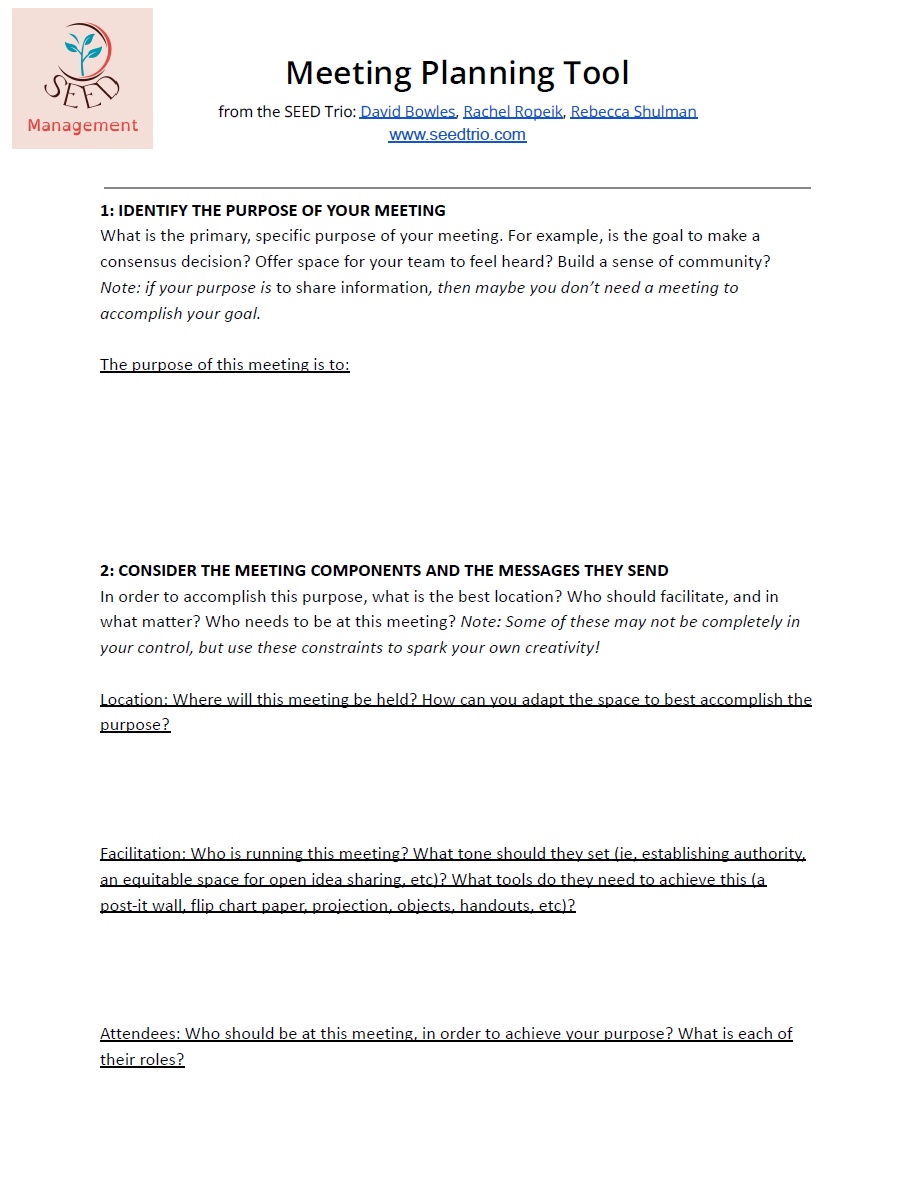
Lately, with my “SEED Trio” colleagues, I’ve been thinking about the hidden curriculum of meetings. How is the room set up? Who leads the meeting? Who sets the agenda? Is food served? Are the goals of the meeting clear? Who speaks up, whose voice is heard, and whose voice matters? Are meetings used as a way to get information from higher up (the leadership team) to lower down (the staff that does the work) on the museum food chain? Are they spaces for brainstorming? Are decisions made in meetings?
Imagine two meetings, in two departments, both taking place after a budget has been approved, with the goal of sharing what decisions were made and what the next year’s budget is.
In one department, the staff received the budget in advance, and were asked to look it over and think about if they had any questions or concerns (but knowing that the department has only this much to spend next year, and no more). The meeting takes place in a conference room with a whiteboard, and there is a bowl of candy (“brain food”) in the center of the table. Everyone sits around the table, and they are asked to share concerns and questions. The department director writes down everyone’s ideas as they share them, grouping items into questions they can immediately address, questions that need research, and issues to problem-solve around.
In another department, staff also were sent the budget in advance, and told to look it over before the meeting. The meeting is held in the department director’s office, the eight department members sitting in two rows to fit into the room, facing the desk. Once there, the department director reviews the budget, category by category, explaining where cuts were made, and what they expect will need to change for the next year. At the end of this review they look up and ask for any questions. There are none, and the meeting ends.
The subject of these meetings is identical – a review of the next year’s budget. The message, however – the hidden curriculum – could not be more different. In the first meeting, staff are learning that their voices are needed to both identify and solve problems, and that the role of a director is facilitation and support. In the second meeting, the staff are learning that choice-making happens elsewhere, and that they are receivers (not creators) of ideas and information.
Identifying these unconscious messages is a critical first step to ensuring that you are communicating what you want to, and treating people as you intend to.
What messages are you sending or receiving through the meetings you run or attend?
What do you want to change, and how will you do that?
This post is by Miriam Bader, the founder of miriam bader consulting. As a learning designer, Miriam partners with people and organizations to design impactful programs, leadership, and organizational structures that strengthen the ability to lead, learn, and make social impact. Miriam is a facilitator, coach, strategist, and curriculum writer with backgrounds in museum education and human resources.
“To listen is to continually give up all expectation and to give our attention, completely and freshly, to what is before us, not really knowing what we will hear or what that will mean. In the practice of our days, to listen is to lean in, softly, with a willingness to be changed by what we hear.” ― Mark Nepo
When people ask me what I do, I often respond, “I help people and organizations to listen so that they can achieve their impact.” Learning to listen has been a lifelong quest and one that continues to fascinate and motivate my work.
As a kid, books were my first passageway into the mystery of listening. I was in awe of a story’s capacity to offer entry into an alternate universe – a place where access is granted to experiences one never physically had, and voices and emotions can be felt for characters living within pages. I remain astounded by the ability to hold someone else’s unique perspective and by the range of interpretations people have who read the same book. When I first saw movies and theater inspired by books, I was most unsettled by this reality. Their interpretations frequently did not mirror my perception and forced me to wrestle with the space between our understandings, where experiences and beliefs shape our insights and imaginations.
Over time this disconcert became a quest to understand listening. How is it that two human beings frequently hear the same thing differently? My focus shifted from the listening that happens through reading books to the things that happen when people listen or fail to listen in real life. This curiosity extended to the ways colleagues could attend the same meeting and leave with divergent impressions of what was said, and partners who might be having two entirely different experiences of the same conversation. The practice of listening can be maddening. It can be a major source of frustration and miscommunication. It is also essential for living.
Throughout my career I have tried to make sense of what it means to listen. I have studied inquiry-based learning, active listening, coaching conversations, and the science of listening. I regularly teach workshops breaking down listening levels and skills. Sometimes, I still fail at listening. The quest continues, as does my drive to strengthen this capacity in myself and others.
Here are some of the core lessons I have learned about listening.
1. Listen to yourself before listening to others
Before heading into a conversation, pause to ask yourself some key questions. Do I have the bandwidth to hear someone else right now? What is my receptivity range? Will I be able to stay present in the conversation? These questions help identify one’s internal state. If a to-do list or something else is demanding your attention, make a counteroffer and request to have the conversation later. Even a five-minute delay can shift one’s ability to intentionally arrive into the conversation with the cognitive and emotional capacity to listen.
2. Prepare the space for listening
Distraction is the enemy of listening. Having the conversation in an environment that minimizes the likelihood of distraction, increases your ability to listen. Consider the conversation format: face to face, video, and phone. Both the format and the setting offer opportunities to set oneself up for optimal listening by reducing surrounding distractions. This might look like closing computer windows, silencing notifications, placing a device out of reach, or simply clearing your table. Presence requires effort. Making time to reduce distractions increases one’s ability to stay in conversation despite the many competing things vying for attention.
3. Listen with your whole body
Consider body language – both your own and the person you are in conversation with. The entire body is attuned to listening. We gather meaning through tone, energy, and sensations. When one listens to facial expressions, eyes and mouths speak volumes. When one hears through hands, sweat and tension convey information. When one tunes into the gut, they might hear what is resonating. Bring awareness to body language and to what else is present underneath and alongside the words. Be curious about your own feelings and the other person’s emotions, and don’t be shy about bringing them into the conversation. I notice how your voice got excited when it talked about X, what’s there for you? I am sensing some heat surrounding this topic, what’s at stake here for each of us?
4. Listen with a willingness to be changed by what you hear
Opening oneself up to learning from every conversation is a critical aspect of listening. This orientation helps prevent participants from getting stuck in their perspective or overly defensive, which can shut down listening. This mindset requires humility, respect, and generosity. This can be done by shifting the focus from the internal discourse of thinking about what one might say next, and instead focusing on what might one learn. It is often demonstrated by asking clarifying questions such as: Let me make sure I heard you correctly… Do I have that right? and Can you tell me more about…
Of all the listening lessons I have shared, this lesson is the one I have had to learn over and over again. It is also the one that leads to meaningful listening and productive dialogue.
Note: This post is one of a series examining organizational culture in museums. If leadership at your museum, or other museum leaders you know, are interested in finding innovative ways to make museums better places to work, please see this page to learn more about three new initiatives from Museum Questions Consulting. Please note, registration for Culture Shift ends on September 30!
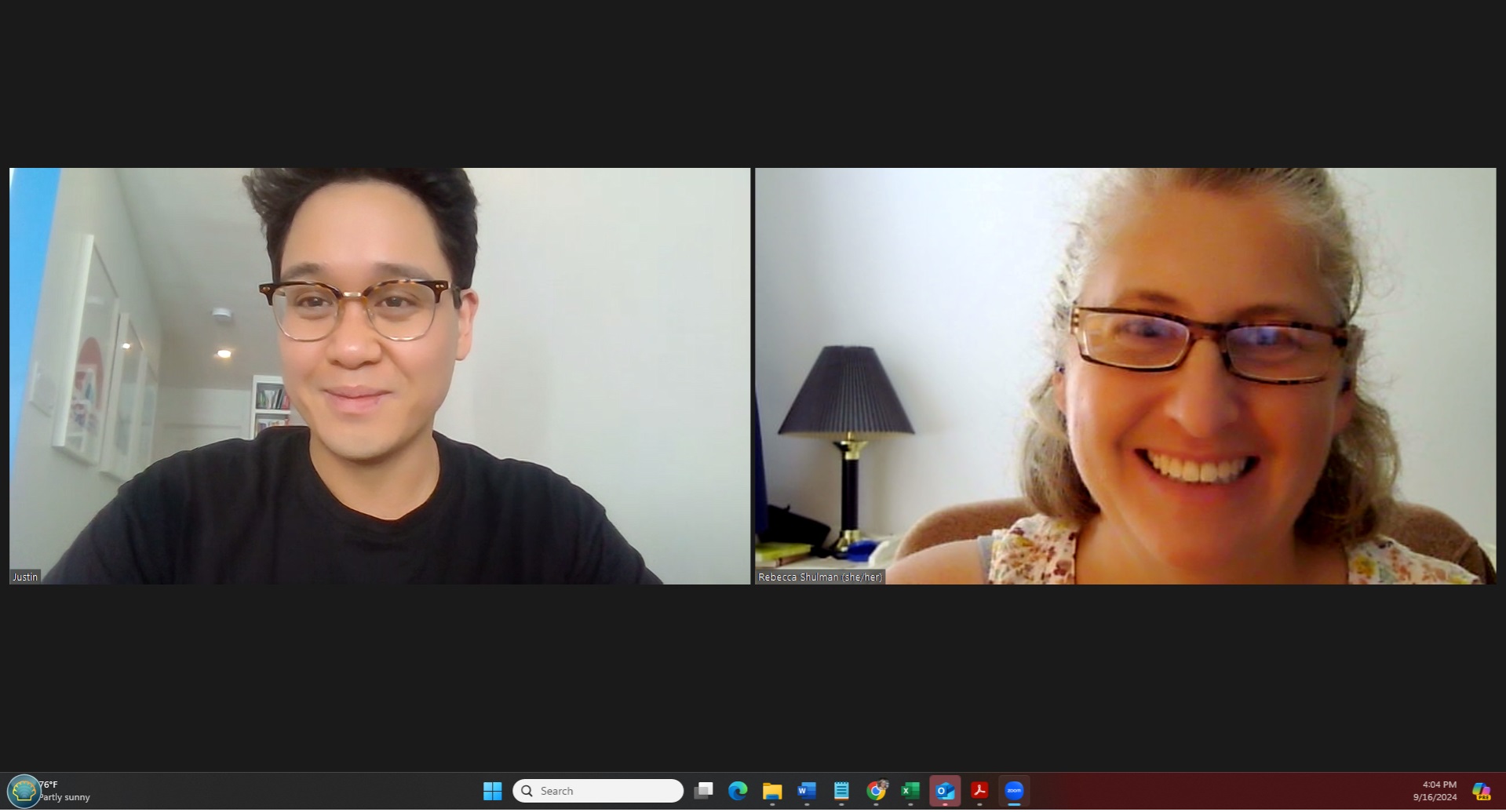
This blog post comes out of a conversation I had with Justin Jalea, and is co-written with him. Justin is a lawyer, DE&I strategist, and professional musician who assists organizations in developing inclusive strategies and practices that enhance equity, collaboration, and belonging.
Justin (left) and Rebecca (right) working on this post over Zoom.
“Listening is being able to be changed by the other person.” – Alan Alda, actor
Listening is critical to a successful organizational culture. While listening is a necessary skill in nearly all jobs, it is an essential skill for leaders and defines their interaction with others. Listening to someone is a way to get to know people and demonstrate respect for them. It is the basis of collaboration, and most endeavors in cultural organizations are collaborative on some level.
Much of the literature on listening focuses on “active listening.” Active listening was developed as an approach to psychotherapy that advocates for decentering the listener. Active listening is a communication technique that promotes awareness and attention. It requires the listener to decenter themselves and focus on what the speaker is saying by being fully present, responsive and empathetic. Tips for active listening include attention to body language, paraphrasing what you have heard, and asking clarification questions to gain adeeper understanding.
While active listening is an important technique for individuals to employ, it is one-sided:one person is the speaker and the other is the listener. It is also episodic: it is an approach to being in the moment during a conversation. Once the conversation ends, active listening is silent on how to act on the information and insights gained moving forward.
We would like to offer another model that we think goes further and is more applicable to the workplace: meaningful listening. Meaningful listening is listening with curiosity and the intent to look for and incorporate new ideas. We posit three key aspects to meaningful listening: respect; comfort with ambiguity; and commitment to a continuing dialogue.
In the context of meaningful listening, respect for others in the conversation is the acknowledgement to oneself that the person you are talking to might have something to contribute, regardless of their position in the organization. Respect is demonstrated by curiosity and openness. A respectful stance requires critical thinking: the ability to take in new ideas, imagine how they combine with existing ideas, and evaluate them in this light. Showing respect is not a passive exercise. Depending on the context, it may require the listener to offer their thoughts or take action to uplift others effectively.
Comfort with ambiguity is important because taking ideas seriously is not the same as agreeing to them. The listener may, in fact, be hearing divergent viewpoints that engender disagreement. Considering ideas that do not immediately resonate is something that requires practice. It is important to acknowledge that an idea has been heard (this is active listening), and that the listener is committed to grappling with those ideas even though they are uncomfortable and complex. This moment of grappling is a moment of ambiguity: “I might change how I’m thinking about something because of what I heard, but I do not yet know.”
Allowing for that moment of ambiguity is a commitment to the challenge of ongoing dialogue. It is unlikely that divergent ideas will be resolved in a single conversation. It requires time for reflection, time to process the ideas that were shared. It cannot be done completely in the moment. And follow-up communication is almost always needed.
Meaningful listening is important for a number of reasons. First, it is a critical part of treating people with dignity and respect that recognizes their inherent worth. Second, it builds cultural competence—the ability to understand individuals with different backgrounds and experiences. While it is not necessarily anti-hierarchical (we understand hierarchy as often necessary to keep large organizations running effectively) it actively and productively counters the assumption that some people have more value than others. Finally, it helps create inclusive spaces by combatting disingenuous pseudo-listening and the common frustration that concerns are falling on deaf ears.
Ultimately, we believe meaningful listening is essential for acting and leading ethically. If leaders are not listening to employees with the intent to act on people’s concerns then they are not treating them well. Worse, they may be doing both employees and the organization harm in the long run by letting genuine concerns fester or go unnoticed.
To practice meaningful listening means to commit to the process to cooperatively explore ideas or concerns a speaker raises. Active listening is an essential step in this process. We recommend understanding and practicing active listening for one’s personal and professional development. However, we believe that in the same way actively listening is necessary for personal development, meaningful listening is essential for organizational growth. Those interested in systematically improving their organization’s health and effectiveness must listen deeply and engage with what they have heard with the same courage the speaker demonstrated in voicing their concerns in the first place.
Yes – organizational problems in museums are solvable! Thank you for this title, Mike!
Mike Murawski of Agents of Change has been one of my thought partners in defining the problems of and solutions for organizational culture in museums. This week I am once again featured on his Agents of Change conversation series. You can listen to the post here. In this conversation we discussed my recent report, meaningful listening, the application of the “customer journey” to museum staff experiences, and why I believe Culture Shift is a great way to create a positive culture.
And while I’m on the topic…
As of today (September 20), there are only three weeks left to sign up for Culture Shift! If you think your organization might benefit, but are not in a leadership position yourself, please share this with your museum director or leadership team!
I’ve been getting questions about the specifics of this offering; so I’m sharing a week by week outline:
Culture Shift is a dedicated, small group space for museum leaders who are committed to the real work of changing organizational culture. Over the course of eight 90-minute virtual sessions we will discuss both theory and practical tips for meaningful change. Each participant will be asked to conduct an internal assessment of their museum’s culture and to design, implement, and evaluate strategies for shifting the needle and making lasting change.
October 15: Why is organizational culture an urgent issue in museums? Participants will introduce themselves and their museums, focusing on why this topic feels urgent right now. They will learn concrete information about organizational culture and what we know from research about common issues and solutions. After this session, participants will be asked to experiment with an ongoing reflective practice and to think about the team they need in place to make change in their museum.
November 19:What does a healthy organizational culture look like? Participants will create a vision for their museum, considering what a healthy organizational culture looks like and what opportunities it presents for them and their museum. After this session, participants will be given the Strengths Finder test, in order to better understand their own leadership style.
January 21: What is the role of listening in organizational culture change? We will discuss the Strengths Finder results, with the goal of developing increased self-awareness and thinking about a strengths-based approach to leadership and culture creation. We will also talk about different types of listening, the role of listening in changing culture, and bringing each person’s strengths to this practice. (Guest presenter: Miriam Bader)
February 18: How do we know what change is most critical? We will talk about formal and informal assessments, what works, and pitfalls to beware of. We will introduce interview-based assessment tools and talk about leveraging the institutional team to conduct this work. After this session, participants will be asked to assess their organizational culture and identify specific areas where change is most needed.
March 18: How do we create change through a Reflective Practice approach? Participants will share and discuss findings from their internal assessments. We will craft clear priorities (for example, “staff will feel like their ideas are heard,”) and goals (for example, “staff will know who to go to to share different types of ideas”) and collaboratively brainstorm ways to achieve these goals. After this session, participants will clarify one priority, three goals, and three experiments to achieve these goals.
April 15, May 20, and June 17: What’s working, and how can we do even better? The final three sessions will be dedicated to sharing and supporting the work participants are doing. We will bring in guest presenters and additional information as needed, informed by the specific participants and their needs.
Questions? Please contact me directly or leave a comment on this post!
Note: This post is one of a series examining organizational culture in museums. If leadership at your museum, or other museum leaders you know, are interested in finding innovative ways to make museums better places to work, please see this page to learn more about three new initiatives from Museum Questions Consulting. Please note, registration for Culture Shift ends on September 30!
I met Hannah Marks through a consulting network, and was impressed by her thoughts on leveraging onboarding as a tool to improve organizational culture. Hannah is an entrepreneurial People Operations leader with 15 years of experience focused on startups and scaleups. She has an MBA in Strategic Design, and is passionate about employee engagement, talent development and supporting a mindful and strategic company culture. Hannah currently provides fractional People Operations support for growing businesses through her consulting firm, Culture Marks.
What is “onboarding”?
There are a variety of definitions. When I think about onboarding I think about these questions: How do we make new employees feel welcome? How do we communicate our values? Connect them with the organizational mission and team?
There are a few stages to onboarding. “Preboarding” is the things that happen between signing the offer and the first day on the job. Then there is the first day, the first week, the first 30 days, and the first 3-6 months.
What should organizations do during “preboarding”?
Organizations often think carefully about the recruiting process, which is the first time a potential employee has an experience with the company. They tend to use a lot of resources around the interview process, and how to hire well, but then the resources drop off until their first day.
Preboarding is the time between when employees sign an offer letter and the time they start the job. There’s a lot you can do in those two to three weeks to have someone show up feeling excited instead of anxious. I recommend integrating a few touch points that will help new employees feel welcome and connected. For example:
Have the employee’s new team send them an email. This might be something like, “We heard you have accepted the role and will be starting with our team in two weeks. We can’t wait to meet you!” You can make this extra special by including a picture of the team!
A week before their start date, people are starting to think about questions like: Where do I have to go? What do I have to bring? What should I wear? Anything you can do to pre-answer these questions will help employees feel like they are being thought about, and that this is a great place to work.
The day before they start, send an email reiterating this same information – where to be when, what to bring, what to expect, here’s your schedule. Make sure that the tone is one of excitement, and “we can’t wait to see you.”
These are simple things that can really change an employee’s experience and first impressions. You don’t need a big budget to send a welcoming email, but it can really make a difference on Day One.
During this time between hiring and start date, managers should also develop a “30/60/90 Plan.” (You can see some examples and resources for this here.) This is a great tool to help new employees get up to speed about what’s expected of them in their role generally and during this time specifically. It might be a document, slides, a video – any format can work. This is something that will be shared during the first week, and which sets both the new employee and the manager up for success through clear expectations.
This document should include what the new hire is expected to accomplish at different milestones (usually 30 days, 60 days, and either 90 days or 6 months). The overall goal of this plan is that the employee has a strong understanding of their role and of the learning curve.
For example, within the first 30 days, perhaps the new employee should familiarize themselves with the organization’s mission, vision, and values; meet their teammates and key internal partners (specify who these are); meet with their manager and review job responsibilities.
By 60 days, maybe there’s a project you want them to shadow. You might specify something like: Spend time with this person and learn about this challenge we are facing. Balance giving new employees small wins (things they can do and check off), and engaging them in bigger issues with realistic expectations. What can someone really accomplish in 60 days?
For the 90-day mark – or, if you prefer, the 6-month mark – you can dive even deeper. Maybe this person will lead a team meeting. Think back to why you hired this person, and set goals for diving into larger challenges.
It’s important to note that this tool can also be useful if any issues or challenges are starting to arise. While this document is not intended as a disciplinary tool, if things start veering off course this document serves as an important touchstone for what’s expected, and can help reset expectations if things are not going well, identify and explain if this is not a great fit.
Ok, let’s imagine we’ve done that. What should organizations do or prepare for the employee’s first day of work?
Think about your overall goal: How do you want people to feel after their first week? Most people answer that they want new employees to be excited to be there, feel welcome, and understand the company’s mission or audience/customers.
Filling out paperwork on day one doesn’t hit any of those goals. The metaphor I like is that of a dinner party. You are walking into a space (real or virtual) for the first time. What would you do? Typically, at a dinner party, someone might welcome you at the door, tell you where to put your jacket and where to pick up a drink. We can think the same way about how to make someone feel welcome at work.
Have a friendly face meet the new employee at the door or on zoom. Maybe someone they interviewed with.
Think about those unwritten rules, like when people take lunch and where. Do people have headphones in while they work? What are these rules that people pick up in an office? Write these things down and share them.
A great new trend is to assign an onboarding buddy. An onboarding buddy is not the new employee’s manager, and it doesn’t need to be someone on their team. It goes back to that friendly face – someone who shows up through the employee’s onboarding experience. Maybe they have breakfast or lunch with the employee on their first day, or give them a tour of the space. Then they check back in with them at the end of the week, and a few weeks after that. This is a great tool to offer early support.
Managers often offer a space to answer questions, but 99% of the time people say, “I’m sure I’ll have questions, but not yet.” Onboarding buddies get more questions than the manager because the new employee feels safe around this person.
You’ve spoken about the 30, 60, and 90-say marks – are there other milestones?
The end of the first week is an important milestone. How do you want new employees to feel at the end of this week? What do you want them to accomplish? Often things that go unspoken or unshared are key bits of information like: What does this organization do? Who do we serve? Why are we here? We forget to step back and share this foundational information that will build a better understanding and engagement.
Employers should share the 30/60/90 plan with their new employee during the first week.
And don’t forget check-ins with new hire. Ask, “how are things going?” During their first week, and for a while after that, new employees should check in with their manager or team lead at a pretty regular cadence. This might look different for different people / different teams – it could be weekly, bi-weekly, monthly. Along with these regular check-ins, new employees should also have a 30-day check in and a 3-month check in specifically to discuss the onboarding experience (rather than day to day things). These are moments to step back and ask: “How are you doing? Are you accomplishing your goals? Is there anything I can do to support you? Is there any information or tools or resources that you are missing?”
Museums employ a lot of hourly, front-line staff. Is there anything different that they should think about in terms of onboarding these new employees?
The same tools still apply. I recommend operationalizing onboarding – meaning, while things look slightly different for different roles, it should have a similar cadence and schedule regardless of a new employee’s role or team.
The 30/60/90 day plan doesn’t need to be customized for front line staff, but there are things that makes a difference between an “ok” visitor encounter and an amazing one. A 30-day goal doesn’t need to be about accomplishing a new initiative – it might be, “Make someone’s day.” You’re building the culture that you want to instill. Other 30-day goals might be to have lunch with other team members and talk about what the new employee has found works well.
This all goes back to challenges of connection and engagement. What builds connection? Talking to different people, learning from different people, and connecting with people, including the audience or customer.
Museum directors feel like they are captains of ships that are under attack. While they put out fires and fight off pirates (metaphors for declining attendance and revenue), the staff below decks are crying out, “But you’re not listening to us! We want to be heard and valued!”
Why are some employees “below decks”? If there are pirates to be fought off and fires to be put out, shouldn’t everyone be on deck, wielding swords and dousing flames with water?
But they aren’t. Museum directors feel under attack for very real and pressing reasons. They are trying to keep their budgets balanced, make up for significant drops in attendance since 2019, and reinvent themselves amidst concerns, ranging from repatriation to relevance. And meanwhile, staff are crying out for very real and pressing reasons: they are underpaid, under-acknowledged, left out of communication loops, and overworked.
In order to better understand and address the challenge of better engaging and the full museum staff, and bring them on-deck to save and improve their museums, I interviewed 14 museum directors. The goal of these interviews, and the resulting report, was to better understand how museums assess organizational culture issues, what they find, and what solutions they have produced. My findings have now been compiled into a full report.
Overall, museums do not have a consistent and reliable way to assess organizational culture. We often depend on a “trickle up” or open-door approach.
The challenges museums are identifying include:
Transparency: What should be shared with everyone?
Interdepartmental Communication: How can communication be strengthened between departments?
Management Training: What do managers need to know and do?
Management Ability: What does meaningful staff support look like?
Change Management: How does rapid change impact staff?
Diversity, Equity and Inclusion: What does real diversity, equity and inclusion look like, and how do museums get there?
Workload: How do we “right-size” workload?
Pay: How can we pay enough?
Personality: What do you do with a mismatch of individual and museum?
Many museum directors are developing significant and useful approaches to address these challenges; most of these directors are working independently, meaning that each museum is finding its own solutions, rather than learning from others.
If you are a museum director and are interested in finding ways to address organizational culture challenges, consider Culture Shift, which will take you through the process of assessing the area of change that will have the greatest impact, and designing strategies to address that challenge and make meaningful change. Learn more here.
Early bird registration ends August 31; registration closes September 30.
Note: This post is one of a series examining organizational culture in museums. If leadership at your museum, or other museum leaders you know, are interested in finding innovative ways to make museums better places to work, please see this page to learn more about three new initiatives from Museum Questions consulting. Please note, early bird registration for Culture Shift ends on August 31!
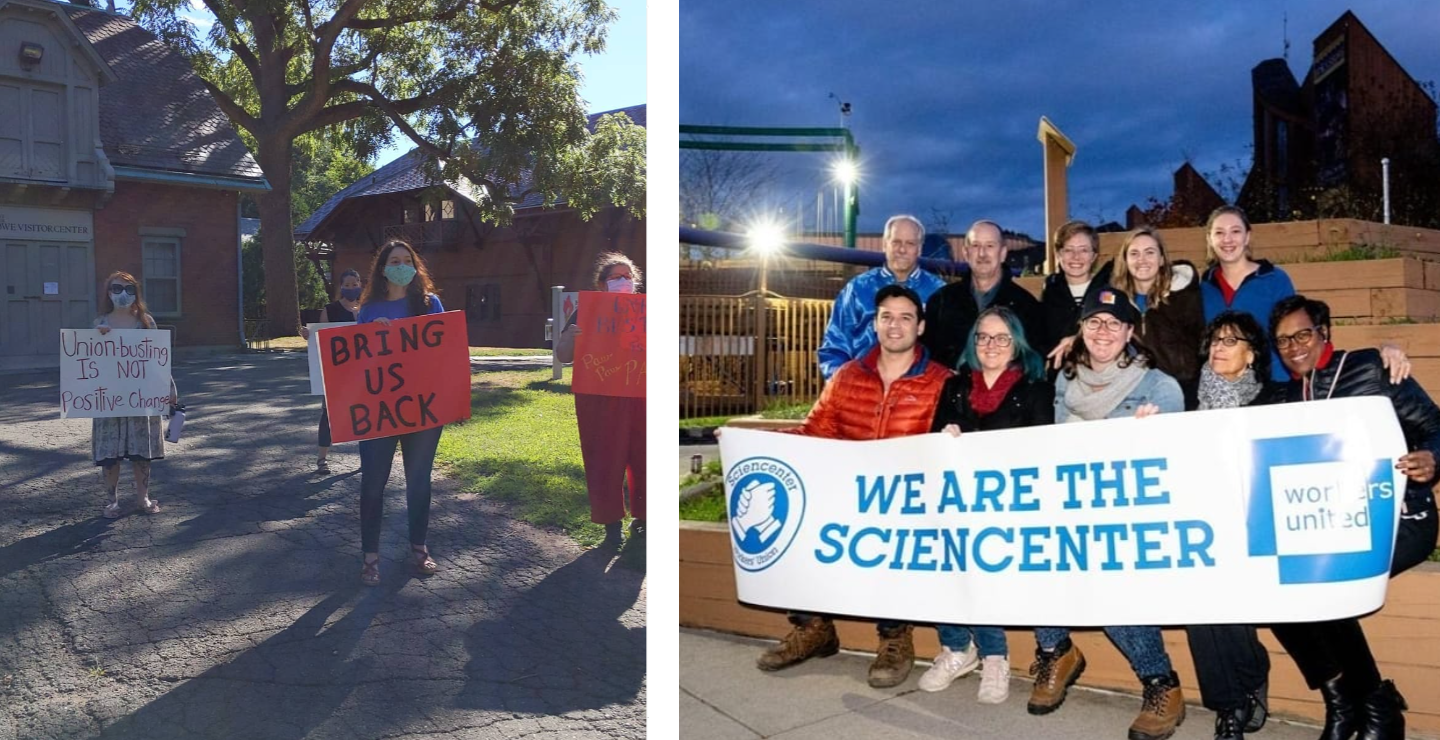
Left: Union Member at Stowe Cener, 2020; Right: Union Members at the Sciencenter, November 2019
This post is dedicated to thinking about changes in museums that have been inspired by the unionization process, that both leadership and union members find productive. These are changes that museums can implement without unionizing, and that lead to staff feeling heard and valued.
Writing about unionization is tricky – there are very strong, highly conflicting views about this in our field. While I hope that this article will appeal to both union supporters and those who are anti-union, I will note that my personal understanding is that most of the time, when staff are unionizing, something has already gone wrong. With or without unionizing efforts, museums can and should do a better job supporting staff and creating healthy work environments.
The organizations I interviewed here have done that. While they moved in this direction because staff unionized, again, all of these forms of staff support can be implemented in non-union museums. As Anne Bergeron, co-author of Magnetic Museums, has said: “Museums, tethered as they often are to academe and scholarship, need to become less hierarchical, less attached to curators/scholars as the standard bearers, and more respectful of all the experts who make a museum a museum, including those who care for the facility and visitors.”
It was challenging to find museums that have “happy” unionization stories – museums that have emerged from the process with both union members and leadership feeling like the institution is stronger due to the existence of a union. I found two: the Sciencenter in Ithaca, New York and the Harriet Beecher Stowe Center in Hartford, Connecticut. Despite direct emails to leaders at unionized museums, phone conversations with contacts at some of these museums, and a LinkedIn post asking for suggestions of other museums which was viewed by 1,000 individuals, I could not identify any other museums for this article.
I interviewed both leadership and union representatives at Sciencenter and the Stowe Center in order to better understand what practices made these institutions stronger. At Sciencenter Ithaca I spoke with Michelle Kortenaar, Executive Director, Annie Gordon, Education Program Coordinator and a union representative who is an organizer, negotiator and member of the Labor Management Committee, and Emily Belle, organizer and negotiator for the Sciencenter Workers’ Union as well as a steward. At Harriet Beecher Stowe Center I spoke with Karen Fisk, Executive Director, and Anita Durkin, Visitor Experience and Sr Education Coordinator and chair of the museum’s union bargaining unit. Both of these museums changed leadership after unionization efforts began. They also have relatively small staff sizes: Ithaca Sciencenter has 28 employees and Harriet Beecher Stowe Center has 16 employees.
That said, these two museums are very different in many ways, including collections, missions, locations, and staff challenges. I believe that the strategies these museums implemented can make a difference in museums of any size.
Unions and Museums
I have long believed that museum unions are an imperfect tool, but often the only externally available tool, to address organizational culture issues in museums. While there are other ways to lodge a complaint, such as through state Labor Departments, union advocates note that the grievance process through unions is significantly easier than through state or federal channels such as the Labor Department, EEOC, or Title IX.
Unionization is an imperfect fit for museums for a few reasons. Unions perpetuate some of the systems that employees find problematic in museums. They are hierarchical – traditionally, a union represents all union members, but does not invite all members to join the conversation. They are full of their own at times inequitable rules – the first step in union negotiations is about who gets to speak, and these negotiations often happen behind closed doors, so that most union members will never know the details of the negotiation, only the results. This may be changing: in a recent interview, Adam Rizzo, a former union leader for the Philadelphia Museum of Art union, said that unions are changing the way they understand their role. Unions are now more likely to focus on ongoing engagement in order to keep all members involved and active. When the Philadelphia Museum of Art and AFSCME held negotiations in 2021, these meetings were open to all union members.
It may be that museum unionization is hardest on middle managers, who often are not allowed to attend negotiation meetings, and have little information or support during the transition to a unionized workplace. However, unions can have significant benefits for the people they represent, in particular regarding pay. Notably, nationwide union members earn more than non-union members, and there is evidence that declining union membership is a causative factor in rising income inequality. (See this article and this article, both cited here.)
It is unclear how many museums in the United States are unionized. We know that unions at 50 art museums represent over 15,000 museum workers. (Museums Moving Forward) AFSCME alone includes nearly 100 museums, zoos, and botanical gardens in their list of who they represent. Most of these organizations have unionized in the last 5 years (since 2019).
In museums, the drive to unionize is complicated, and is fueled in part, by:
Low wages, which are a result of an endemic mismatch between non-profit funding and ambitions and a long-standing tradition in our field of paying entry-level workers minimum-wage, hourly salaries.
A lack of power on the part of staff who are not part of their museum’s leadership team to impact not only their own work environment but ethical issues such as climate impact and repatriation; this results in looking beyond the existing institutional structure for sources of power.
Inequities and workplace injustices (for example, sexual harassment, inequitable distribution of salaries between and within departments, and COVID layoffs and furloughs) being perpetrated by some leaders, with little or no consequences or accountability.
A culture of secrecy in museums, and a culture of competition even within organizations fed by a narrative of underfunding. One example of this secrecy is museums’ unwillingness to make salaries public.
A movement on the part of unions to gain new members in cultural fields, fueled by declining union membership in traditional union fields. A 2023 NPR article notes that in the 1950s one in three workers belonged to a union; now only one in ten workers does.
Motivations to Unionize
Unions, and people unionizing, have changed since the mid-20th century. In the past, unions were about salaries and safety. Now, at least in museums, while pay matters, unionization is largely about having a voice at the table: the ability to be heard directly by the Executive Director and the Board, the people who make the decisions. Emily Belle from Sciencenter told me that unionization is about “appropriately valuing staff expertise and commitment within the system in which we operate.” Anita Durkin at the Stowe Center described unions as critical for creating a more equitable workspace, saying, “unions are just the people in the bargaining unit; in museums, these voices want to be recognized as having value. Museum workers are trying to figure out how to leverage the union to create new structures [and identify] what power-sharing looks like. Unions are a way to navigate those questions.” Issues that led to unionization at these two museums included:
Empty supervisory positions, with no apparent move to fill these positions leading to additional burden on other staff
Leadership that reacted to challenges with anger, leading employees to fear that their jobs were at risk
Failed attempts to share concerns with management
Unionization and positive change
In my interviews with Sciencenter and the Stowe Center, both union representatives and museum leadership described ways that unionization led to new strategies for allowing non-leadership staff to be heard. Most of these strategies were not directly mandated by unions; they are ways in which these museums went above and beyond to respond not only to union mandates, but to the staff needs which led to unionization. Below I am sharing new approaches these museums shared which can be implemented with or without a union in place, and which may be useful to improving the organizational culture of any museum where non-leadership staff feel unheard and/or unvalued.
Ongoing meetings between leadership and staff
Regular meetings between labor and management is a change that was mandated by unionization. At the Ithaca Sciencenter, these meetings include equal numbers of managers and non-management staff. This group discusses things that affect everyone, including the museum’s COVID vaccine mandate; open positions that need to be filled and who should be on the hiring committee; staff dress code; and policies regarding people bringing children or dogs to work. At the Harriet Beecher Stowe Center these meetings are opportunities for updates, ensuring that union members are informed about upcoming initiatives. They also provide an opportunity for union members to share how team members are feeling about the museum and their jobs. These meetings are followed by a post-meeting email summary to update the entire staff.
Board participation
At the Sciencenter, the museum’s Board now includes a non-voting, non-management staff member. While this ex-officio Board member cannot vote, they can talk and represent the views of staff. This board member also also has the ability to request to speak to the Board in executive session without the Executive Director present. Note that the Sciencenter staff has never asked for a meeting like this, which indicates very different feelings about leadership than prior to unionization.
In addition, every Board committee includes a voting non-management staff seat. These are generally individuals whose work relates to the committee – for example, there is a Development professional on the finance committee, and a Facilities professional on the facilities committee.
Transparency
At the Sciencenter, the entire staff receives the monthly Board packet, as well as minutes from management and senior staff meetings. In addition, everyone receives the full, detailed institutional budget, and has a chance to ask questions. Michelle Kortenaar, the museum director, attends meetings with each department separately to discuss the budget and answer questions.
Michelle shared a story about one staff member who wanted to know why the museum had a large amount of money in assets, but couldn’t afford pay increases for staff. Once Michelle explained that the assets are the building and the endowment, the staff member was satisfied. Emily Belle, Sciencenter union member, noted that this leads to the question, What deeper understandings about museum structure have union members gained through increased transparency? Often, leadership has no idea what staff don’t understand.
Staff support
At the Harriet Beecher Stowe Center, time is set aside each Friday for professional development time. Anita described this as a commitment to “continuous learning and nurturing of what staff is doing, and a time to process big ideas, not in front of the public, but in a way to help staff respond to the public.” She also noted that organizationally, this has expanded what the Stowe Center is able to offer. Trainings include reading time, DEI trainings including training related to microaggressions, and training on facilitating public conversations.
Rethinking staffing
The mission of the Harriet Beecher Stowe Center is to encourage social justice and literary activism; because of this radical mission, front-line staff expressed concerns for their safety during some conversations. In order to address this problem, the Stowe Center switched to a co-touring model, which means the museum pays two staff members for every tour. The museum also created new, hybrid positions. Front-facing staff who are invested in participating in the larger work of the museum now spend some time doing front-facing work and some time on another task that meets their interests and qualifications – for example collections, education, or outreach). This has led to a less silo’ed, more connected and involved staff. It also means that four of the five union members who hold hybrid positions are now full-time.
Pay
Pay is both the most intractable and arguably the least complicated aspect of staff dissatisfaction. I would guess that if the other problems can be solved more immediately, many staff teams would be willing to help implement a longer-term plan for wage increases.
That said, not only is pay for front-line staff too low, but it is also often inequitable. A blog post from Corporate Rebels suggests that the ratio between CEO pay and the pay of the lowest staff should be less than 5; a publication from Harvard Business School suggests a ratio of 7:1. This would mean a major change to the pay structure of many larger museums. In an ideal world, the American Alliance of Museums would initiate a museum-wide project to determine ethical pay ratios for museums.
That said, unionization is generally responsible for pay increases. At the Sciencenter, the lowest hourly rate before unionization was $16 per hour; the first union contract brought pay up to $18 per hour. It is now $19.60 per hour. At the Stowe Center, the lowest hourly pay before unionization was $15 per hour (the Connecticut minimum wage); in 2024 it is $21.50.
Calculating compensation as a ratio, the Executive Director of the Ithaca Sciencenter makes approximately four times what the lowest paid person on staff makes. As union members argued while in contract negotiations, and Michelle recently restated, “The #1 donor to your organization cannot be your staff. If you are underpaying them, this is the scenario you are creating. You cannot build a nonprofit on the back of staff. If you can’t exist financially without this, you need to rethink what you do.”












 Museum Questions