One way to address the question, “What do people think about museums?” is to look at cultural references to museums. Museum professionals often make note of references to museums in movies. For those who want to pursue that line of thought, here is Huffington Post’s list of “10 of the most memorable museum scenes in film.” In these movies museums serve settings for scenes (or occasionally the entire movie), often implying sophistication, wealth, or glamour.
But there are moments when museums are used or referenced in less straightforward, and perhaps more telling, ways. Below are four moments in which artists use the idea of “museum” in ways that are freighted with meaning. They present four visions of museums that are very different from each other. How do these ideas about museums connect – or disconnect – with how we are shaping our museums?
If you know of other songs, books, poems, etc. which imbue museums with symbolic significance and thus speak to the ways in which people understand museums, please share them – I will add them to my Museum of Museums.
1. Amichai
In Yehuda Amichai’s “Poem Without an End,” a museum is grouped like a matruschka doll (those dolls that fit one inside the other) with history, religion, and the heart. It is not a physical space, but something that lives inside one’s heart:
Inside the brand-new museum
there’s an old synagogue.
Inside the synagogue
is me.
Inside me
my heart.
Inside my heart
a museum.
Inside the museum
a synagogue,
inside it
me,
inside me
my heart,
inside my heart
a museum
2. Spektor
In Regina Spektor’s song “All the Rowboats,” the museum is a mausoleum that traps timeless art in a lonely, cold purgatory. (I recommend that you just listen to the song, without watching the much less interesting video.)
3. Pamuk
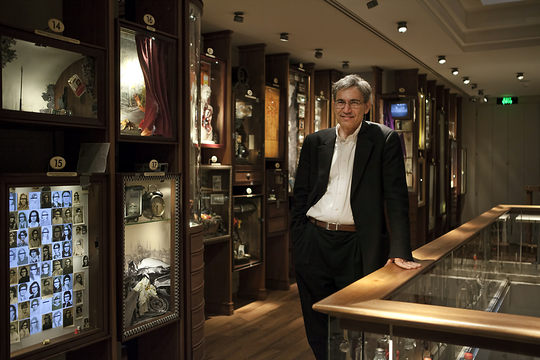
I have to admit I have not yet gotten my hands on a copy of Orhan Pamuk’s “The Innocence of Objects,” only read reviews of it. It is a museum catalog for a real museum dedicated to the life of a fictional character. The reviewer Presca Ahn described the museum as follows: “The cozy feel of the museum’s interior, the antiqued numbers over the vitrines, and the faded beauty of its objects are all part of the same curatorial strategy: to generate in us a false sense of longing, a nostalgia for something that neither we nor anyone else has ever experienced.” Museums, in this construct, are like novels – vehicles for stories, sites of invented history, which spring from the mind of a sole author/artist/curator.
Pahmuk in his museum
4. Rives
In Rives’s Ted Talk “The Museum of Four in the Morning,” a museum is a conceptual space in which to crowd source and save the things that haunt us:
About a year ago, while teaching art history at Bradley University, I committed to giving a talk about the spiritual in modern and contemporary art. That talk is fast approaching, and has been leading me to think not only about artists who embrace a spiritual purpose for their art, but about where the spiritual is to be found in the act of viewing art.
I am defining “spiritual” not as religious, but as the urge – often achieved through religious practice – to transcend self or the present moment, to connect with the universe in some larger way. Numerous artists write or speak about the relationship between their art and the spiritual (see, for example, Kandinsky, Newman, Abromovic). But to what extent is viewing art about connecting with something larger, something cosmic, something beyond the self? And what are the conditions that allow for this experience?
There are very few resources out there that investigate this aspect of art viewing or museum going. The most useful may be Kiersten Latham’s article Numinous Experiences with Museum Objects. “Numinous” is a word borrowed from religious studies, and a numinous experience can be defined by deep engagement or transcendence, empathy, and awe or reverence. It might also be described as a state of wonder or resonance. While not all of the experiences Latham describes can be called “spiritual,” and only two of them involve experiences with art, her study is useful in that she captures and investigates transcendent experiences with objects.
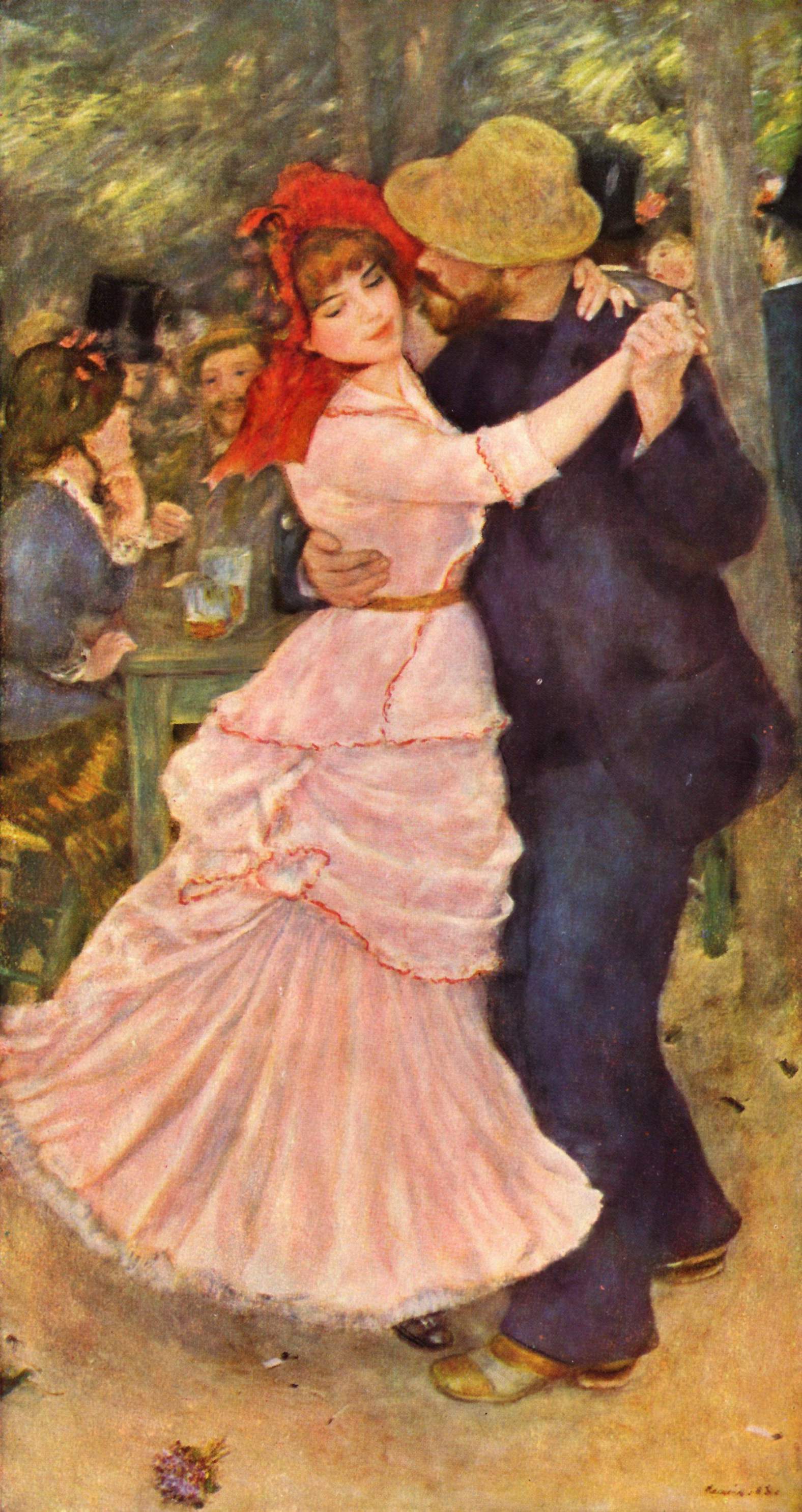
One of Latham’s subjects, Erin, described a numinous experience with a Renoir painting while at the Museum of Fine Arts Boston. Erin vividly describes being transported:
In TV shows … sometimes they do that camera trick where the person’s being, something’s being sucked towards … the camera. That’s kind of what you felt. I mean, I felt I was, like I was being drawn to [the painting]. Or drawn into it . . . as I’m looking backwards on it, I can see it [the painting] framed in the doorway and … everything else was dark, except for this painting.
Pierre-Auguste Renoir, Dance at Bougival, 1883. This is one of over 40 works by Renoir in the collection of the MFA Boston.
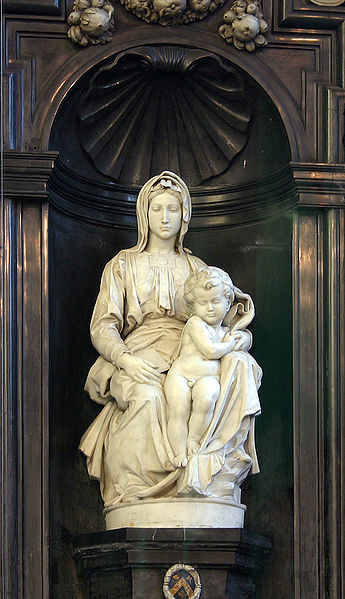
The Visitor Studies Association, which published Latham’s article, also published an interview in which people reflected on Latham’s article. As part of this interview Theresa Sotto, an Education Specialist at the Getty Museum, described her own mystical experience with a work of art. In her case, the object was Michelangelo’s statue of Madonna and Child in Bruges:
[It] may not have been the sculpture alone that so greatly impacted me. Other factors that likely played a role were the soaring gothic ceilings of a church that dates back to the 13th century, the elaborate and enormous stained glass windows, the the choral music…. But the experience … – that was all Michelangelo. And the imaginative empathy I felt while picturing the artist chiseling out tenderness, affection, and serenity from a block of marble – that was all Michelangelo too.
Michelangelo, Madonna with Child, 1501-4, Onze Lieve Vrouwekerk, Bruges
These described experiences focus on the relationship between the space and the work of art. (In the first example, the experience was marked by the disappearance of the space.) They suggest that museums support a spiritual encounter in a way that books or computer screens cannot. Further, they suggest the possibility that museums themselves create the potential for numinous experience with any object.
The importance of the museum space is supported by a study published the The Atlantic and Hyperallergic in 2014, which investigated “whether people visiting museums, churches, and libraries experience similar brain activity to those practicing meditation.” They found that “contemplative spaces induce “markedly distinct” states compared with non-contemplative spaces…. Ultimately, they allowed subjects to enter into a meditative state “with diminishing levels of anxiety and mind-wandering.””
I did find two additional areas of work that seem related to the connection between the spiritual and art viewing. They are related in that they examine the museum’s potential to impact the way one understands oneself in the context of the larger world, rather than to evoke a feeling or teach information. The first is the program Art-O-Mancy, a form of therapy through art viewing in which visitors view and consider a work of art with the intent of making sense of their own lives. The second is Jay Rounds’ article Doing Identity Work in Museums, which explores the ways in which museum visitors make use of exhibitions to better define and understand themselves. However, these approaches offer personal growth rather than spiritual transcendence.
As is often the case, this research has left me with a series of new questions:
Do museum professionals value spiritual experiences with art? If so, how do we support the spiritual experience, alongside cognitive and emotional experiences?
Are specific types of art more conducive to spiritual experiences?
How do we promote this type of experience as a potential benefit of museum-going?
What can museums do to encourage these experiences for visitors?
Do unstated rules such as “don’t talk loudly in the galleries” contribute to spiritual experiences? Do we need to consider these types of experiences when rethinking rules and manners in the 21st century museum? (See Elaine Heumann Gurian, “Intentional Civility“)
These questions assume that (1) it is possible to have a spiritual (transcendent, transporting) experience with a work of art, (2) spiritual experiences with art are memorable and of personal importance for those who have them, and (3) spiritual experiences with art are due in part to the interaction between the work of art and the space in which they are housed.
The topic of spirituality is uncomfortably fuzzy and new-age-ish. But it lingers because spiritual transcendence is a human urge. And it lingers in museums because they have the potential to serve as non-denominational temples, spaces for spiritual experience set apart from any particular religion. I would be very curious to hear from any museum professionals who have thought about how to foster or promote these experiences, and equally curious to hear from those who think this is outside of the purview of museum work, and can explain why.
Hilla Rebay, the first director of the Guggenheim Museum, wrote to Frank Lloyd Wright asking him to build her a “Temple of Spirit.” Image credit: “Guggenheim New York” by Martyn Jones at en.wikipedia. Licensed under CC BY-SA 3.0 via Wikimedia Commons.
At the end of this post there is a link to this survey. Please help me more deeply consider the question of classroom management by completing and sharing the survey!
A few months ago, I was tagged in a tweet asking whether I knew of any good resources for classroom management in the museum setting. More recently, a colleague started an on-line conversation asking for classroom management strategies. And, although I can’t put my hands on other similar tweets and posts, I am certain that I have seen this question many times recently.
Museum educators are concerned about management strategies because it is very difficult to teach a group of children in the galleries when they are not following a shared and accepted code of behavior. It is hard to facilitate a large group discussion if children do not listen to each other, which often involves being quiet for most of the time and raising their hands before sharing their ideas. It is difficult to efficiently move from one gallery to another if children wander off.
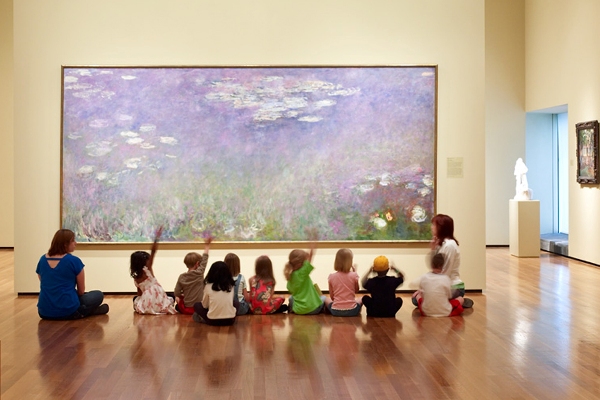
Students in Museum Art Classes at The Cleveland Museum of Art.
It concerns me – and I suspect others have noted this, as well – that museum educators often resort to the phrase and model of “classroom management.” This implies that we are using classroom behavior as a model for gallery behavior. On one level, this makes sense: A class of school children presumably knows a shared set of rules, and it is easier to enforce these rules in a new educational setting than to create and teach new rules. But there are a number of reasons that this approach may be misguided:
1.The contributors to Museum Questions have noted over and over that the value of the museum experience for school groups is that it is different from the school setting. To cite just one of these contributors, Brian Hogarth wrote, “What I hope is emerging is the idea that museums are not extensions of the classroom, but rather engender exactly the kind of learning that we believe students should engage in.” In order to rethink museums as spaces apart and different from the classroom, we may need to rethink the behavior we expect and encourage in school groups.
2. The need for “classroom management” may indicate a program design problem.Kylie Peppler, a professor of Learning Sciences, claimed that management problems on a class visit are “an indicator that something is not working in the tour. Something is not high quality in that environment. In a high quality environment the teacher reports a sense of Zen.” If children on a group tour are acting in a way that makes learning challenging, is it possible that the learning experience is structured in a less-than-ideal way? Instead of relying on classroom learning strategies, are there alternate ways we can engage children?
3. Ongoingconcern about classroom management reflects a set of long-held, and possibly faulty, assumptions about museum and classroom behavior. Do we want children to raise their hands because this makes conversation possible, or because it is part of our own familiar and respectful code of behavior? Do we want children to walk from point A to point B without stopping to look and talk because point B is so worthwhile, or because of an ingrained and unquestioned assumption about how museum tours should be structured? In the article “Intentional Civility,” Elaine Heumann Gurian questions our beliefs about how people should act in museums. She writes, “it is past time for public institutions… to intentionally review the many assumptions they have made about the people they interact with, [and] how those assumptions have been translated into action.” Gurian is speaking about the general visitor, not school groups; she notes that assumptions about visitor behavior reflect “a model from a former time, when good manners were assumed to be part of the upper class armamentarium to which the rest of society either already aspired, or ought to. Museums, in this formulation, are gracious places and should not be inclusive of such behaviors found in a diversified culture that might undermine their elevating effect.” The article is a call for museums to consider the intent of behavioral rules and assumptions, and to allow these to guide a reconsideration of the behavior we encourage among both staff and visitors.
Perhaps instead of asking about strategies to manage and encourage a certain set of behaviors, we ought to be asking: What does good behavior look like for school visitors to the museum? Under what conditions do these behaviors occur?
I would like to better understand the context and use of classroom management. Perhaps some of you have figured out program designs that reduce the need for management. Perhaps some of you have great management resources to share. Perhaps there are certain groups that are most difficult, which might reveal more about why and when management is needed. Please help me to learn more by completing this survey. I encourage you to share this survey with other museum educators who work with school groups, including those who lead the tours. If enough of you respond, I will use the responses to create a follow-up post.
In early December, I wrote a post considering whether and how museums should respond to the grand jury verdicts in Ferguson, Missouri and Staten Island, New York. My response was, and remains, that before they can respond to moments of political crisis, museums must create intentionally ethical and self-critical ways of operating. A few weeks after writing that post, I was offered the opportunity to be the founding director of a children’s museum, which provided me with the challenge and opportunity to think about what an ethical museum looks like.
To act ethically is to act in a way consistent with one’s beliefs. Therefore, in order to act ethically, one must have strongly-felt, well-considered beliefs, and reflect these in one’s actions.
In the museum field we do not spend much time thinking about strongly-felt core beliefs. In fact, it is unclear to me whether we share underlying beliefs, or whether these are individual and varied. Again, this question was raised, and quickly dropped, during the responses to Ferguson. A number of museum bloggers signed a joint statement. I posted the statement, but declined to sign it, because of one sentence: ““As mediators of culture,all museums should commit to identifying how they can connect to relevant contemporary issues irrespective of collection, focus, or mission.”” In conversations with signers of this document, it was unclear whether this sentence articulated a shared belief, or whether it was simply expedient to sign and post. Similarly, conversations about the differences between learning, participation, engagement, and other ways museums might impact or relate to visitors rarely get the time they merit. We are so busy doing that we do not have time to identify and articulate our ethical true north.
The American Alliance of Museums has a Code of Ethics; this code has three categories: governance, collections, and programs. Museum governance, the Code says, should support the mission and the public good, be responsive to society, treat staff with respect, and uphold professional standards. Collections ethics mandates that collections relate to mission and accord with laws, access is granted, and care, loan, and disposal are regulated. Programmatic ethics dictate once again that the museum support both mission and public trust, that programs are rooted in scholarship and intellectual integrity, and that access and plurality are valued. But what do we mean by “public good”? What does it mean to be responsive or respectful? This set of ethics falls short of truly defining what an ethical museum should look like. If ethics are individual and cultural, rather than field-wide, than this is appropriate, as AAM cannot speak for each individual.
Gretchen Jennings offers more detailed ideas about museum ethics, using the phrase “empathetic museum.” Jennings says that empathetic museums include the following traits: They see themselves as part of a larger community, with related responsibilities to that community. They persistently take this role into account, planning accordingly and responding to audiences in a timely manner. These “audiences” are defined not as traditional museum-going audiences, but as all of the diverse members of the community, and the museum plans for inclusivity in staffing as well as visitorship. (For a full list of the qualities of an empathetic museum, see Jennings’ post on the Incluseum blog.)
Jennings’ definition of empathy is detailed and focused. But it dodges a controversial question at the heart of what she defines as empathy. If a choice has to made between the good of funders and the good of the general public, where do museums stand? AAM’s decision not to speak up regarding the grand jury verdicts was a strategic one; by avoiding taking a stand, they avoided offending the government officials they lobby and the elite who fund museums. To act often puts museums at risk. If it is a choice between funding (which, as I was reminded in a linked-in discussion about this post, keeps the doors open and the lights on), and doing what’s right, what do we choose? What guides us?
There is another way of thinking about ethics that I would like to add here, but I do so with reservations, because it borrows from religion (illustrating, perhaps, how ethics are culturally defined). In Judaism, there is a concept called “tikkun olam,” which means repairing the world. Tikkun olam encapsulates the idea that we are co-creators of the world we live in, and must act accordingly. While tikkun olam originally had mystical, cosmic connotations, these days it is used to refer to social action, and “human responsibility for fixing what is wrong with the world.” (For more on this, see My Jewish Learning.) I feel the need to add tikkun olam to a discussion on ethics because it presents a question to guide ethical decision-making, that goes beyond the idea of “do no harm.” It asks, how can museums help to make the world a better place?
To take on the responsibility of acting ethically, of making a better world rather than maintaining the staus quo, is to take on a heavy burden. A good example of this is the ethical issue of unpaid internships. Michelle Millar Fisher has argued persuasively that internships perpetuate the elitism of museums by keeping out those who cannot afford to work for free. But for many of us, interns provide needed help to staff limited by small budgets. Added to that, people clamor to work for free – we get calls from people who ask to work for free. So do we turn these potential interns away and limit the amount of work we can do, in order to create a more equitable professional community, and change the ways museums think about labor? That would certainly be the ethical choice. But a very difficult one to make.
I am grappling with countless questions like this one. Here are a few:
I want to ensure diversity in both staff and visitorship, so that the museum is not an enclave for the privileged but a contribution to the quality of life for all. Do I hire the person with the most experience, or people who will ensure a diverse staff?
Working with a small budget, is it ethical to spend money to create an attractive work space, or offer professional development to staff, if this means less funding available for programming? Is it ethical NOT to spend money on creating a comfortable and stimulating environment for staff?
Is it ethical to charge additional rates for family workshops? Or does this exclude audiences in a problematic way?
Is it ethical to create unpaid internships? Is it ethical to rely on volunteers? What if I simply don’t have the budget to operate in any other way? What would make unpaid internships or volunteerships equitable and ethically appropriate?
What can I do to limit waste and plastics, given limited financial resources? How can I host birthday parties without paper plates and plastic cups, or hold art workshops without buying newly created foam and plastic pieces?
Because our field-wide discussion of ethics is so limited, I suspect there are important questions I have not even considered. I’d love to hear thoughts on these and other important ethical considerations. What are your answers to the above questions? What do you think is important in creating a museum that helps to make the world a better place?
When I started the Schools and Museums series I was working as a consultant, and wished that there were a museum in which I had the freedom to experiment with some of the ideas shared by contributors. Now I have just such an opportunity – at the Peoria PlayHouse Children’s Museum – which (like many opportunities) is also a challenge. It is easy to gather and share ideas, to argue for ways of doing things. But it is much harder to put them into practice. When put to the test, will I be able to place depth and partnership above field trip income in school programs? Can I find ways to articulate value as I believe in it, and still convince school groups to visit the museum?
With this in mind, I have identified one basic commitment and three field-trip-related experiments that I would like to try, in partnership with a yet-to-be-hired Education Manager.
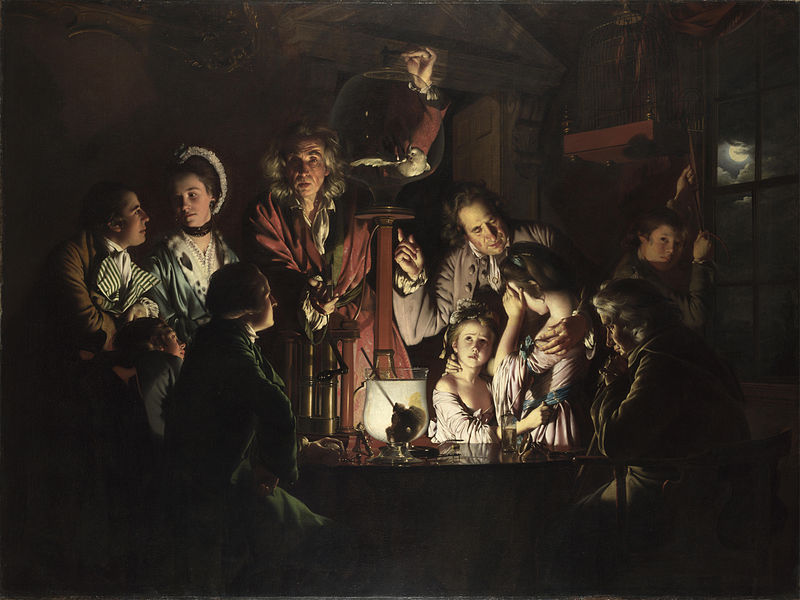
Joseph Wright of Derby, An Experiment on a Bird in an Air Pump, 1768
Commitment: Align tours with PlayHouse goals, and offer tour themes that reflect these goals (rather than classroom instruction).
I can’t call this an experiment, because I have done this before, as have a number of other museum educators. But it is essential, and therefore I want to be sure to include it in this post – which is, essentially, a public promise to putting ideas from this blog into practice.
At the PlayHouse we have two overarching goals. The first is to encourage and support visitors in becoming explorers and creators of the world. The second is to support and promote play in the fullest use of the word. Our goals for students, then, will be something along the lines of:
Students will explore in the museum, and learn to explore beyond the museum
Students will create in the museum, and learn to create and innovate beyond the museum
Students will understand play as part of the work of scientists, artists, engineers, writers, educators, and other professions.
All tours will need to be designed to achieve these specific goals. This doesn’t preclude mentioning core curriculum connections in marketing material, but only as these connections can legitimately be mapped to the tour after it is designed.
Experiment #1: Support teachers in helping kids follow up on areas of interest or curiosity inspired by the tour.
For each tour available, we can work with teachers to create and constantly update a list of resources that they might share after the visit with students who are curious or inspired. This might include other field trip destinations in Central Illinois that students might visit independently or as a class, along with books, web sites, even movies or episodes of television shows. This will make it easier for teachers to support the curiosity that students generate in the museum – a difficult but essential job, as noted by Daniel Willingham.
We can start this work in the museum by ending tours with time and concrete prompts to help students think about what they are interested in, or to think about what they would do if they visited again with their families. As John Dewey said, and Cindy Foley and Caitlin Lynch reminded me, “We don’t learn from experience, we learn from reflecting on experience.”
Experiment #2: Offer school groups the opportunity to make the museum their own for a day.
We cannot offer this to every group, and I would guess we will need to charge something for the space. But I imagine offering a classroom space to teachers who would like to spend the day using the PlayHouse, the neighboring zoo and botanic gardens, and the park in which we are all situated as a classroom. In this way, teachers and students can make the museum their own, moving in and out of the galleries as part of a day-long lesson.
Experiment #3: Have students respond to exhibits in ways that change them and impact the experience of other visitors.
As Anna Cutler pointed out, we can use the controlled laboratory of the field trip to model new ways of engaging with the museum. What signs, videos, objects, exhibition components, images, and other products might students create that could in turn challenge drop-in visitors to think in new ways?
Those are my experiments. What are yours? What new ideas do you have about school visits to museums? What is one experiment you – as a teacher, museum educator, museum administrator, parent, or in any other role – would like to try this spring, or for the 2015-16 school year?
In graduate school in the Museum Education Program at George Washington University (admittedly more years ago than I should admit to), the first semester was dedicated primarily to the idea of object-based learning. How does one teach with objects? How do you select objects for a tour investigating a larger theme? This course of study made sense, because museums are places that collect and display objects.
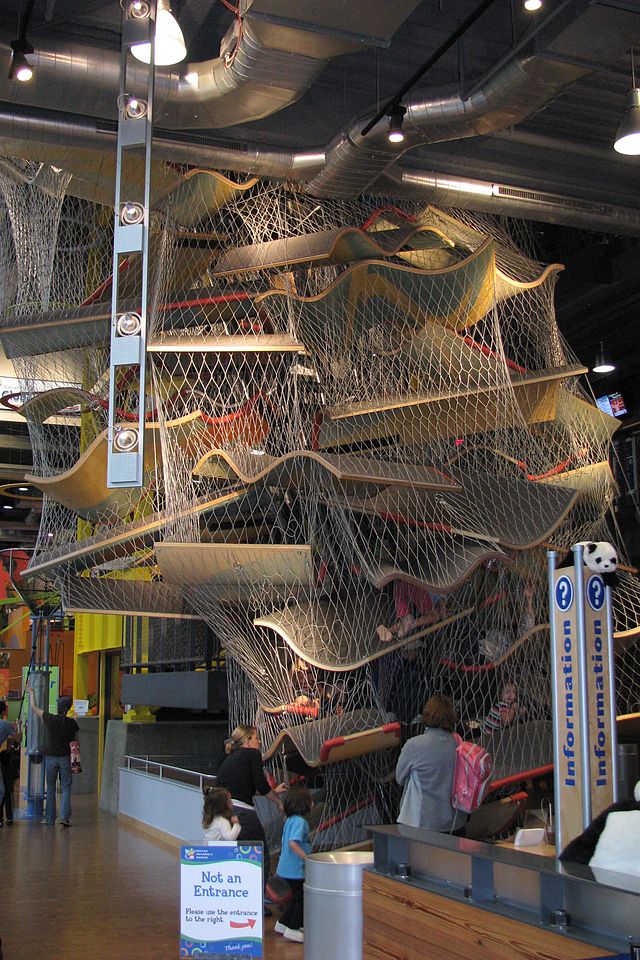
But this is generally not the case in children’s museums. Children’s museums curate experiences, not objects. They are, essentially, indoor programmed play spaces. But if they are not object-centered institutions, why are they museums? Are they museums? This question is clearly important for children’s museums, but also of broader importance for all museums, as a subset of a larger question: What makes a museum a museum?
In order to better understand why – or if – children’s museums are museums, I turned to three sources. I interviewed Barbara Meyerson, a consultant with The Museum Group who has worked extensively with children’s museums, and founded the Arizona Museum for Youth. I also spoke with Elaine Heumann Gurian, another consultant with The Museum Group as well as an influential writer on museums who worked for fifteen years at the Boston Children’s Museum. And I considered a 1999 article by the esteemed and prolific Stephen Weil (who, sadly, died in 2005 and therefore was not available to be interviewed for this post), “From Being about Something to Being for Somebody: The Ongoing Transformation of the American Museum.” (Thank you, Museum Hack, for recommending this article!)
Barbara Meyerson attributed children’s museums’ status as museums to their historical origins. Because they grew out of collection-based museums, they continued to ally themselves with the museum field, which allows them to influence both museum visitors and other types of museums:
When I went to the Brooklyn Children’s Museum as a child, it was like any grownup museum you would go to – there were objects in cases, and registry numbers on labels. The difference was that the collections they presented tended to be things they thought children would be interested in: toys, dolls, anthropological objects, botanical specimens.
Michael Spock became the Director of the Boston Children’s Museum in 1962, and asked, why do we have stuff in cases? Children want to touch things. He culled the collection and took things out of their sanctified resting spots. This happened at the same time as a lot of research about informal learning and its value, from psychologists such as Howard Gardner.
Children’s museums have spread ideas about learning and engagement exceedingly well. Learning has become the prime directive in any museum, and it is now hard to walk into any museum without seeing children’s activities, workshops, etc. A generation ago this did not exist. Children’s museums have had a profound impact on the grownup museum field.
Children’s museums have allied themselves with the museum community. One of the unspoken ideas behind children’s museums is that they introduce families with children to the concept of a museum, with the understanding that these children will grow up and become patrons of other museums.
Museums as Public Spaces for Three-Dimensional Learning
Elaine Heumann Gurian defines museums as public spaces in which people learn in three dimensions, and spoke in more depth about what this learning entails:
Museums are part of a panoply of sibling organizations which have two competitive advantages. One is that they are sites where strangers can safely interact. Sometimes people refer to that as public space. The other is that they have three-dimensional evidence set up in a mode that induces personal learning. By three-dimensional I don’t mean collections only, and think that creating authentic tactile experiences or contemplative sensory locations count as well.
Children’s museums are places that specialize three dimensional experiential learning. Botanic gardens and zoos are places that I consider siblings to museums. Parks may also be part of our family depending on the opportunity that parks have designed into their experiences.
I am no longer interested in the classical narrow definition of museums – collect, preserve, educate, research and exhibit. I care more about creating safe public spaces where strangers meet, that are welcoming and set up for free-choice learning. Three-dimensional learning is important because it has different sensory components than two-dimensional learning. One of hallmarks of children’s museums is that they create experiences. These tactile experiences have been carefully designed to provide ways of understanding the topic for a multiplicity of ages. Other museums have copied the techniques originated in children’s museums.
Not all experiences are the same, however. At the Boston Children’s Museum we used to talk about “flappers and crankers,” meaning push buttons that were facile but might not facilitate learning. Sometimes museums have been very easy on themselves thinking any interaction is equally educational. Obviously pushing buttons randomly is an experience, but it is not necessarily learning. On the other hand learning, especially conceptual learning, is very complex and is understood and integrated in small bits. Museums don’t have to offer a complete learning experience but they should offer opportunities for individuals to add new “bits” of understanding. Children’s museums can help themselves by testing and retesting their exhibition ideas to see if they add to experiential learning they desire. While it looks simple, the critical testing is what makes interactive exhibition design become a gateway to new understanding.
Museums as Non-Profit Entities with a Responsibility to the Public
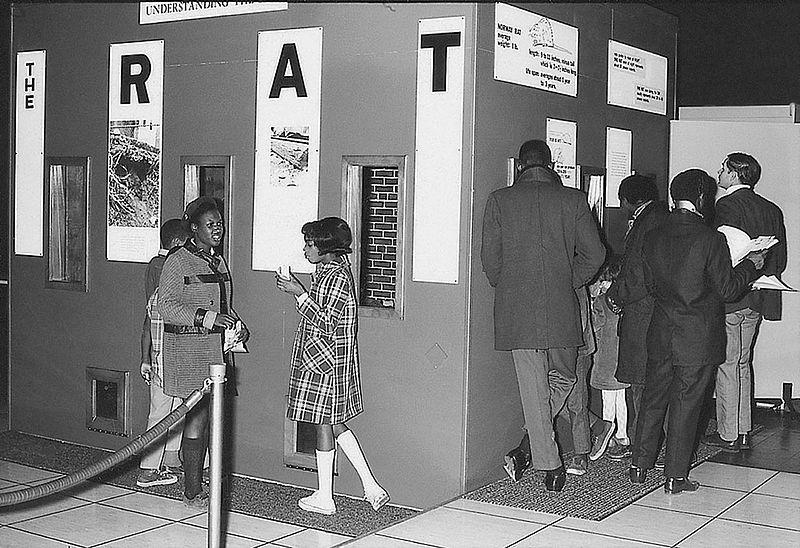
The exhibition “The Rat,” at the Anacostia Neighborhood Museum, which Weil uses as an example of a museum dedicated to serving its public.
Stephen Weil argues that museums as non-profits have made a commitment to provide “demonstrably effective programs that make a difference in the quality of individual and communal lives.” Rather than defining themselves by their collections, museums should define themselves by their relationship with their public.
To serve this public well, museums must “be of profound service… [they must] use their competencies…to enrich the quality of individual lives and to enhance their community’s well-being”. They might do this by providing a safe space, a personal haven, an opportunity for individual growth.
While Weil was not, in this article, explicitly addressing the question, “Why are children’s museums museums?”, the answer inherent in his writing is that children’s museums are museums because (and if) they serve the public in important ways.
So When are Children’s Museums Museums?
Of the three answers cited in this post, Barbara Meyerson’s is, I would venture, the most accurate: children’s museums are museums because of their historical origins. The decision to keep the word “museum” in the name, and to ally themselves with organizations such as the Association of Children’s Museums and the American Alliance of Museums offers children’s museums a certain cachet: The word “museum” implies, to a certain demographic, that they are simultaneously educational and fun. It suggests that there is cultural capital to be gained by taking your children to these spaces instead of an amusement park or the playground. Children’s museums are museums, then, because and when the word “museum” proves a useful marketing strategy.
Elaine Heumann Gurian and Stephen Weil offer definitions that are perhaps less evidently “true,” but which offer guidance on what (according to them) a children’s museum should be. If one accepts their definitions, than one must plan and program accordingly. Defining a museum as a three-dimensional learning space leads to a host of useful questions:
Under what conditions do children learn?
What the difference is between play and learning, and when do these overlap?
What does it take to connect physical manipulation of or within a space into cognitive or emotional engagement?
How do the answers to these questions vary by age group?
What is the role of social interaction in learning within a children’s museum?
Stephan Weil’s insistence that a museum “be of profound service” requires us to consider an entirely separate set of questions:
What does it mean to serve a public?
Which public(s) are we serving? What conditions need to be in place to be of service, or to be public-oriented?
Museums today are used as tools of city- and community-building – what is the difference between the individual public good and the benefit of a city or neighborhood?
If children’s museums fail to consider these questions, to provide real three-dimensional learning experiences or to be of service to their public, do they fail at being museums? Yes, if you agree with these definitions.
The vast difference in these three definitions makes evident that each of us may have a different response to this question, or to the umbrella question of “What makes a museum a museum?” Our responses are important because they drive the concerns that we address, the things we need to think about to ensure that museums are the institutions we want them to be.
What other ideas are out there? Why is a children’s museum a museum? What makes a museum a museum? Please share your own thoughts, and any interesting relevant theories you have come across.
As mentioned in a recent post, I am currently hiring full-time staff for the Peoria PlayHouse Children’s Museum. The job description for the Education Manager can now be found here (scroll down to find it) and at the end of this post.
It’s an interesting experience to be hiring someone else to do the job I held (in one version or another, at one institution or another) for fifteen years. I am struggling not to get too excited about planning programs myself. For the visionary museum educator interested in living in Peoria, this is a great opportunity, and I promise not to take all the fun parts for myself.
But, just to inspire you, here are some thoughts…
We could offer children the opportunity to work with artists to transform the landscape of Glen Oak Park,where the museum is situated…
“Required Reading” by Chicago artist Melissa Jay Craig – one of the artists on my wish list for an artist in residence program.
We could let kids of all ages make things…
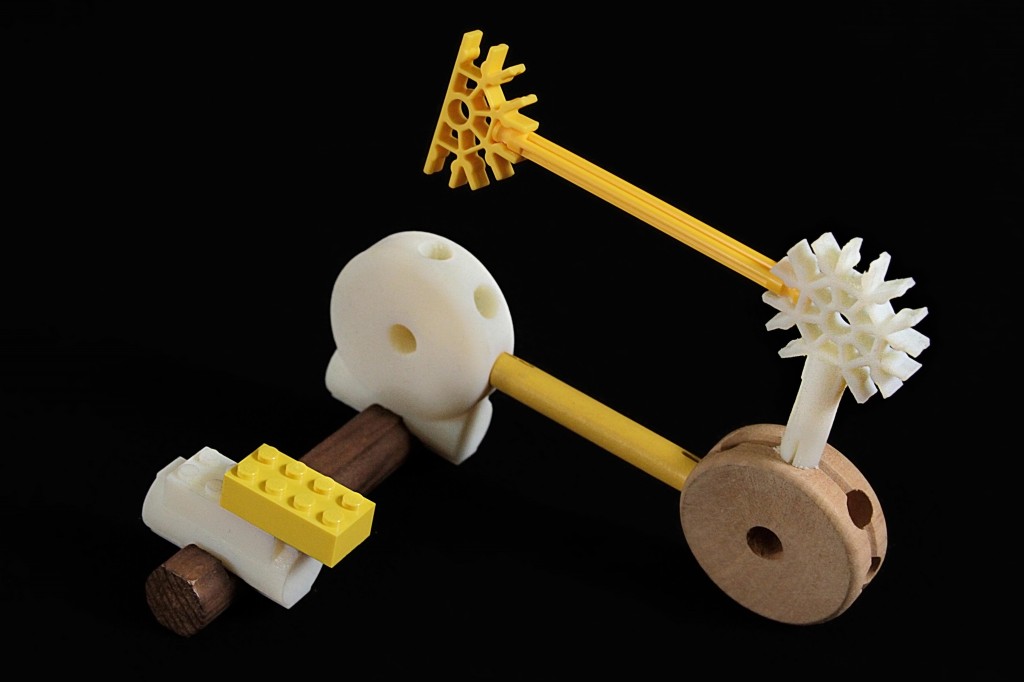
The Free Universal Construction Kit from Free Art and Technology Lab, which allow you to combine Lego, K’Nex, Bristle Blocks, Tinkertoys, and more. Thank you Cooper Hewitt for introducing me to this!
And, of course, we could reinvent the field trip…
One of my favorite ideas from the 13 year old blogger Jake, of Jake’s Bones, who wrote: “The Grant museum had a load of tables and chairs in the middle, and when I was in with Ben Garrod there was a class came in. I don’t know what they were studying but you could be studying quadratic equations in Hungarian and it’d still be a fascinating room to have it in.”
If you are inspired, you know where to find me.
Job Opening – Peoria PlayHouse Children’s Museum
Education Manager
POSITION: Full Time
REQUIREMENTS:
Four-year college degree in museum education, education or a closely related field is required. Although a degree is preferred, extensive experience in a like position with similar duties or responsibilities may be substituted for all or part of the educational requirement.
Requires a minimum of two years of direct experience in an educational setting, ideally a museum or other informal education setting.
Must have excellent customer service, problem solving and organizational skills.
Must have knowledge and experience in creating and facilitating educational experiences in a science and engineering, art, history, early childhood and/or other related context. Must be comfortable working in all of these disciplines.
Knowledge of basic personnel supervision practices.
Knowledge of computers as needed for office work, including knowledge of Microsoft Office suite.
Ability to train, supervise and evaluate employees and volunteers. Create an atmosphere of teamwork and positive energy among staff and volunteers.
Ability to communicate with others clearly in person and in writing.
Ability to plan, organize, implement, supervise and evaluate educational programs.
Ability to manage multiple tasks simultaneously with a minimal degree of supervisory oversight.
Ability to establish and maintain good working relationships with co-workers, other park district personnel, vendors, and the general public.
Must be people oriented. Must continually demonstrate a customer-friendly personality while performing all duties in a manner that demonstrates reliability, initiative, tact and resourcefulness.
Must be able to work with children of all ages, as well as adults. Must show interest in children and families.
Must demonstrate an ongoing commitment to learning and innovation.
DUTIES:
Develop educational programs for a range of audiences, including infants, toddlers, young children, older children, teens and parents. Develop strategies for engaging parents and guardians.
Establish and maintain relationships with schools and community groups. Develop programs for school groups and teachers.
Create and manage off-site educational programming. Promote education programs and work directly with visitors to the Museum.
Collaborate with programming staff from Peoria Zoo, Luthy Botanical Gardens and other Park District staff to create educational programs in Glen Oak Park and elsewhere.
Help to train staff, volunteers and interns to work with Museum visitors. Develop policies and procedures for staff and volunteers working with education programs.
Manage special events and birthday parties as needed.
Evaluate programs and use the evaluations to inform program changes.
Coordinate with Operations Manager and other staff.
Follow and support all aspects of the Park District’s safety program.
Perform all other duties as assigned.
OTHER:
Under the supervision of the Director of Peoria PlayHouse Children’s Museum
Salary range: $33,000 – $38,000 per year.
Schedule consists of four week-days and one weekend day per week. Additional evening and weekend hours may be required.
How to Apply: Applications are available at the Park District Administration Office or can be downloaded/printed from www.peoriaparks.org under “Join Our Team”. Applicants may submit a resume’, but to be fully considered for this position an application must be completed. Applications will be reviewed until position is filled.
To ensure full consideration, applications/resume should be forwarded in a timely manner to: PEORIA PARK DISTRICT – Human Resources Manager, 1125 West Lake Ave, Peoria, IL 61614 or fax to: (309) 686-3352.
PEORIA PARK DISTRICT
Human Resources Manager
1125 West Lake Ave
Peoria, Illinois 61614
The Peoria Park District hires without regard to race, color, religion, sex, age, national origin, citizenship status, ancestry, sexual orientation, marital status, disability, pregnancy, military status or unfavorable discharge from military service, protected veteran status or on the basis of any characteristic protected by law. All qualified individuals are encouraged to apply. AN EQUAL OPPORTUNITY EMPLOYER.
This guest post is from Michelle Grohe. For the past ten years Michelle has been the Director of School & Teacher Programs at the Isabella Stewart Gardner Museum in Boston, Massachusetts, where she has overseen the School Partnership, an intensive multiple-experience program with local Boston schools, including in-depth professional development with classroom teachers. Michelle has taught courses using Visual Thinking Strategies (VTS) at Harvard Medical School and Simmons College and she is also the Eastern Region Representative for the National Art Education Association’s Museum Education division, for which she started the Peer to Peer initiative.
I was very drawn to Lynda Kelly’s literature review, Student Learning in Museums: What Do We Know?, posted a few months ago on Museum Questions. At the Isabella Stewart Gardner Museum, we have an institutional commitment to research in our educational programming This is part of what keeps my job interesting – I LOVE to geek out to data – and I challenge my colleagues to embrace research, as well.
Coding data capturing student thinking for aesthetic development, February 2014.
There are two types of research in the field of museum education. Unfortunately, we often only think about one of them: large-scale studies. So, when compilations focusing on art museum program design and implementation (for example,Next Practices in Art Museum Education by the Association of Art Museum Directors, and Building the Future of Education: Museums and the Learning Ecosystem by Center for the Future of Museums) mention research, they focus exclusively on in-depth investigations. But there is an equally important, often-neglected type of research, in which practitioners work on a small scale to examine the impact of their programs.
The National Art Education Association (NAEA) Research Initiative is looking at the role research plays in our work. As part of this initiative, NAEA’s Museum Education division is asking the question, “what are the benefits of art museums to people?,” in particular (initially) our K-12 audiences. In July 2014, as NAEA Museum Division Director Jackie Terrassa was working on this project, she and I discussed the wide range of goals for school programs or tours listed by art museum websites. As Rebecca described in her recent Goals for Students post, this buffet of outcomes covers a range that includes developing critical and communication skills, encouraging students to be independent lifelong museum learners, modeling how to ask questions and find the answers, and providing opportunities to form connections to oneself and/or larger community.
As many of the Museum Questions’ School and Museum posts demonstrate, museums are effective at articulating a wide range of goals for K-12 audiences. What we are lacking, however, is quality research that provides evidence of the impact of the programs we offer schools. By research I don’t mean major, expensive studies (although here is a bibliography of those). I mean small scale studies such as internal program evaluation, action research, and student self-evaluation. Through its Research Commission, NAEA is working to understand, expand, and support this type of practitioner research. You can help NAEA in this effort by completing this survey by Friday, February 6th.
There are many ways in which we as practitioners can engage in research and assessment to inform our work. At the Gardner Museum, we often use an approach that combines big picture ideas with questions about program details. For example, a museum educator might be asked to answer these questions at the end of a tour:
Big Picture: How did the group respond to their visit? What happened today?
Detail: How did the group respond when I gave a bit of information to help them understand where to look for the answer to their questions about artist’s intention? Did they get there? How did the small groups problem-solve through an activity I gave them?
Big Picture: What do we still have questions about? How could we answer those questions? What did today’s visit tell us about this group of students and their comfort in the museum environment?
To complement this thinking, we often ask the same questions of our partner teachers and the students themselves, whose reflections provide another lens onto the museum experience. Our answers to these questions become a reference for future programs and curriculum design, a growing body of data and knowledge we can draw on.
Gardner Museum School Partnership Program educators map out program outcomes for students, August 2014.
To embark upon this type of action research, ask yourself:
What questions do you want to answer? These questions might relate to your program, audience, working styles, personal/professional goals.
What information about or from your audience would help you design or teach better programs?
How would you change your programs in response to what you learn and discover through this process?
Build in time to ask these questions of yourself and of your audience. What just happened? Was it expected? What did you see that makes you say the goals were or were not accomplished? How did your audience know what was expected? Follow up after five days, five weeks, five months, and five years later. Has your understanding changed? If so, how?
In recent years the museum education field has developed a number of tools for sharing findings from small-scale research such as this. Blogs are one way to share – they are immediate, manageable in length, and often quite candid in their exploration of ideas. Mike Murawski started his blog, Art Museum Teaching, for exactly this purpose. Similarly, the NAEA Museum Education division’s Google+ page and monthly Hangouts on Air were started for the similar reason of providing ongoing dialogue between colleagues.
Michelle facilitating Visual Thinking Strategies (VTS discussion) at the Gallery Teaching Marathon at Museum of Contemporary Art San Diego during the National Art Education Association annual conference, March 2014.
So, I challenge you, readers and colleagues, to embrace the mess of our art museum education questions, trials, and experiments, and to share that process as you go! You could…
Organize a Google+ Hangout on Air, where your conversations are recorded and available for others to listen and respond to, and revisit later. What did you learn along the way? Do you have more questions about your work now? Share it.
Propose a session for a regional or national conference where you talk through your questions and experiments.
Make your questions and resources available to others (the link in this sentence is to a bibliography crowd sourced during an NAEA Museum Division Peer to Peer Google Hangout). By doing so, you will find thoughtful colleagues who are grappling with similar issues and questions, and others who may help you see new perspectives, and strengthen our field by deepening our shared exploration and understanding of our K-12 programming.
I will be hiring two full-time staff members to work with me at the Peoria PlayHouse Children’s Museum. We have posted the first job description, for an Operations Manager, and you can see the posting here (scroll down – at the time I am writing this blog, the position is the third one down). The full description is also at the end of this post.
The mission of the PlayHouse is two-fold:
We provide young individuals with the tools and inspiration they need to be explorers and creators of the world.
We work to understand, support, and promote play in the fullest sense of the word, one that includes imagination and creativity.
Because the PlayHouse does not open until June 2015, this is an excellent opportunity to be a voice in the creation of a museum. The Operations Manager will run the daily operations of the museum, including hiring, training, and supervising staff, determining and refining policies, and supervising the admissions and retail operations of the museum. It’s a big job, with flexibility to adapt to meet the strengths and interests of the right candidate.
As a team, here are some of the Museum Questions we will be thinking about:
What is play? How do scientists play? Artists? Engineers? Other professions? How is play learning?
What kind of learning happens in children’s museums? What interventions help layer on the reflection needed to transform fun into learning for older children?
What is a parent’s role in a children’s museum? How can parents also be challenged to play, learn, and grow through their encounters in the museum?
How can a museum provide experiences that catalyze learning beyond the museum? How can we know this is happening?
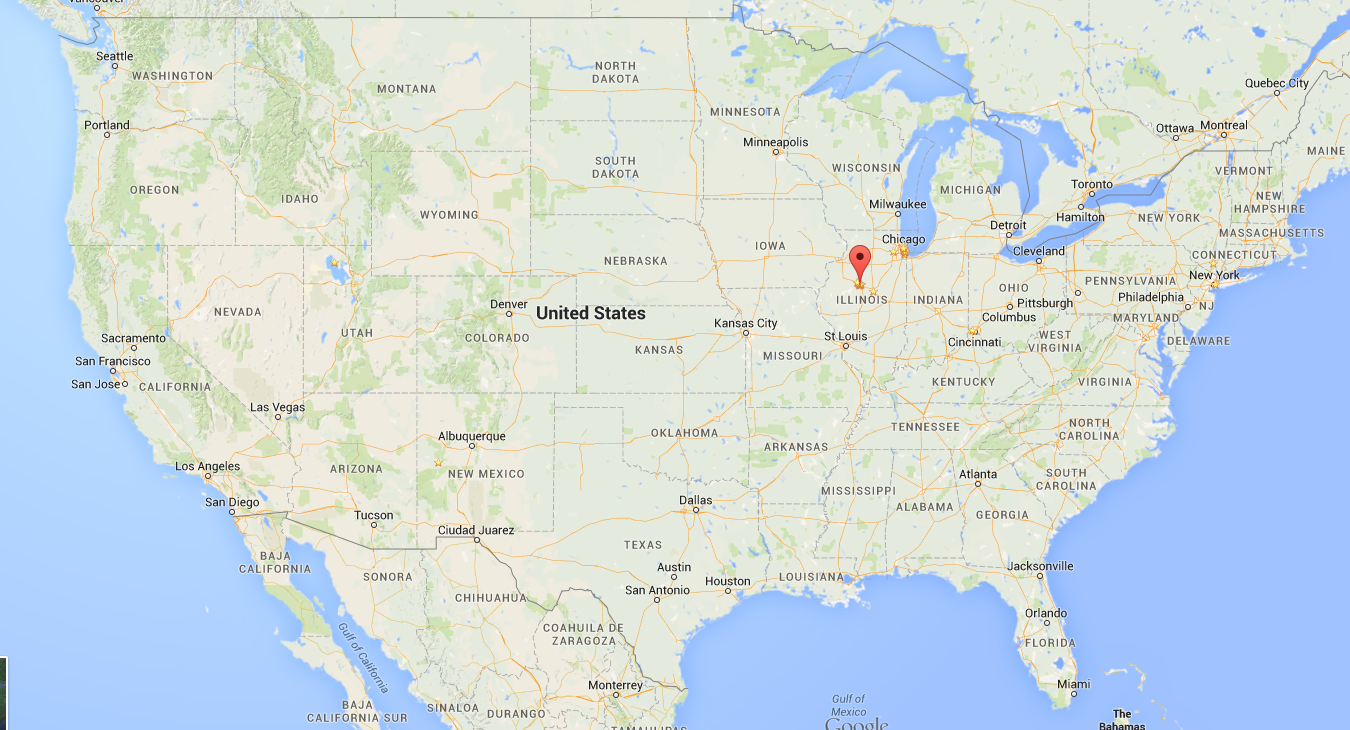
Wondering where Peoria is? It’s here, in Central Illinois:
Feel like you’ve heard the name “Peoria” before?
Historically, Peoria provided the testing ground for vaudeville shows before they opened in New York. Thus the phrase, “Will it play in Peoria?”
And just for fun, see the clip on David Letterman here (see minute 4:15):
And – for those of you old enough to remember the Smothers Brothers – another song here:
You too could be in Peoria!
Job Opening – Peoria PlayHouse Children’s Museum
Operations Manager
POSITION: Full-Time
REQUIREMENTS:
Four-year college degree preferred. Extensive experience may substitute for all or part of the educational preference.
A minimum of three years working in a customer-service environment. Management experience preferred. Experience in hospitality, attractions, or cultural organizations preferred.
Knowledge of facility operations, including scheduling, programming and basic supervisory practices.
Ability to train, supervise and evaluate employees and volunteers. Ability to lead and collaborate with a diverse team. Ability to foster a positive work environment for this team.
Excellent communication and organizational skills.
Excellent customer service skills, including the ability to identify and resolve problems. Ability to work with both adults and children.
Familiarity with computers as needed for office work; proficient in Microsoft Office.
Interest in children and families and in museums. Ongoing commitment to learning and innovating.
DUTIES:
With the Museum Director, develop operations procedures and customer service strategies for the PlayHouse, including opening and closing procedures, ticket-selling and retail store procedures, scheduling policies and procedures, and attendance-tracking.
Test and refine systems as needed.
Hiring, training, scheduling and supervision of admissions, retail, and floor staff and volunteers.
Day-to-day management of the daily operations of the PlayHouse, ensuring professional operation and appearance of the site during all public hours and events.
Maintain exceptional standards of customer service. Handle visitor concerns, comments, and complaints as needed, and communicate visitor concerns and comments to Museum Director.
Prepare schedules and conduct briefings with floor staff to keep them informed.
Follow all safety procedures that pertain to the duties performed.
Constantly evaluate, reflect on, and improve on operations procedures.
Manage special events and birthday parties.
Coordinate with custodial and maintenance services and personnel to ensure that museum is clean and safe and any issues are addressed promptly.
Coordinate with Education Manager and other staff to ensure a seamless visitor experience.
Perform all other duties as assigned.
OTHER:
Under the supervision of the Director of Peoria PlayHouse Children’s Museum.
Salary range: $35,000 – $42,000 per year.
How to Apply: Applications are available at the Park District Administration Office or can be downloaded/printed from www.peoriaparks.org under “Join Our Team”. Applicants may submit a resume’, but to be fully considered for this position an application must be completed. Applications will be reviewed until position is filled.
To ensure full consideration, applications/resume should be forwarded in a timely manner to: PEORIA PARK DISTRICT – Human Resources Manager, 1125 West Lake Ave, Peoria, IL 61614 or fax to: (309) 686-3352.
PEORIA PARK DISTRICT
Human Resources Manager
1125 West Lake Ave
Peoria, Illinois 61614
The Peoria Park District hires without regard to race, religion, sex, age, national origin, ancestry, sexual orientation, marital status, unfavorable discharge from military service, or disability to perform the tasks of the job. All qualified individuals are encouraged to apply. AN EQUAL OPPORTUNITY EMPLOYER.
A few people have responded to my recent post Goals for Students to suggest that history museums are likely to focus on content rather than more general skills and understandings (see Anne Dealy’s comment on Goals for Students; others have responded privately). The implication is that school visitors to history museums expect are more likely to expect to leave having learned factual content, as compared to visitors at other types of museums. This may be true. But is it a realistic goal for a single visit? This post continues the discussion about school visit goals by looking more closely at the experience of visitors in the history museum context, and the realities of teaching content.
History museums fall into at least two categories: the historic house, and the exhibition which constitutes a collection of objects. The Lower East Side Tenement Museum is an example of the “historic house” model. Visitors to the Tenement Museum are led through the museum’s primary artifact, 97 Orchard Street. Within this historic building a number of apartments have been reconstructed to look the way they might have 100 years ago (plus or minus 20 years), in order to tell the stories of the families who lived there. The experience – like that at many historic houses – is immersive, by which I mean visitors physically enter another time period. This immersion helps visitors understand what it might have been like to live in that time and place.
The impact of the Tenement Museum is not to teach the big-picture history so often taught in schools – the dates of wars or economic crises, the names of Presidents or Governors – but to offer visitors a glimpse into daily life in the past. And, ultimately, the goal (or at least, a goal) is for visitors to understand how prejudice, government policies, and economics impact newcomers to this country, both past and present.
I would argue that visitors to the Tenement Museum are not learning a great deal of factual content. Rather, they are gaining an understanding that is as much about feeling as it is about fact. I would also argue that the immersive, sensory nature of tours at the Tenement Museum and similar museums makes them essential for any student group learning about late nineteenth and early twentieth century immigration.
The kitchen of the Levine apartment at the Lower East Side Tenement Museum
In contrast, however, I would guess that this experience means little to a school group that is not studying immigration or turn-of-the-century American history, and that tours of historic spaces in general are productive in teaching history only when offered in the context of a larger body of knowledge. A few months ago I observed a second grade class touring life-sized replicas of the Nina and Pinta, two of Christopher Columbus’s ships, docked at the time In Peoria’s harbor. After the visit, I asked a number of students what they had learned. They thought the cannons were cool. Other than that, they had learned very little.
To a large extent, this lack of impact was the fault of the tour guides, who did not have a clear sense of what they wanted to teach, or training in age-appropriate pedagogical strategies. But, equally importantly, the students had little or no context in which to understand the history presented. How could they understand what it was like to live on a ship in the fifteenth century, when they didn’t know what it was like to live on land in the fifteenth century? How could they imagine the decisions Christopher Columbus had to make on board that ship without understanding anything about the history of exploration or the science of navigation?
The second type of history museum collects and curates objects into displays intended to illuminate historical moments. I grew up in Washington, DC, and visited the National Museum of American History with both classmates and my family. I remember the pendulum, the tattered American flag, a room filled with the dresses worn by First Ladies to their husbands’ Inaugurations, and cases filled with television and movie memorabilia: Archie Bunker’s chair, Dorothy’s ruby slippers.
My response, and I think that of many of my peers, was often, “Wow, that’s cool!” I could have watched the pendulum for hours, but I had (and still have) no idea how it relates to the history of the United States. I know the flag was old, but it did not contribute to my understanding of any historical moment or the development of American symbols. And I loved the film and television cases, because I recognized them, and it was amazing to see familiar and famous objects in real life. These responses are typical: often people go to museums for the “wow” factor, to see the real, original objects represented on television or in history books. As Daniel Willingham suggested in a recent interview, these visits serve to excite students, and to make them want to learn more.
In a recent post, Andrea Jones described “Fight for your Rights,” a tour at the Atlanta History Center about the Freedom Riders. This tour engages students in dramatic re-enactment; the intent is for participants to understand that there are multiple responses to a single question or situation, and begin to develop tools for answering these questions for themselves.
School visitors as Freedom Riders at the Atlanta History Center
I imagine that if a group arrives for this tour already knowledgeable about the Civil Rights movement they might learn information that they can connect with this prior knowledge, which will deepen their understanding: Who became a Freedom Rider, what the Freedom Riders were trying to achieve, what challenges they faced. For a group arriving with historical context, teaching content is a useful and appropriate goal.
Another group might not have not studied the Civil Rights movement before the tour. Students might leave this tour with questions about the Civil Rights movement. Perhaps the teacher helps guide them to appropriate books, or the Eyes on the Prize documentary series, or brings in classroom speakers with first-hand experience of the Civil Rights movement. In this case, the museum visit may not teach content directly, but will lead to content acquisition. An appropriate goal for this group is to spark curiosity and interest.
But often neither of these things happen. Perhaps a teacher feels she needs to dedicate classroom hours to preparing students for standardized tests, but books a museum visit as a break from the drudgery of this classroom work. Or the teacher spends social studies time studying the space race and the moon landing, and linking to the science curriculum, but visits the history museum because it is a grade-wide trip organized by another teacher. Or the teacher had planned to get to the Civil Rights era by April but they are still studying World War II, and never get past the 1950s in that year’s social studies class. Or a teacher has focused on the biography of Martin Luther King, not realizing that the tour would cover entirely different material. In these instances, a tour with the primary goal of teaching content is futile. For this group, the museum can offer the “wow” factor. And it can set goals apart (but possibly similar to) from the curriculum: Teaching skills related to those needed by historians, such as question posing and critical thinking. Teaching students to be independent museum goers. Engaging students in learning about themselves by considering what they would have done in a given situation, or thinking about what they are drawn to or curious about.
Content can only be taught effectively in partnership with classroom teachers. If museums want to teach content, than they – we – need to find better ways to partner with teachers, and ensure that the work of the classroom and the work of the tour are directly connected. We need to communicate regularly with teachers, either about the work they are doing in the classroom or by offering support for them in guiding their students’ experiences in the museum themselves. When a teacher who is not engaged in a deep partnership with the museum, or who we do not have the resources to communicate with weekly, books a tour, we should offer experiences that we know will have impact regardless of what is happening in the classroom.