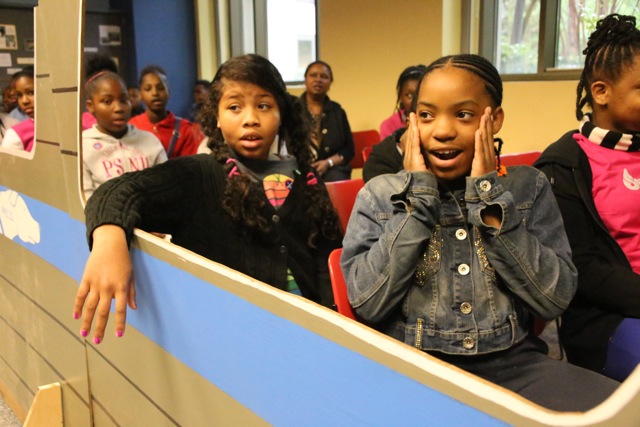
A few people have responded to my recent post Goals for Students to suggest that history museums are likely to focus on content rather than more general skills and understandings (see Anne Dealy’s comment on Goals for Students; others have responded privately). The implication is that school visitors to history museums expect are more likely to expect to leave having learned factual content, as compared to visitors at other types of museums. This may be true. But is it a realistic goal for a single visit? This post continues the discussion about school visit goals by looking more closely at the experience of visitors in the history museum context, and the realities of teaching content.
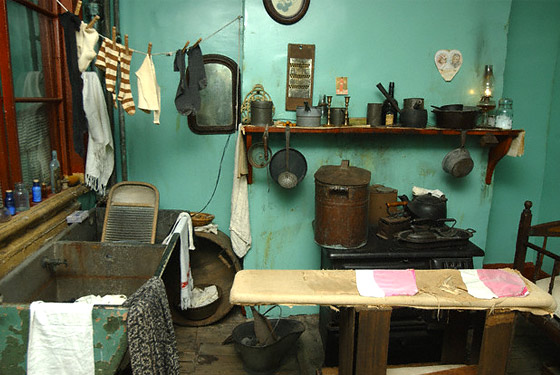
History museums fall into at least two categories: the historic house, and the exhibition which constitutes a collection of objects. The Lower East Side Tenement Museum is an example of the “historic house” model. Visitors to the Tenement Museum are led through the museum’s primary artifact, 97 Orchard Street. Within this historic building a number of apartments have been reconstructed to look the way they might have 100 years ago (plus or minus 20 years), in order to tell the stories of the families who lived there. The experience – like that at many historic houses – is immersive, by which I mean visitors physically enter another time period. This immersion helps visitors understand what it might have been like to live in that time and place.
The impact of the Tenement Museum is not to teach the big-picture history so often taught in schools – the dates of wars or economic crises, the names of Presidents or Governors – but to offer visitors a glimpse into daily life in the past. And, ultimately, the goal (or at least, a goal) is for visitors to understand how prejudice, government policies, and economics impact newcomers to this country, both past and present.
I would argue that visitors to the Tenement Museum are not learning a great deal of factual content. Rather, they are gaining an understanding that is as much about feeling as it is about fact. I would also argue that the immersive, sensory nature of tours at the Tenement Museum and similar museums makes them essential for any student group learning about late nineteenth and early twentieth century immigration.
In contrast, however, I would guess that this experience means little to a school group that is not studying immigration or turn-of-the-century American history, and that tours of historic spaces in general are productive in teaching history only when offered in the context of a larger body of knowledge. A few months ago I observed a second grade class touring life-sized replicas of the Nina and Pinta, two of Christopher Columbus’s ships, docked at the time In Peoria’s harbor. After the visit, I asked a number of students what they had learned. They thought the cannons were cool. Other than that, they had learned very little.
To a large extent, this lack of impact was the fault of the tour guides, who did not have a clear sense of what they wanted to teach, or training in age-appropriate pedagogical strategies. But, equally importantly, the students had little or no context in which to understand the history presented. How could they understand what it was like to live on a ship in the fifteenth century, when they didn’t know what it was like to live on land in the fifteenth century? How could they imagine the decisions Christopher Columbus had to make on board that ship without understanding anything about the history of exploration or the science of navigation?
The second type of history museum collects and curates objects into displays intended to illuminate historical moments. I grew up in Washington, DC, and visited the National Museum of American History with both classmates and my family. I remember the pendulum, the tattered American flag, a room filled with the dresses worn by First Ladies to their husbands’ Inaugurations, and cases filled with television and movie memorabilia: Archie Bunker’s chair, Dorothy’s ruby slippers.
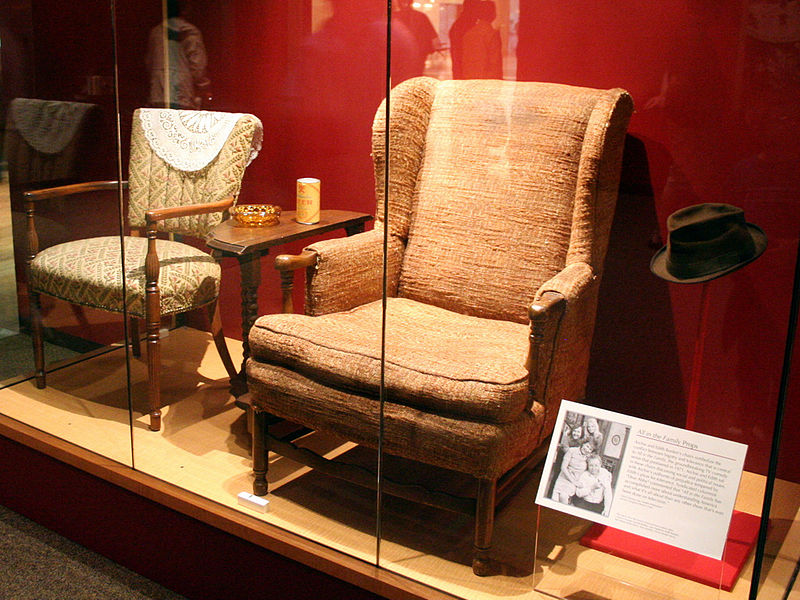
My response, and I think that of many of my peers, was often, “Wow, that’s cool!” I could have watched the pendulum for hours, but I had (and still have) no idea how it relates to the history of the United States. I know the flag was old, but it did not contribute to my understanding of any historical moment or the development of American symbols. And I loved the film and television cases, because I recognized them, and it was amazing to see familiar and famous objects in real life. These responses are typical: often people go to museums for the “wow” factor, to see the real, original objects represented on television or in history books. As Daniel Willingham suggested in a recent interview, these visits serve to excite students, and to make them want to learn more.
In a recent post, Andrea Jones described “Fight for your Rights,” a tour at the Atlanta History Center about the Freedom Riders. This tour engages students in dramatic re-enactment; the intent is for participants to understand that there are multiple responses to a single question or situation, and begin to develop tools for answering these questions for themselves.
I imagine that if a group arrives for this tour already knowledgeable about the Civil Rights movement they might learn information that they can connect with this prior knowledge, which will deepen their understanding: Who became a Freedom Rider, what the Freedom Riders were trying to achieve, what challenges they faced. For a group arriving with historical context, teaching content is a useful and appropriate goal.
Another group might not have not studied the Civil Rights movement before the tour. Students might leave this tour with questions about the Civil Rights movement. Perhaps the teacher helps guide them to appropriate books, or the Eyes on the Prize documentary series, or brings in classroom speakers with first-hand experience of the Civil Rights movement. In this case, the museum visit may not teach content directly, but will lead to content acquisition. An appropriate goal for this group is to spark curiosity and interest.
But often neither of these things happen. Perhaps a teacher feels she needs to dedicate classroom hours to preparing students for standardized tests, but books a museum visit as a break from the drudgery of this classroom work. Or the teacher spends social studies time studying the space race and the moon landing, and linking to the science curriculum, but visits the history museum because it is a grade-wide trip organized by another teacher. Or the teacher had planned to get to the Civil Rights era by April but they are still studying World War II, and never get past the 1950s in that year’s social studies class. Or a teacher has focused on the biography of Martin Luther King, not realizing that the tour would cover entirely different material. In these instances, a tour with the primary goal of teaching content is futile. For this group, the museum can offer the “wow” factor. And it can set goals apart (but possibly similar to) from the curriculum: Teaching skills related to those needed by historians, such as question posing and critical thinking. Teaching students to be independent museum goers. Engaging students in learning about themselves by considering what they would have done in a given situation, or thinking about what they are drawn to or curious about.
Content can only be taught effectively in partnership with classroom teachers. If museums want to teach content, than they – we – need to find better ways to partner with teachers, and ensure that the work of the classroom and the work of the tour are directly connected. We need to communicate regularly with teachers, either about the work they are doing in the classroom or by offering support for them in guiding their students’ experiences in the museum themselves. When a teacher who is not engaged in a deep partnership with the museum, or who we do not have the resources to communicate with weekly, books a tour, we should offer experiences that we know will have impact regardless of what is happening in the classroom.
















 Museum Questions