This post is re-blogged from The Teacher In The Museum, which “is written to help museum educators better understand how to design learning experiences for the 21st Century student.” The author of the post is Steve Gillis, President & Chief Learning Officer at Net Learning Solutions Inc. and a Social Studies teacher who “helps to bring the spirit of museums into the classroom using online technologies”. Steve can be reached at: netlearningsolution-at-gmail.com for further information.
I’d love to take my students on a field trip to a museum, but…
It is too expensive. I teach 120 grade 7 students. To take all of them to a museum it would cost $1800. That’s $1200 for four school buses and $600 for museum fees ($5 per student is cheap, some museums charge more). I am not allowed to ask students to pay for such field trips; the money has to come out of my school’s enrichment budget (and I’m not the only teacher wanting to access these funds).
It’s a hassle finding chaperones. For such a large group of students, I’ll need at least 10 adults to join us. Not every parent can take time off of work to help out with field trips. If I don’t have the required number of adults to chaperone, the trip is cancelled.
It’s too far. I’d love to take my students to Rocky Mountain House National Historic Site, but it’s a 2 1/2 hour drive one way from my school. I can’t justify a field trip in which travel time is greater than the time that we would spend at that site.
Paperwork. Imagine the paperwork if a student gets injured!
It isn’t educational. Some museums just don’t know how to cater to school audiences. Their programs don’t engage the students. Teachers and students walk away from such experiences feeling as if their time was wasted.
These are but a few of the issues that keep schools from participating in field trips.
I love museums, because:
There are interesting people that work in museums. I always meet interesting museum professionals that I wish that I could clone so that they could make history come alive in my classroom. You have to admit, that an engaging interpreter does make the story come to life.
Museums have cool stuff! I’m like a kid in a toy store, when I’m in a museum. I often see things that help me to better understand the topic at hand. It’s a shame that I can’t bring those artifacts into my classroom ( I know that some museums offer ‘museum in the box’ programs, but that’s not the same as visiting the museum).
Museums make learning fun! You might not think that you’re learning as you walk through the museum, but you are – it’s a different kind of learning than classroom learning.Sometimes students need to get out of the classroom to learn!
Bringing The Museum To The Classroom
If I can’t take my students on field trips, how can the museum come to the classroom?
I could invite someone from the museum to come to speak to my students. The problem with this is that it can become a scheduling issue. Teachers that teach other subjects don’t take too kindly to their class time being taken away from them, because the Social Studies teacher has arranged a museum presentation.
I could reserve a ‘museum box’. I have always been leery of doing this, because you know and I know that students (and some teachers) are not always gentle with the items in the box. Things can be damaged or go missing – I don’t want to take a chance!
Technology is a game changer – it can bring the museum into the classroom. A well designed online lesson (or series of lessons) has the potential to capture the ‘spirit’ of the museum and engage students at the same time.
Online technologies allow the teacher and the student to access the museum from anywhere and at anytime. What does that mean to museums? In theory, a museum’s educational program can be accessed from anywhere in the world, as long as the museum and the school are connected to the internet. Imagine the possibilities:
Reaching out to a much larger audience. Field trips limit the number of people that you can reach. Most schools won’t allow their schools to travel more than 1 – 2 hours away for a field trip. How many schools in your area are not accessing your educational programs, because of distance? Imagine offering your programs to schools that don’t have the opportunity to come to your museum. Imagine reaching out to schools throughout your province or state; imagine reaching out to schools across the nation or even around the world. Imagine…
Increased revenue. Some museums charge a fee for their online educational programs. Schools are willing to pay for access to such programs. Let me give you an example: My principal and I were discussing the cost of a field trips. It costs $300/ day to rent a school bus, then add the cost of admission to the museum – it can get expensive. I brought up the issue of paying for access to online educational programs at museums. Her response was that even though a visit to a museum can be a valuable educational experience, that museums have to understand that schools can’t always come to them. She would be willing to pay a fee for the students to access the museum’s educational program online. Let’s assume that student admission is $5 (whether the student is attending the museum in person or online). The cost of online access is far cheaper than participating in a field trip ($1800 in my example at the beginning of this article, as opposed to $600 – 120 students at $5/each). How many schools could access the online material in day? Think about it!
Increased interest. An interesting thing happens when students access museums online, especially when they find the site interesting and engaging – they tell their parents about it, which often leads to a family visit to the museum. Don’t take my word for it, check out the literature to confirm my suspicions.
I hope that I have piqued your interest.My plan is to continue this discussion with a series of articles that will look at how to use technology to reach to schools, what makes an engaging online lesson, and how to market your museum’s educational programs. I encourage you to subscribe by filling out the subscription box in the right hand corner. Please feel free to pass this article to your friends and colleagues.
This is the second guest post in the Schools and Museum series on Museum Questions. It is from Elisabeth Nevins, a museum education consultant located in New England. Elisabeth’s firm, Seed Education Consulting, develops educational programming and content for museums and historic sites, and, in her own words, “is driven by the possibilities of exploring the past as a means for understanding the present and shaping the future.”
As with an earlier guest post, I have added a few of my own thoughts at the end of the post, in italics.
Elisabeth Nevins
Board members love fieldtrips: smiling school children scampering around their museum or historic site learning about the past. Because, you know, a fieldtrip program—how hard can that be?
Hard.
As a consultant who works with historic sites and small museums, I find that these institutions rarely have the resources needed to offer high-quality education programs for school-age audiences. Most of my projects begin with significant capacity building before we can progress to program development.
Sustainable programs require four types of resources: financial, facilities, collections, and staff. Finances are always tight, but grant funding is often available. Facilities pose challenges, but through creative problem solving we can find the space for larger groups. Collections are rarely a problem—there is always lots of good stuff, although it’s much easier to create programs if these collections are catalogued, or at least organized. Staff, however, is the most chronically undervalued and commonly lacking asset at small museums and historic sites.
Yes, Rebecca Herz, we do need museum educators. Museum education programs should be created by trained professionals, experts versed in informal learning pedagogy, current curriculum standards, and effective practices. However, many small museums are lucky to have a paid director or administrator, let alone an educator.
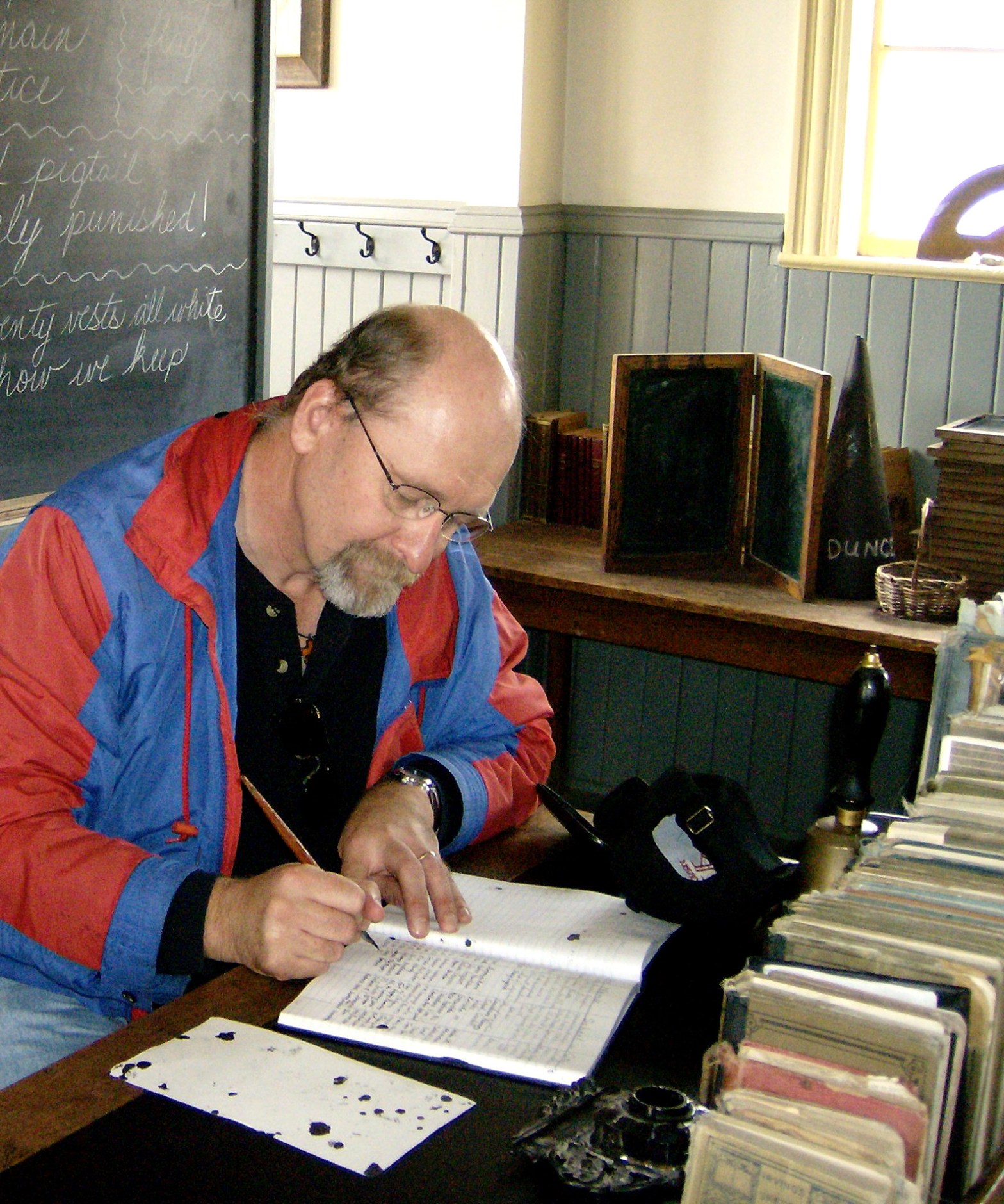
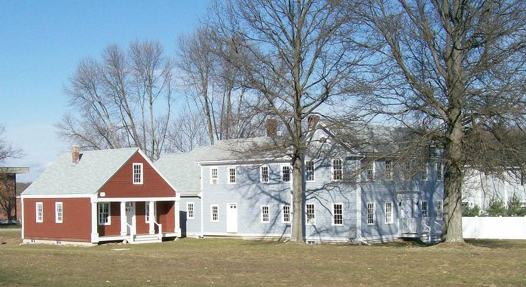
There are options when trained staff is not available. Museums can partner with classroom teachers, another kind of education expert, to create programs. For example, the Needham Massachusetts Historical Society opens their one room schoolhouse to local teachers and their students. The teachers develop and lead the lessons with support from historical society materials and staff.
Needham Massachusetts Historical Society
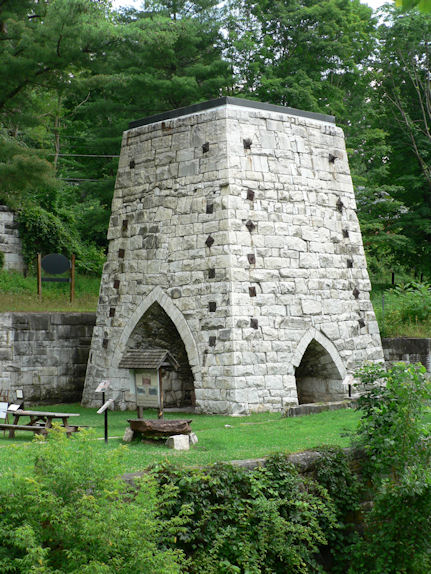
Recently, the Beckley Furnace Industrial Heritage Site in East Canaan, Connecticut approached me about planning a curriculum and fieldtrip program.¹ Beckley’s financial, facilities, and collections resources are typical of a small historic site. And, like many similarly sized institutions, Beckley doesn’t have a staff. Friends of Beckley Furnace, a robust, volunteer-run nonprofit, maintains the historic site.
The group was already providing informal tours and programming for school children and scout groups and hoped to build on these relationships to generate greater awareness of the site in the community. This goal is worthy and, if created thoughtfully, school programs can give local history organizations a solid foothold in the community from which they can further demonstrate their relevance and value.
Beckley Furnace Industrial Heritage Site
After meeting with project stakeholders, I recommended that rather than offer a “packaged” curriculum and tour, Beckley should create a Local Heritage Learning Lab to collaborate with local teachers in developing individualized educational experiences for their classrooms. Beckley has the historical assets, but the teachers know their students’ needs—which vary from student to student, classroom to classroom, grade to grade, and, with ever-evolving standards and assessments, from year to year.
At the heart of the Local Heritage Learning Lab is a professional development series for teachers. This will not be your standard teacher professional development offering. From the Federal agency level on down, history and social studies teacher workshops tend to follow the same format: a week of unrelenting content immersion with no time to process new ideas and very little focus on classroom transfer. This type of professional development is like speed dating. Teachers engage in quick, superficial “getting to know you” interactions. Then the bell rings and participants move on to the next topic.
Local Heritage Learning Lab will be as much about relationship building as it is about content— professional development like a slow, smooth wooing with a Barry White soundtrack. It will explore a central question: What can we learn about our community in exploring this place? While it will begin with a weeklong immersion in historical literacy skills development using Beckley’s resources, it will also include regular coaching and peer feedback sessions throughout the fall and winter. And it will culminate in teachers bringing their students to Beckley to implement their lesson.
Rather than invest Beckley’s limited resources in creating an education program that might be obsolete in a year, Local Heritage Learning Lab will provide teachers with the materials and the tools necessary to build their own programs—programs they can evolve with students’ needs. And by sharing authority with teachers, Beckley will create advocates, build awareness of their site and collection, and demonstrate their value in the community.
Teacher advisors from the regional school district have enthusiastically endorsed the plan and Beckley is seeking funding to pilot the Local Heritage Learning Lab in 2015. Hopefully this pilot run will represent Beckley’s first step in building a lasting and mutually beneficial relationship with the students, teachers, and school administrators in their local community.
N.B. Slides and a resource assessment worksheet from my 2011 NEMA sessionSchool Programs for Smaller Historic Sites: Just Because You Can, Doesn’t Mean You Should can be found here: slides | worksheet 1 | worksheet 2
This post evolved out of a conversation in which Elisabeth and I debated pre-packaged tours vs. teacher-driven experiences. I hope that this post will inspire museum educators to think more about how we might empower classroom teachers to plan their own visits to museums. Elisabeth’s post suggests a few things that must be in place first:
A clear guiding idea or question that is meaningful for teachers and students. For Beckley Furnace, the question is “What can we learn about our community in exploring this place?”
What Elisabeth terms “shared authority;” trust in teachers to take visits seriously and thoughtfully; and the belief that they can guide themselves and each other – note the “peer feedback” built into the Beckley project.
Resources dedicated to this work – paid educators to guide professional development; money and time for teachers to conduct this work; resources to support return visits for students.
All of this leads me to wonder: What if museums did not allow teachers to delegate responsibility for their students’ field trip experiences to the museums they visit? And what if such a decision were supported by significant resources invested in helping teachers develop the tools and knowledge to create deep and meaningful experiences for students in museums? Would the loss of many school groups (classes taught by teachers too overwhelmed, or without the confidence, knowledge, or interest needed to be active participants in field trip design) be worth the potential gain in the depth for the students who did visit? And in what ways other ways might museums consider shifting resource allotment to emphasize depth over numbers, quality over quantity?
This post, by Gretchen Jennings, is reblogged from Museum Commons. Thanks to Gretchen for allowing me to share this.
Gretchen Jennings, author of the blog Museum Commons
The museum blogosphere in the past few weeks has been filled with postings related to the work of museum educators and the role of museums as educational institutions. Rebecca Herz has posted a number of articles and interviews with teachers and museum educators on her blog Museum Questions. Rebecca is examining from many angles the complicated connections between museums and formal education, as well as museums’ roles as informal environments for learning. UK museum blogger Nicole Deufel recently asked whether museum interpreters should be accredited teachers, as some of her colleagues maintain. Nicole defends the unique role of museum educators in introducing visiting students to experiences other than those provided by formal education environments and methods. And Washington Post critic Philip Kennicott raised lots of hackles in the museum field when he opined about how people should experience exhibitions and works of art, at the same time dismissing the work of museum educators. Kennicott’s ideas and the subsequent responses are ably described and analysed by Ed Rodley in two recent posts on Thinking About Museums.
I believe that all of this discussion is important and useful. The work of museum educators is often forgotten or devalued (witness the Kennicott column) despite the fact that the central purpose of museums as educational institutions has gained importance in both museum literature (see ICOM and AAM definitions of and documentation on role of museums) and in the mind of the general public. The above posts explore so many aspects of what is essentially a discussion of the museum experience–and educators’ contribution to it–that it is hard to know where to begin to comment. But I do see a couple of threads I would like to tease out.
One common theme is the continuing view of museums as places of teaching–whether it be of thinking skills or of museum content–and the accompanying use of classroom techniques by docents, museum teachers, or outside consultants. These approaches run the gamut, from traditional methods such as the use of museum classroom-like spaces and guided tours linked to specific curriculum goals, to more open ended techniques, such as Socratic questioning or group activities in the galleries. The discourse and mental models of formal education predominate. (See Herz’s interviews with Bown, Bowles, and Everett and Deufel’s post.)
Another thread is the view of museums as places of engaged experience, where learning occurs because spaces and exhibits have been designed to encourage it, and interpretive staff are there to encourage and facilitate. The focus is on providing students with experiences and ways of interacting with museum content that don’t happen in the classroom. (See Herz’s interview with Garcia and Deufel’s post again.)
Visitors are challenged to create whirligigs in the Invention at Play exhibition developed by the Lemelson Center at the Smithsonian’s National Museum of American History and the Science Museum of Minnesota. Museum educators were involved in all aspects of development, working with exhibit developers, designers, inventors, and historians. Educators also developed teacher and family materials and programs. Photo courtesy of NMAH.
While I spent much of my career as a museum educator happily operating within the first paradigm (so I know why museums operate this way and how it important it is to their financial sustainability) I have come gradually to the conclusion that this model has its limitations. The role of museum educators is being expanded in many museums, and this needs to continue throughout our field.
Museums are so much more than resources for the formal educational system. Yet they often justify themselves almost exclusively, especially to politicians who control funding, in terms of their contributions to STEM and STEAM success. There is no doubt that exhibitions and museum programs provide all kinds of enrichment to students, but as school visitation to museums continues to diminish around the country, and as students continue to graduate and succeed even without museum visits, defending museums as essential to school learning seems short-sighted. As the school system narrows what it considers to be success (eliminating art, drama, music, field trips, etc) museums should ponder the wisdom of squeezing themselves into ever smaller curricular slots in order to attract and serve school groups.
The tours, manuals, workshops, and other resources and approaches developed by museum educators over the years have enhanced and enriched many a museum visit. I am not advocating an end to these practices, which are both valuable to visitors and rewarding to the the educators who create them. However, following the warning against keeping all your eggs in one basket, I believe it is important for museum education departments to budget an increasing amount of time and energy to shaping directly the creation of that which remains central to the museum experience: exhibitions. Educators already have many of the skills that exhibition teams require especially as they develop more participatory experiences. Here are just a few:
– understanding of human development, stages of learning
– understanding of accessibility guidelines
– experience in working on the floor with visitors; thus able to assist with testing and prototyping exhibits and text with visitors at various stages.
All of these skills and abilities of museum educators can be made available to museum exhibition creation through the development of an interpretive plan, about which I’ve written in earlier posts.
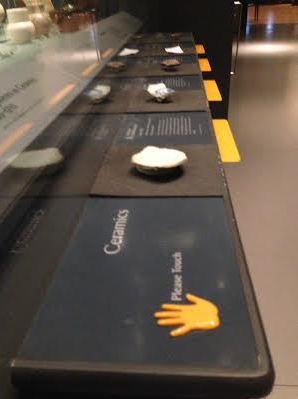
The British Galleries at the V&A in London were developed using a comprehensive interpretive plan on which curators, designers, and educators collaborated. Educators led the development of the plan. Here visitors are encouraged to touch examples of ceramics displayed in case above. Photo by Colleen Dilenschneider.
Tying the role of a museum too closely to its work with schools may narrow the public understanding of museums as educational institutions at their very core, not just in their contribution to formal education. When museum educators’ roles are limited to gallery teaching or to development of school programs and materials, this divorces them from involvement in the direct creation of the exhibition experience. From my experience in working in museums, positions most closely identified with the exhibition enterprise often take their power and prestige in the organizational hierarchy from this proximity.
It’s my view that the “something different” that museum educators should consider is less about fine tuning programs for schools and teachers and more about exploring with their administration and staff the very important contributions they can make to helping the museum to create exhibitions that are visitor-friendly and engaging for the multi-generational groups that are the staple of museum visitation. Thanks again to Rebecca for posing the questions that got this discussion going.
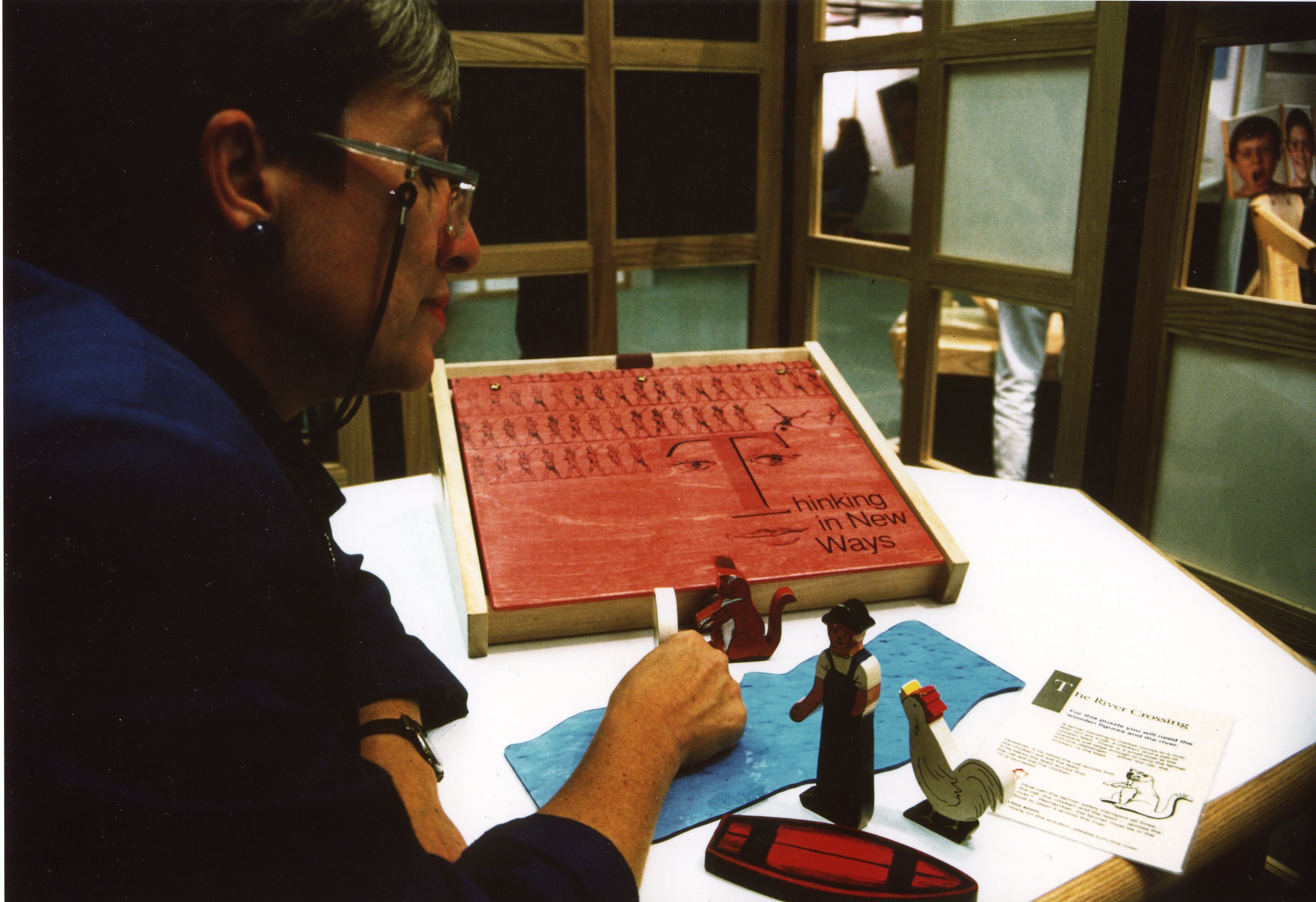
One of 10 Discovery Boxes developed by museum educators in collaboration with Ontario Science Centre exhibit developers and cognitive researchers for the Psychology Exhibition in the 1990s. Photo courtesy of APA.
Brian Smith blogs for Scholastic; you can read his posts here. Brian also teaches in the education department at Lenoir-Rhyne University in Hickory, North Carolina. He serves as Vice President of the North Carolina branch of the International Dyslexia Association, treasurer for the Catawba Valley Chapter of the Autism Society of North Carolina, and serves as a board member for the Patrick Beaver Learning Resource Center.
Why should schools visit museums?
Museums are a great place to cover a lot of the standards that schools need to meet, especially in science and social studies. These are the areas where hands-on experiences really help students to understand, and it’s hard for a classroom to provide this hands on. So if you can find an exhibit that correlates with your curriculum, then that’s when you say that this is a museum I’m going to take my kids to.
There is one museum that we go to, in Rutherfordton, North Carolina, called Kid Senses. Kids can pretend to be a dentist, a cashier, work in a restaurant… There’s a cool bubble room – kids stand in the middle of a ring and pull the bubble up around them. When I taught kindergarten in my previous school we would go there as a culminating activity for a unit on senses. I shared this museum with teachers in Newton-Conover at the beginning of this year. I told them that it’s a great trip, very hands on – so we’re going to go.
I told my new school, when you call they are going to push an educational class, but it’s not worth the time away from the exhibition, which is hands-on and great. When the educator comes you end up in a small classroom; it’s not hands on, and we want hands on experiences and as much time as possible for exploration.
The cost is $3-4 per child. They only charge $1 per parent, which is great because we always need more adult chaperones. Parents don’t want to pay $4 each to go (plus the gas to drive an hour away) . Kid Senses makes it cheap for parents — $1 for a great day with your kid.
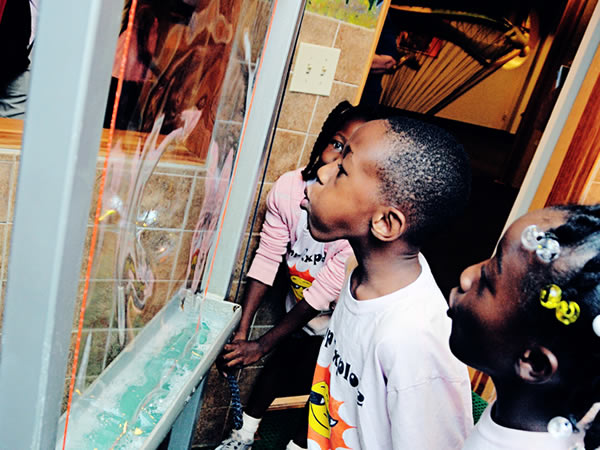
Kids exploring Bubble-Ology exhibition at Kid Senses.
You mention history and science museums. Would you ever take your students to an art museum?
Art is a little harder to justify to a Board of Education, because they are looking at how field trips connect to the standards that we are responsible for teaching. Also, we need to be very careful about what we are asking parents to spend money on.
If I could, I would be on field trips constantly. In our area, we have a high unemployment rate right now, and different schools have different rules for field trips. Some can only ask parents for $25 per year, or sometimes schools say we can only go on two field trips per year. So it’s very hard to work art museums in there. In my ideal world I would go on at least one field trip per month. Especially for kindergarten. I would go to an art museum and teach shapes, and colors and lines – that would be an ideal field trip for a beginning-of-kindergarten field trip.
Personally, my family has had a membership to the Hickory Art Museum, so I have seen how taking my daughter has enhanced her learning.
Is money the biggest barrier to taking field trips?
The cost of a field trip is not the admission cost of the museum, but the cost of transportation. You can get into a museum for $1 or $2, or even for free. But then you need to get students there, and then you’re charging – well, it depends on the distance, because we have to pay for the gas. Travel costs end up being $5 or more per person. Then suddenly it’s an $8 trip, which is a big chunk of the $25 you can ask parents for.
Alignment with what you’re teaching in the classroom is another barrier. Most states have adopted common core at this point, for math and reading; each state then has science and social studies curriculum. This is what we have to teach and show mastery of by the end of the year.There are 180 days in our school year. When you look at all the standards – computer / technology, math, science, etc – the teacher is responsible for all of them.
Most schools have an art teacher – so many classroom teachers don’t even look at the art standards, because the art teacher is covering that. Specialty teachers (such as art teachers) don’t go on field trips, because they can’t be gone for the full day — the other grade levels would miss their class.
Often, museum educators talk about how tours can teach thinking skills – for example, careful observation, inference, evidentiary reasoning. Claire Bown just wrote about teaching thinking skills for this blog. Does the idea that museums might teach thinking skills (rather than content) make field trips more or less compelling?
Any time you can work in those 21st century skills, it’s helpful. One of the skills that can be difficult to teach is imagination. Art museums could really teach this, but it’s going to take a great deal of marketing to share this with teachers. Many teachers, when thinking about 21st century skills, think technology, which feels like the polar opposite of art. How is looking at a work of art a 21st century skill?
But the skills you are describing – observation, inference – are really important. So many times the 21st century skills are viewed as technology skills rather than problem solving skills. So if you say you will hit those skills, you make it a richer experience for the kids. The teachers can then justify it.
In all honesty, so many teachers are just focused on that test. If art museums are wanting to be more relevant, than they have to say, we can ask these deeper questions of these kids that make them think, and make them look at the surroundings. Compare work by two artists and describe the stories they tell – this is a great introduction to one of the kindergarten standards for literature (Common Core standard RI.K.7). With the right guiding questions, the art museum would be a great place to learn the Speaking and Listening objectives for many grade levels.
Teachers tell me that a museum trip costs them a day in the classroom? When is a museum trip worthwhile? For example, what would make it worthwhile for you to take students to the Hickory Museum of Art’s tour about folk art and families?
After a field trip, we have to be able to say, this hour was well spent, it was worth the 40 minutes each way on the bus, worth the logistics and paperwork. There’s a lot that goes into a field trip: first notice doesn’t make it home, need to send home a second notice. Have to apply for funding for kids who can’t afford the trip. Lining up the buses, making sure kids have name tags, remembering the cooler for the lunches, getting all the medications ready and organized. Taking kids on a field trip is like herding squirrels. Will this field trip justify my time and effort? If I’m going to miss working with them for the day, it needs to connect on a bunch of levels. I can sit and talk to students at school. If I can do it in my classroom, why would I go through all these logistics?
I want to be able to send home a letter to parents saying, “You would never believe what your kid learned today. Your kid saw these pictures and we talked about families and how families have changed through the centuries through art… This artist did this, which we compared to this artist which did that…” That kind of art lesson would be hard for me to teach, not having that art background. Also, keep it structured, don’t let my kids get wild, make good use of my students’ time. If there’s not a good use of time, we won’t go back.
Anytime you change the environment it makes learning stick. I could hang new posters out every week, and change books out, but if we can get on the bus, that is something special.
I like guiding questions — questions that help them look at that picture and think deeply. For example, here’s this paper, with a list of the paintings. Find a picture of a family that you think would have to work in the fields; find a family that you think would live in a city; find a family that reminds you of your family. This relates to the kindergarten standards. When the kids gather back with the museum educator they have to justify the paintings they picked.
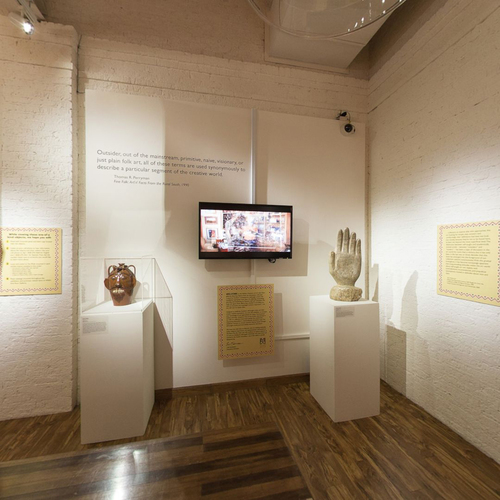
Discover Folk Art exhibition at the Hickory Museum of Art
How do you identify field trips that connect to the curriculum?
A lot of teachers love a good worksheet that has the standards right on it.
If I’m going to a science museum and I know that they have a huge display about wood and uses of wood, that directly relates to one of the kindergarten standards – understanding characteristics of wood, clay, etc. So I know how to make that connection. Art museums take more out of the box thinking. If people who know art and people who know education could sit down and collaborate… the museum could say, “this is what we have,” and the teacher could say, “This is perfect for X.” It’s a different way of collaborating – let teachers make the connections.
Here are some of the challenges to that from the museum’s end. First, museums have education departments staffed with educators, often former teachers. So we need to recognize the expertise teachers bring: they know the standards intimately, they understand how exhibitions can fit directly with the curriculum. Second, museums are often working on a short timeline. By the time the education department has details about the exhibition, it might be opening in three or four months.
If a museum educator knows in October what they will have from February through May, then the next week pull in different teachers for meetings. Look at this, how can we fit this in to the curriculum? Then teachers can work on it.
The museum should provide things to do before the visit, and then tell us exactly how it aligns, and give us materials to take back to the classroom.
Museums often have these activities for teachers to do in the classroom. How do they get the word out?
Some teachers are on email. But teachers get inundated daily with emails about products and services. I get about 45 messages per day, and about half are advertising products or staff development opportunities. It’s easy for emails to get lost. I know snail mail is old fashioned, but it is something I can take to my next grade level planning meeting and share. So much of planning still happens with teachers sitting and talking. “Did you realize that you can cover these standards at the art museum?” I know that costs money, but that’s what gets attention.
What type of lesson plans do you find most useful?
I prefer blog post with ideas instead of a specific step by step lesson. Give me the ideas and I can run with that. But that’s my creative side – it depends on the teacher you have. I will still need to modify any lesson; give me an idea and I can make it fit in my day.
I have been interviewing museum educators, who have articulated why, for them, kids should visit museums. I’d love your thoughts on these two ideas.
One educator, David, proposed that museum should help kids be aware of the world around them. It should help them understand where things come from. The second educator, Ben, said that school and home are sometimes spaces where kids have to be a certain type of person. Museums are a third space, where kids can access another part of themselves.
Neither of these relate to the curriculum. What are your thoughts on these goals?
In response to David: In an ideal world, that sounds great. But teachers are under so much pressure, that unless it connects to the curriculum, it’s hard for us to say that’s worth our time, even though we as an educator may totally agree. And the parents are also so concerned about their kids passing those tests. So that idea is pie in the sky.
In response to Ben: it’s a great point. But that will only appeal to a certain group of teachers. Last year my kids had a 90 point difference in IQs – a wide range of kids in one classroom. I tell parents, I don’t want your kid in a box. But a lot of people do want their kids in a box. I want my kids to say, “I totally felt at home in a museum, that was so much fun, Mom and Dad, I want to take you to the museum to show you this and this and this.” Even if it’s only one or two kids who say that. But as a teacher, I still need to justify the trip for everyone. If you don’t come to an educator’s point of view, you’re not going to get educators to come to you.
My daughter, Ella, who is 10, considers herself an artist. We take her to art and science museums and many other cultural events because my wife and I recognize how much her life experiences enhance her education. Ella makes art with duct tape, with her rainbow loom, she loves to paint and draw. She went to a calligraphy camp this summer, even though she writing is far from her favorite subject, because it involved creating something beautiful. Those are great reasons to go to the museums. When Ella comes home from a museum she says, “I want to show you this and this and this.” But the way to get the teacher to get you there first is to connect to standards and 21st century skills.
Ben Garcia is Acting Deputy Director at The San Diego Museum of Man. In 2012 Ben published the article “What We Do Best: Making the Case for the Museum Learning in its Own Right,” which proposed that museums should be true to their collections rather than aligning with the school curriculum. This article provoked a great deal of debate – at least for myself and colleagues and teachers with whom I worked. I asked Ben if he would be interviewed for this blog series because I wanted to better understand what “museum learning in its own right” looked like.
What do you want school group visitors to get from a museum visit – what do you see as the primary intended outcome?
As a young person, your life is divided between school and home. For some kids school is where you get to be some version of yourself you can’t be in your home context; for others school is a difficult place. School can run the continuum from oasis to prison. Museums are a third space, a metaphysical and spiritual space, a world of the imagination, a world of the intellect, outside of that world that you encounter in your home context or in school. The theatrical director Peter Sellers described museums as wildernesses for the dark parts of your soul. It’s that spiritual place, a space where a student, feeling the millions of things that students feel, can bring all of that, and through some sort of interaction with the museum environment can process some piece of it.
There is something about these spaces important enough that we devote our professional lives to them. We serve students best by helping them see why we who work in museums fell in love with museums. When it comes down to it, I think the most valuable outcome of a school tour is student awareness of what can happen in a museum – how the museum can be a resource for them. For me that resides more in a personal matrix than an academic one. Being explicit about why we work in museums, why we think these places are cool, is something that puts us out on a limb in terms of the relationship between educator and student, but it is the kind of risk that is worth taking.
We need to make our institutions into environments where students truly feel welcome. They should leave feeling that they own this space, that they have as much right as anyone to be there, that the museum is a resource for them. Helping students fall in love with museums sounds like a self-serving goal, but it isn’t about sustainability – it’s about the highest value of museums.
This goal is inherently both personal and individual. School experiences are usually group experiences, and academic or intellectual. Would it be better to reach out to young people through families or communities, rather than schools?
On a practical level, schools are where you get a bunch of kids together. So through school visits you get 30 or 60 or 120 students who would not otherwise encounter the museum. In terms of identifying people for whom museums might be that third space, the school cohort is a useful one.
The question is, how useful are museums for schools? Is there an essential conflict between the goals of formal education and the goals of museums?
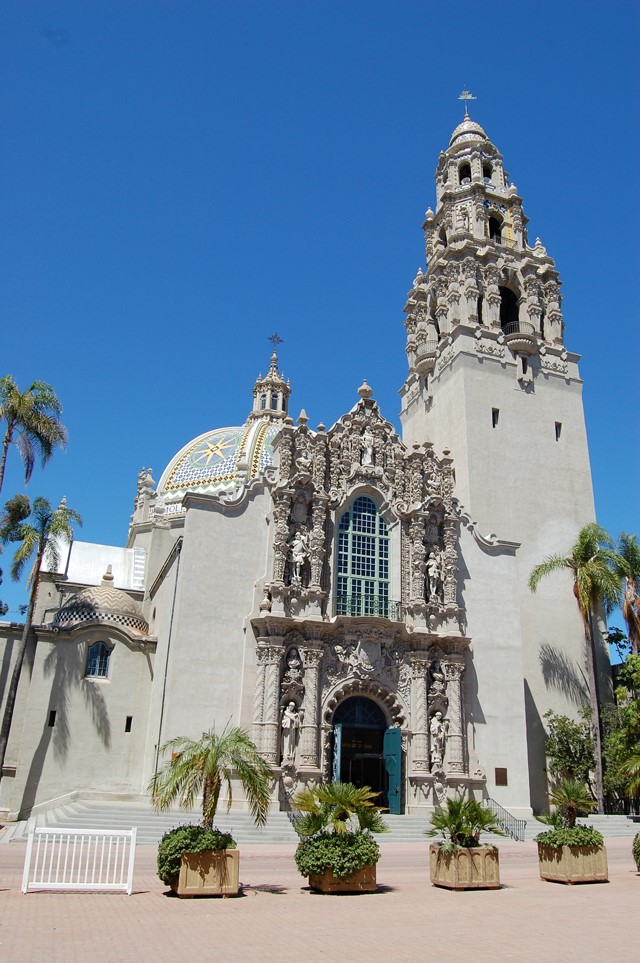
The San Diego Museum of Man
That question – whether there is a conflict between the goals of schools and museums – deserves to be explored further. Are there some audiences that museums should not pursue, because what we offer and what they need are not aligned?
But I also wonder: does the structure of a school group compromise the experience of finding personal meaning in a space or objects? How do you offer school group visitors (especially elementary school visitors) individual experiences?
Middle school and high school students can have a true free choice experience if you can structure staffing and galleries to allow them time on their own. For elementary age kids, some portion of the experience can be free choice within a gallery, but not wandering around the whole museum on their own.
Your question relates to other questions you have blogged about: What is an educator today? What is education today? What is education in a museum? We continue to experience the tension between a formal educational tradition (including the progressive tradition) and the kinds of things that informal environments are set up to do.
You said earlier that “We serve students best by helping them see why we who work in museums fell in love with museums.” Many museum staff members, including docents who often lead school tours, love museums because they love learning about the objects. Docents share this love with students, which results in a lecture. How do you reconcile (a) sharing what you love with students in order to open up the museum experience, with (b) loving and sharing information?
There is a wonderful feeling that you get when you learn something, and it comes together around a museum artifact, and you can’t wait to share that. We don’t want to denigrate that experience, because it is important to many people’s sense of self and ego. And many young people coming in will have their most exciting connection through content and an intellectual experience. We all know those kids who love knowing the answers to things, and spouting it back – they are like mini-docents themselves. But the yield is so much greater when you introduce visitors to what you really care about after understanding what they care about. It is about starting with your guest, not yourself.
The thrill of a successful teaching experience, one in which students respond and sustain involvement, is powerful enough to overcome a docent’s excitement about being the expert and downloading information. But finding a way to bring docents along that path when you only see them weekly or monthly is one of the structural problems that museums have.
There are some risks that we need to take as educators to signal that we are really there to listen, that we work in these places for a lot of reasons, but the bottom line is that we are here to introduce them to the coolest place in the world. That is the message that often gets lost. Many docents think they need to do this in ways that are very different than what will actually open these kids up.
You talk about risk. What are some risks that you think educators should take in order to accomplish the outcomes you described? Let’s use middle school students as an example – what might educator risk-taking look like with this group?
Museums can be horizon-openers for a middle school kid dealing with the physiological, emotional and intellectual changes that are going on for them, such as experiencing the extent of their power to affect things in their world. Most of the time they look like they are not that interested in engaging. This scares off a lot of people, including educators. Middle school kids remind many of us of that uncomfortable time in our own lives.
When we work with these students, early on, we need to signal that we are authentically interested in what they are bringing to the table. We have to be ourselves with them. We can feel foolish when talking about something that is sincere, authentic, related to our own passion to kids who look like they couldn’t care less.
We also need to think about ways to make them feel comfortable. Give them time to explore alone or with one other person. Accommodate the fact that many middle school students are not going to want to speak up in front of the group about something new to them. We need to create a protective experience, in which they get to peek around the corner of who they are to find a warm and welcoming adult interested in engaging with them. If you can set the tone with them at the beginning, then you can offer experiences where they really get to think about how these things relate to their interests and their lives.
In art museums, I ask students to go around the gallery and select a work of art that they would take home with them. They vote on it by standing in front of the artwork, and then talk about why they selected it. Those kinds of experiences are the ones that will let students walk away from the experience with the sense that this is a place where they get to have an opinion – ownership. When considering which artwork you would you take home, you occupy a place of literal ownership.
What is the equivalent activity that you would you use in your current museum, which is an anthropology museum?
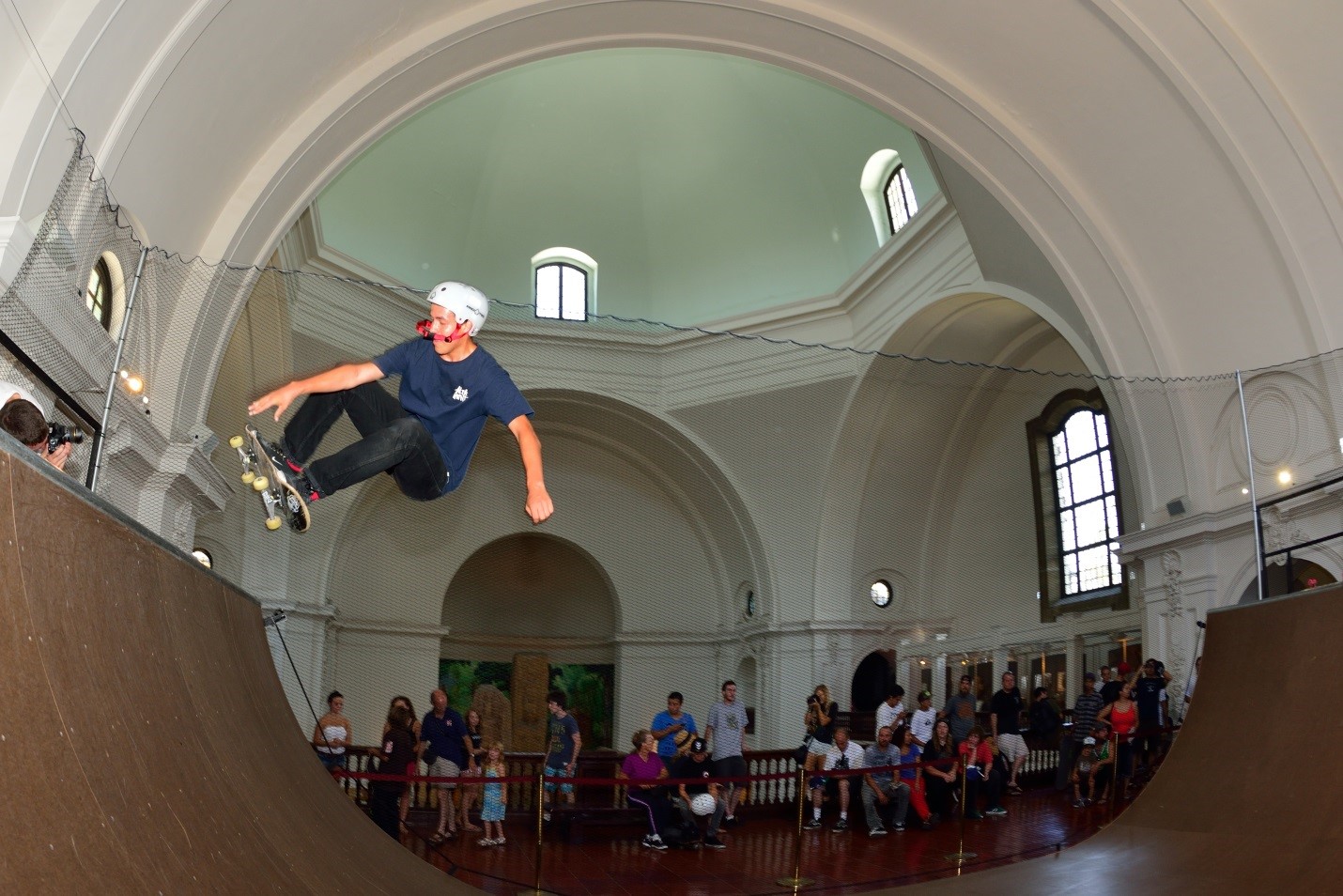
Encouraging young people to feel that sense of ownership in our Museum is certainly a goal. I hope that the Museum of Man will become that third space, that wilderness for young people to explore and occupy. A place where they will encounter something valuable for their souls, egos, and minds. Right now, the challenge is great as we are organized to interpret artifacts in very traditional ways (Ancient Egypt, Mayan Civilization, Evolution, etc.). The potential is there, as many of our artifacts have strong narrative and imaginative associations. And the museum has made great strides over the past four years to change things up with the temporary exhibitions (like building a half pipe in the museum for a skateboarding exhibit). Our plan is to move to a cross-cultural approach to interpretation, where visitors can delve into the largest identity questions (race, religion, gender, myth, etc) while looking at commonalities: between Mayans, Egyptians, and contemporary Californians. I guess my answer to your question is that I do not know yet. But I do know that we will only be successful when our exhibits are places where a student can find a personal connection to our collections and spaces. And one that opens up new possibilities for how that person can navigate her or his path.
Skateboarding in San Diego Museum of Man
What are the costs of field trips?
The first two museums I worked at were predicated upon the idea that the institution subsidizes the cost for educational programming, through sponsorship or donors. The revenue from education programs might have been about 10% of the resources spent on the endeavor. Now I work in an institution that has to survive in the marketplace: we only remain in the black if we are able to convince enough people to buy what we have to offer. Educational programming at this museum has to at least be revenue neutral (break even). This is incredibly healthy – it forces you to contend with your value, and the why and how of education.
In the case of school programs, the why needs to be really compelling. The economic engine of the museum is the exhibit program – that is what keeps the general public coming through your door. School groups are a part of it, but you’re really looking for visitors who will come and visit during their leisure time.
This gets to the fundamental question: Why does your museum exist? What are we here to do? Big museums – museums like the Met or the Getty – are well-resourced; they can subsidize school programs, and can take them to a very ambitious level. They would probably frame what their value is in ways similar to the Museum of Man, but their ability to have impact is very different than ours.
I would note that large and smaller museums offer very different experiences, and thus have different impacts — and perhaps they have, or should have, different goals. Lately I have been thinking about this in terms of the stadium concert vs. the more intimate musical venue. The stadium concert does not have a greater impact than the smaller venue’s concerts; they are incomparable experiences.
But back to costs: What do you need to charge school groups to cover costs?
At the Museum of Man, we offer two types of school programs. There is the school tour program, where the school comes once. Those students pay $5 each for a tour; for $10 each they get a tour and a hands-on workshop. The cost is appropriate for the audience that we are serving – it is what the school market can bear. The fee pays for our educator and for consumables (such as art materials), but does not cover any overhead costs.
Our other school program is the School in the Park, which is foundation supported. This is a week-long program, which serves a few schools in the City Heights neighborhood of San Diego. Students spend a week in Balboa Park; they spend the mornings for five days in one museum, and afternoons in another museum. For this program, we get $15 per day per student, from the Foundation. That covers our costs for the week-long experience and subsidizes cost of one of our full-time educators, so that she can work on other programs as well.
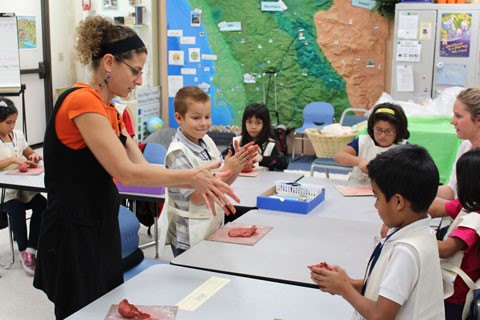
School in the Park
When I worked at the Getty, they chose to pay thirteen full-time educators; each educator spent approximately four hours teaching and four hours researching and prepping each day. There was a tremendous yield in the quality of instruction. The current administration there does not see that yield. So they got rid of a program that was very expensive – they saved a considerable sum by changing the staffing to a model in which docents teach school programs.
This leads to another big issue: The intangible nature of what educators do. Because our programs are intangible, they are always endangered. As powerful as educators have become in museums over the past 30 years, the most thoughtfully constructed education program can still disappear with the switch of an administrator. And then they are gone. In ways that collections, even if interpreted differently under different regimes, normally do not.
A number of people have reached out to me to share ways in which they, too, are exploring new approaches to school visits to museums. Some of them have generously agreed to write guest posts to share their ideas.
The first of these guest posts is from Claire Bown, a freelance museum educator based in Amsterdam. Claire started her own company, Thinking Museum, in 2013. Claire designs innovative learning activities, workshops and training for museums and heritage organizations, and specializes in the use and application of Visible Thinking in the museum environment.
In order to mine these guest posts for ideas related to the bigger question – “What if we tried a whole new approach?” – I have added a few of my own thoughts at the end of the post, in italics.
Claire Bown
In 2011 I joined the Tropenmuseum in Amsterdam with the aim of creating a new English language primary school programme for a growing number of international schools in the Netherlands. These schools, free from the constraints of nationally imposed curricula, have long been able to embrace new and innovative ways of learning and teaching. From the outset, therefore, it was important to develop a programme that linked not only to what was being taught in international schools but also and, more importantly, to how it was being taught.
Indeed, there is a great deal of emphasis on the ‘what’ of museum learning: the content. For school groups, especially, there is still a strong need to cover and provide distinct content created to link to school curricula in order to appeal to teachers and school authorities. Whilst this content-based approach certainly has its benefits, defining museum school programmes by their ability to link to curricula limits the potential of museum educational experiences. For my part, I was interested in developing a programme that supplemented learning and complemented the curriculum and worked throughout the project in partnership with teachers from four international schools. These teachers were an integral part of the research and development on the programme and dedicated considerable time and energy to discussing and piloting the new programme.
On the basis of results from research and focus groups, a new programme was developed based on a common theme of stories and storytelling. However, Stories around the World, as it was christened, was not a content-led programme but one that was guided by it. The main focus was to let students slowly explore and discuss objects for themselves using elements of Visible Thinking as a structure to guide their thinking and to help them practise and develop certain skills, such as careful observation, thoughtful interpretation and considering different viewpoints.
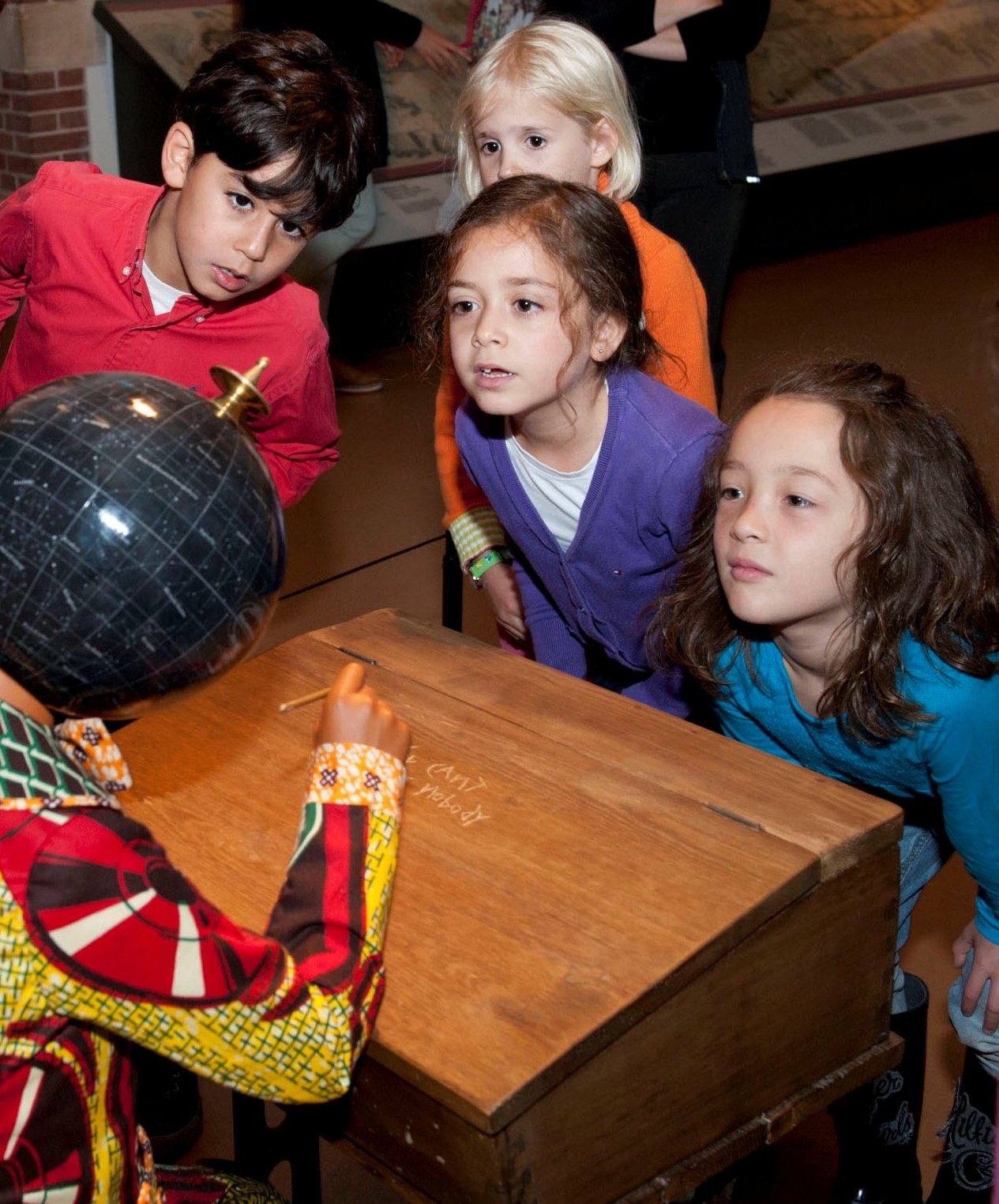
Students examining Yinka Shonibare’s “Planets in my Head: Literature,” 2011.
Visible Thinking is an initiative developed over a number of years by researchers at Harvard’s Project Zero in collaboration with various schools. At the heart of Visible Thinking are several practices that help to achieve these goals – such as thinking routines. These routines, originally designed for the classroom, are flexible mini-strategies that we adapted for use in the museum. They provide a structure for student-led discussions and encourage the exploration of ideas and also help to spark curiosity and provoke debate about the Tropenmuseum’s extensive collection. Each different routine encourages certain types of thinking – for example, observing and describing, reasoning with evidence, making connections and even wondering. This allows different types of thinking routines to be used easily around the museum for different objects and in a variety of educational programmes. In Stories around the World we used a mixture of historical objects, such as The Great Pustaha, with contemporary art objects and sculpture, such as Yinka Shonibare’s Planets in my Head: Literature.
The Great Pustaha, 1852-1857, from the Southeast Asia collection of the Tropenmuseum (photo courtesy of Tropenmuseum).
The thinking routines trigger lively discussion facilitated by a museum teacher who encourages multiple interpretations from all group members. The process of using a routine also helps to teach students to work collaboratively and to listen respectfully to other student’s opinions. This is an inclusive method that grants even the quietest and most reticent of students the confidence to share their thoughts.
The programmes were launched in 2012 and have been enthusiastically supported by international schools. We discovered fairly quickly that thinking routines have a broad application within a range of subject and age group areas across the museum and two further educational programmes have been created for Dutch primary and high schools. Thinking routines have also been incorporated into adult programming and special events like Museum Night. Museum docents, once trained in using this method, start to incorporate the routines independently and flexibly into other areas of their work with other age groups and types of programmes. These routines can be easily applied in many different types of museums – not just art museums – to target and develop a wide range of thinking skills and promote engagement and curiosity.
When developing a skills-based programme for schools, it is important to manage teacher expectations from the outset and to build strong partnerships and collaborations with schools that can then understand and support the way the educational programme works. Teachers are often surprised (and sometimes even disappointed) that the students will only explore 3-4 objects in around 1.5 hours. Attitudes and assumptions change once teachers have experienced how the programme works in a completely different way to content-led programmes. Educational promotional materials and the museum website and/or blog should be used to their full advantage in explaining the benefits that the students will gain – that is, valuable skills that can be transferred to other locations and contexts.
Ideally, more research needs to be undertaken as to how many schools and students are taking these skills and routines back into the classrooms or their everyday lives and using them again. However, there are numerous possibilities for extending the learning possibilities further and to other contexts. Museums offer a different learning experience from the school environment and as such should not duplicate the learning that takes place there, but be duty-bound to offer a broader range of experiences for students demonstrating the full potential of what museum learning truly has to offer.
For educators who are offering and promoting programs that link to the school curriculum, thinking routines offer an alternative which may be attractive to teachers. For those who have designed programs that teach skills, thinking routines may support what you are already doing.The use of thinking routines during field trips is interesting for a number of reasons:
These routines suggest a number of skills, or – better termed – habits of thought that we might consider teaching students in the museum. In this way, they support a broader exploration of possible goals for school visits to museums.
I wonder whether thinking routines might offer museum educators strategies for ensuring that conversations are rigorous – open, but not so open that every answer is considered equal. This is a question many of us grapple with: How do we teach students what good, rigorous interpretation looks like, in the context of constructivist educational approaches? (See the post When is Inquiry with Art Philosophical Inquiry? for another approach to that.)
Thinking routines, like Visual Thinking Strategies, are routines that teachers can use in their own classroom. This allows museums to work with teachers to create bridges between museum and school time, deepening impact.
My second interview in theSchools and Museums series is with David Bowles, currently Assistant Museum Educator for School Programs at the Metropolitan Museum of Art in New York City. Although the Met is much larger and has many more visitors than most other museums, I think David’s ideas are both smart and broadly useful. Before working at the Met, David worked at the Rubin Museum of Art. David also participated in The Think Tank for a year-long exploration of school visits to museums that I hosted while at The Noguchi Museum.
Why should museums offer school tours?
On a basic level, museums are for everyone, so a museum needs to serve everyone. We work with school groups because we work with all human beings.
In the United States, museums and museum learning are caught up in the progressive education movement. John Cotton Dana, said, “Study your tea-cups.” He meant that you should be aware of the world around you, you should understand where your things come from. Lucy Sprague Mitchell, who started the Bureau of Educational Experiences – which became Bank Street College – was interested in helping young kids understand where their food comes from, how the buildings around them got built. Why is the world around us the way it is and how could it be different?
A functioning democracy requires that people know how to ask questions about the past. It makes sense for museums to work with schools, to help students become active participants in the world – where their food comes from, why their schools look the way they do, what lasts, and why.
What are the costs of school tours to a museum, in time as well as money?
Here at the Met it’s phenomenally complicated. We are fortunate to have an endowment which allows us to offer free admission and guided tours to all New York City schools. In 2013, the Met had over 53,000 visitors who came as part of guided school tours (this includes teachers and chaperones).
We have about 125 volunteer and 27 paid educators. There are about five positions in the Education and Visitor Services departments dedicated to school tours. And of course, staff from other departments – IT, Design, Editorial, Volunteer Services, Security, and Custodial – who end up with work related to school tours.
And then of course teachers still need to book buses and negotiate with administrators.
What do you see as some of the inefficiencies of museum school tour programs?
The logistics are very complicated. At the moment, at the Met, our staff resources are not yet in alignment with the way we invite schools to book tour offerings. Long story short, this means that some volunteers feel underutilized, while others feel overwhelmed. The same can be said for paid educators as well. We are working to align these systems, but there are a lot of moving parts.
More generally, there is a fundamental disconnect between what teachers need and what museums are willing to offer. For example, school groups need a place to eat lunch. We don’t have that space… yet. So much effort and energy on the part of teachers could be alleviated if museums would offer a space for students to sit and eat.
Another inefficiency is trying to align the tours with curriculum. Sometimes teachers book a tour to support a specific moment in the curriculum, but then life gets in the way and the kids aren’t actually studying this topic by the time the tour comes around. It makes me think about the value of tour topics that are rooted in content areas (like Art of Ancient Egypt) vs. tour topics that are thematic (like Communities Around the World).
I have been thinking a lot about how much we should adapt programs for teacher requests. One teacher requested a Canterbury Tales tour. A Met educator spent a phenomenal amount planning this tour, and then the teacher cancelled.
This brings up questions of adaptation vs. customization. What are the boundaries of each? And to what extent are museums willing to plan tours according to the goals of teachers and students? Ben Garcia’s article “What We Do Best” (Journal of Museum Education, Summer 2012) suggested that we are selling out our collections when we do this.
Ben brings up good points about being true to ourselves and playing to our strengths. But just as museums cannot customize tours for each group, they also cannot be only interested in themselves and what they do best. We have to meet at a middle ground (in the same way that we must adapt our teaching for other groups). We have to make an effort to understand why people want to use museums, and incorporate that into our plans while pushing things forward a bit by asking ourselves questions like, “What don’t they yet know that they can do in museums?” Although this begs the question: can we really meet needs related to the school curriculum?
You and I worked together in The Noguchi Museum’s “Think Tank” a few years ago. While many of the classroom teachers in this group said at first that they don’t need a curriculum link for their visits (although they do need something to justify the trip to their administrators), they seemed to change their minds when actually planning museum trips. The trips need to make sense in their own school contexts.
The Met sends out a post-visit evaluation form to teachers. We ask about primary and secondary goals for trips. Last year, 68% of teachers said that their primary goal for school tours here is a curriculum connection. The highest ranking secondary goal was“exposure to the arts – 28% of teachers chose that. 18% chose skill building, and even fewer chose “fun.”
Anecdotally, teachers often mention fun as a Met tour goal in conversation. So I wonder how mutable this data is. The context in which you collect information matters. An online survey feels official, so I am probably getting official responses. If I asked over wine and cheese, the answers might be different.
What would school tours look like in an ideal world?
There would be free limitless space for schools to sit and eat lunch. School groups are often traveling an hour to get to museum – we should value their comfort.
There would always be something to do besides group discussions – there would be activities.
There should be choice embedded in the structure of the experience; students should be able to make informed decisions about what they want to do during some aspect of their visit.
Museums would have open maker-spaces, where kids could respond to their visit in a way that is not a directed art-making activity.
School budgets would havebus money built into them, so that travel to museums was free. (New York City has this.)
Museums would integrate evaluation throughout the tour experience. In the planning stage, we would have time to reflect – how do you want this program to work? Right now we do so much work to create reports that just get filed. We would do much better to gather solid data about how what we are doing relates to our goals.
Visits would be more integrated into what is happening in the classroom – instead of one-off visits, we would see a more holistic approach. Well-resourced schools sometimes do this. At the Rubin Museum of Art, we were able to form relationships with some of the teachers and really build visits into their curriculum.
Clearly there is a tension here between wanting to offer customized visits that are part of larger relationships, and arguing that for efficiency’s sake we should not customize school tours. If you had to choose between serving fewer students in a more meaningful way, or serving many students with non-customized tours, which would you choose, and why? Other thoughts on this?
Honestly, I’m not ducking the question by saying this, but why must this be an either/or proposition? We can do both. In fact, we are starting to do that now. The Met will be partnering with a few schools in the city to develop a sort of holistic package approach to partnership – in-school programs, in-museum programs, after-school programs, PD for teachers, Family programs, etc. This will be in addition to the broad tours that we’ve been discussing. Lots of challenges of course, but lots of opportunities. Stay tuned.
You mentioned space for lunch. Imagine that museums had this space. How might that change the quality of a school visit?
So many reasons. If there is space for them to have lunch, groups can slow down. Tours could become a two-hour experience. They could make a day of it. Settle in.
Lunch spaces might improve student focus – hungry children are unfocused children. Lunch could also punctuate the day – there is something to be said for doing something, taking a break, and then returning to it. It would also send an important message about the museum’s priorities; that young people and their needs are valued.
They could spend the day learning at museum. In New York City there used to be a “City Academy;” participating school groups could spend a week or two learning in that space. And in the blog Jake’s Bones one of 12-year-old Jake’s suggestions for museums is “Let schools have classes there.”
When I was at the Rubin, there was a first-grade teacher who brought her students to the Museum as part of a unit on “How Cities Work.” She wanted kids to understand museums, and how they work, as part of cities. So she arranged to have the kids interview people who work in museums – security guards, people who work at the front desk or in the gift shop. The students led the tour. First graders. She was an amazing teacher, who really made the museum visit work.
I recently interviewed Meghan Everette, a 1st grade teacher at Daphne Elementary School in Baldwin County, Alabama, in order to gather her thoughts on school visits to museums. This is the first in a series of interviews that I will be sharing as part of my series rethinking the field trip.
Why should schools visit museums?
ASCD talks about educating the whole child, and I believe whole-heartedly in this. If you restrict education to what’s in the classroom, you are not educating the whole child. Field trips give kids a broader view of the world.
Often kids are not aware of cultural resources in their area, so unless teachers take them, they will not visit cultural sites or events. And even if they do go with their families, that’s a different experience from being with their peer group.
We take five or six field trips each year. Some of these are local walking field trips – in a couple of weeks we’ll go to the grocery store. We also make an annual visit to the National Naval Aviation Museum in Pensacola, FL, which is a big attraction about an hour from here – they have fighter planes, some ships, and the Blue Angels – precision demonstration squadron jets that practice there.
In Mobile County, we had to align trips with our curriculum, and we could not repeat a field trip in K through 5th grade. In Baldwin County we try to align field trips with the curriculum when possible.
What are the costs of field trips?
The biggest financial cost is the buses. For the Naval Aviation Museum we need to take charter buses, which cost thousands of dollars. Any field trip here requires a bus, so even if the museum is free, it costs us a lot to visit.
For any trip, you’re going to lose a day in your classroom. Not only are you going to lose a day, you’re going to lose a little more, because you’re going to do a little prep work beforehand, and then the next day, getting settled takes time – kids like to talk about where they went. So if you are charged with teaching a specific curriculum each day that makes trips tricky. If you really value that trip – if you think kids are really getting something out of it – then you don’t mind that you lost that day.
What do you see as some of the inefficiencies of field trips to museums?
The timing is off. A lot of our trips seem to be set up for half a day. At lunch time, we have to wait for the buses or go find them to get the kids’ lunches. Museums need to streamline the whole eating thing, or be more accommodating of getting lunches off the bus when we arrive at the museum.
After the museum visit, we have the bus and we’re already out and about, so we go to a local park and play before we go back to school, which is kind of silly. The bus drivers need to be back at the school in time to run their afternoon routes, so once you’re back at school you have this weird hour or so before dismissal. That kind of stinks.
Renting charter buses solves some of the timing problem, but that’s expensive. If museums planned something from 9-2 (or whatever that school’s schedule is) that would be great.
What’s an example of a great experience you have had with a museum visit?
Space 301. They had a special grant-funded program, and we took three visits to the Art Center. Before each visit they came to us. We saw the same teachers you see again and again – the kids build relationships; they know what’s expected.
The educators were knowledgeable about what they were going to teach, and in my classroom they led an activity that got kids really excited. Kids then had an expectation in their minds of what they were going to see, and even if it didn’t match up, that’s still a good experience for them. Any time you are forced to change your thinking about something is a powerful learning moment. Science is a really good example of that – when I put out materials, the kids think the materials will behave one way, but then they behave a different way: that completely engages them, they want to know why the material did what it did. (For more on cognitive dissonance as a teaching tool see this and this.)
So one time they came to the class and taught about radial symmetry. They when we visited Space 301 and saw the artists’ version, it was so radically different. The kids thought, “Oh my gosh, I never thought about it like that,” and then they would remember it better.
Space 301, part of Mobile’s Centre for the Living Arts
What if Space 301 gave you the pre-visit lessons to lead?
Many teachers would look at their day and not give the time it really warranted, or forget, or not be confident. I can imagine a teacher saying, I’m not going to see it right, I’m not going to do it right. I could see it working, though, especially if teachers were trained in some way: if they got to see the teacher teach the first time, or see a mini-lesson, even a video.
If we’re going to take a trip to see something I don’t know a lot about, and I have to learn about it on line and feel my way through, that’s probably not as good as someone who knows a lot about it. We take kids to see these field trips because it’s something we are not specialized in.
We do take the same field trips year after year – I could lead pre-visit lesson after seeing it once. There is an initial scariness. Having materials and lessons would make a big difference.
Museums often do provide lessons for teachers to use in their classroom, for before or after a visit.
Sometimes people don’t know this. It’s a lot different if someone actually puts this in your hands. And teachers stick to what they know – someone might be comfortable with art, but not science.
What are some of the barriers to great museum visits?
There has been a big crackdown from the district, discouraging teachers from taking kids on field trips because it’s time out of the classroom. They want field trips to be really purposeful. If kids have a great time but don’t remember anything, the district administration frowns on that.
Define purposeful.
When kids come back and they say, “That trip was fun, I played with my friends,” and can’t really tell you what was amazing, that’s a problem. Concepts tied to classroom learning help schools see purpose.
Field trips got a bad rap because they were just a fun outings – just time go to the park and play, there wasn’t any purpose in it. I think a field trip can be both, help children learn about the world, broaden their horizons, and learn something meaningful. For me, it’s important that they learn SOMETHING – it doesn’t matter so much what it is.
A lot of times the higher powers want to see that curriculum link. They want to know that the eight or more hours you lost in a classroom is going to better students’ understanding of some curriculum goal. This might be content, or skills – in my old school field trips had to teach vocabulary. Or it could even be career based.
What does a school visit to a museum look like in an ideal world? What are some options we might explore – distance learning? Full days at the museum?
I love the idea of a full day spent learning at the museum idea. I’m sure there’s a lot of logistics to work out, but if kids could show up at 8 and leave at 3, then they gain an hour in the morning and an hour in the afternoon, and they’re settled. Kids get so hyped up getting on the bus and stuff.
I’m not in love with distance learning. There are always technology issues. It’s one thing when it’s a one-on-one interview, like with an author – that’s personal, and they’re talking to you. But when they’re trying to show you animals, something gets lost in translation – I want to see the animals in real life.
What else should museum educators know?
If a visit is guided, the museum educators should be trained to work with children. We’ve had some docents – I’m sure they’re lovely people and all – but they talk above children’s heads, and then the children get restless and rude. When kids are active and involved they tend to remember more.
We went on one trip last year, and I never want to go again, because it was completely unguided. The kids were let loose and just ran around.
A visit doesn’t have to be guided, but I appreciate when they’ve given us something to go by. So, for example, at the Museum of Mobile they give first graders a visual scavenger hunt, which helps them to focus. It’s better than sitting and listening to someone talk.
Meghan Everette teaches 1stgrade l in Baldwin County, Alabama. Previously, she taught 3rd and 4thgrades in Mobile County, Alabama. Meghan is a blogger forScholastic’s Top Teaching Blogand ASCD Emerging Leader.
There is a great deal written about the myriad problems with the K-12 educational model in the United States. The system is outdated, constructed to suit a society of factory workers and farmers. The system (many argue) needs to be rethought from the ground up: What should children be learning and why? What scheduling, teacher training, curricula, and assessment are appropriate for the 21st century?
Similar arguments can be made about the museum school tour. In Teaching in the Art Museum Elliott Kai-Kee traces the roots of school programs to a guided tour model originally developed for adults. When an independent adult visitor comes to the museum, it makes a great deal of sense to offer him or her an hour-long tour, which the visitor can then pair with independent time in the galleries, lunch in the café, or a visit to the gift shop. But when students come to the museum – from greater and greater distances, as cities and suburbs have expanded, taking time out from a test-driven, centrally mandated curriculum – an hour-long experience makes very little sense. The problems lie in both the cost (the time and money both museums and schools dedicate to these programs) and the benefits (the articulated and perceived value of school tours): our failure to articulate a clear purpose, along with our inefficient systems, results in a very low cost to benefit ratio (high costs, low benefits).
In a recent post, I noted that museums seem to be shifting from education to engagement. I must admit that “engagement” has always seemed to me to be an ambiguous term, representing a reluctance to ask visitors to involve themselves with challenging content, and opening up the museum to any experience necessary to keep people there.
But comments to my post indicated a great interest in engagement. Futurist Garry Golden commented, “There is always risk of being seen as trendy or just buzz– but ‘engagement’ is a huge concept being explored today by people across the learning world…. I think engagement is a concept worth exploring.” And blogger Gretchen Jennings responded, in a post on her Museum Commons blog, that she has and continues to “[urge] museum educators to focus less on formal education materials and methods and more on interpretive planningin exhibitions and visitor engagement in the museum, both on site and online.
So I have decided to explore engagement in more depth. What is it, anyway? What would it mean for the-profession-formerly-known-as-museum- education to facilitate visitor engagement?
The Research
Garry directed me to the work of Valerie Hannon, who calls engagement the “golden key” to education.
You can watch this recent talk by Hannon yourself, but here are a few of Hannon’s ideas:
In the school context, research demonstrates that engagement is an excellent predictor of success – in fact, engagement predicts success better than achievement does.
“Engagement” is traditionally understood as engagement in school, and is defined by five characteristics:
attendance
attentiveness (eyes open and focused);
conformity (joining school community);
achieving some academic results;
behavior / students are not misbehaving.
Engagement in school is not the same thing as engagement in learning. Engagement in learning is better understood by looking at:
whether students are energetic and enthusiastic
passion
learning all the time, everywhere
students taking responsibility for own learning
achieving a wider set of learning outcomes – not just in school subjects, but more broadly
In schools, teachers often strive for engagement by one of two means: rewards (students who score well win a pizza party) or entertainment (teaching math through a rap). Neither rewards nor entertainment lead to true engagement.
Hannon cite’s Daniel Pink’s theory that true engagement is motivated by autonomy (choice and control), mastery, and purpose (can connect learning to situations in your life / society)
Pink’s ideas complement those of Mihaly Csikszentmihaly, who wrote about engagement using the old-fashioned term “intrinsic motivation.” Csikszentmihaly tells us that when people are engaged they are in a “flow” state. Activities that lead to a flow state tend to have clear goals, appropriate rules, and opportunities for action in balance with the participant’s abilities. As one’s skills increase, the challenges increase. “When goals are clear, feedback unambiguous, challenges and skills well matched, then all of one’s mind and body becomes completely involved in the activity.”
Csikszentmihaly also writes about giving learners the opportunity to draw their own conclusions. “Information that is presented as true without alternative perspectives discourages the motivation to explore and learn more…. Motivated learning is an open process involving uncertainty and the discovery of new possibilities. A fixed presentation of the material thwarts such further exploration.”
In other words, engagement is not synonymous with fun. True engagement is defined by an individual’s choice to take on a difficult (but not too difficult) task that has relevance for him or her, whether it be physical (playing a sport or a musical instrument) or purely cognitive (making sense of competing ideas). Continued engagement is achieved through finding or creating new challenges, making the task harder as mastery increases. Video games often lead players through levels of increasing difficulty. A sports fan who is knowledgeable about basketball – who has perhaps learned about it by playing him or herself – is much more likely to be engaged in watching a game (making predictions and judging plays) than someone who has never previously attended to the sport.
Engagement Fail
Hannon’s talk points out that schools are using misguided tactics (rewards and entertainment) because they are identifying engagement by place (school) rather than activity (learning). Museums, of course, fall into this trap as well. We think about engaging visitors in activities that will make their museum time enjoyable, and measure engagement by how long visitors spend in the museum, for example, or by how attentive they seem.
But when visitors enjoy an interactive booth or a gallery activity, they are often not engaging in the ideas or work of the museum itself. An example: In June, I visited the Museum of Art and Design in New York City with my 12-year-old daughter, Charlotte. We saw Multiple Exposures: Jewelry and Photography, an exhibition of contemporary jewelry that, according the museum, “transform[s] and add[s] new meaning to the pervasive images of this digital age” as artists “explore changing views of beauty and the human body; examine social, political, and cultural issues; probe perceptions of memory and desire; and question the broader relation of jewelry to society and personal identity.”
While I explored the videos of artists examining ideas related to beauty, gold, and self-decoration (I can’t resist a few pictures, the exhibition was rather amazing)
Lauren Kalman, Tongue Gilding, 2009 (click to view video excerpt on Vimeo)
and the necklaces inspired by 19th century mourning jewelry
Pendant from 1855Sally von Bargen, Elegy, 2008-9. This necklace contains portraits of the more than 4,200 Americans who lost their lives in Iraq during the Bush administration.
my daughter found the “Auto-Selfie” station:
Charlotte at the Auto Selfie stationPhotograph of Charlotte generated by Auto Selfie station
Charlotte loved it. She took picture after picture. It made the museum experience both memorable and exciting for her. But the Auto-Selfie booth neither illuminated the exhibition ideas nor added to her understanding of photography or “selfies.” Rather, it distracted her from the exhibition, which she barely looked at. Yes, she might want to go back to the museum again. But not out of an interest in the exhibitions or institution. She will be disappointed if there is no photo booth when she gets there. The Auto-Selfie provided Charlotte with 30 minutes of fun, but failed to engage her in any way that had a life beyond the activity itself.
Meaningful Engagement
I recently led a workshop for museum educators in Central Illinois. As a way of illustrating how goals should drive program decisions, I noted that gallery activities should lead participants back to the work, and help them look at or understand it in new ways. It was an audible “a-ha moment” for many in the group. “Oh yes,” you could hear them thinking, “we engage children in activities not just for fun, but because multisensory or independent activities help them understand the objects on view.”
Without facilitation, I’m not sure an activity station is an effective means of engagement. These stations distract children (and adults) from opportunities for real engagement. In a recent article for The Telegraph, Sally Saunders describes taking four young children to an exhibition of Matisse’s Cut-Outs at the Tate Modern; she describes the Drawing Bar, “a computer suite set up to allow budding artists to create their own artwork, electronically.” Saunders writes, “All four children find this incredible fun, and love seeing their pictures flash up on the giant screen above them. My friend and I are both worried that the highlight of the day will be a computer game.” Happily, Saunders is an expert at taking children to the museum, and, despite the many challenges, engages her children with the art itself.
If we want to engage visitors – to inspire passion, an interest in self-directed learning beyond the museum – what might that look like? Many museums have answered this in clever ways. I will never forget a visit to the British Galleries of the Victoria and Albert in 2004, making notes on brilliant gallery strategies, in particular loving a spiral-bound book exploring competing ideas and unsolved mysteries around a piece of furniture. More recently, I visited the terribly titled exhibition “Art as Therapy” at the Art Gallery of Ontario, which, despite some missteps, brilliantly rethought how a museum can spark a philosophical conversation through art. Still, as a field, we are inconsistent in our approach to and success with engagement.
Some strategies that we might continue to experiment with include:
What if, instead of offering a stand-alone activity booth, the exhibition incorporated questions like this into the labels? What if instead of sites of knowledge, labels were sites of engagement – what might that look like?
What if exhibitions were framed as questions instead of answers, sharing knowledge and challenging visitors to form their own opinions?
What if supplementary, nearby materials allowed visitors to think about, for example, the ideas of elegy and mourning photos in different ways – through poetry, or modern uses of photography on social media or in newspapers?
Museum Educators as Facilitators of Engagement
What skills, then, must a museum professional have in order to support visitor engagement? What must the former-educator-who-is-now-an-engagement-officer bring to interpretive planning in order to supplement and not supplant the curator, exhibition designer, or project manager?
She or he must be knowledgeable about research in social sciences and education, comfortable with these disciplines and able to keep up with the literature.
She or he must be curious about how people learn from and respond to objects, as well as about the museum’s content and collection.
She or he must be interested in experimenting with interpretive strategies, and able to evaluate whether or not new strategies are effective.
And she or he must be familiar and comfortable with outcomes-based thinking — able to help the exhibition team articulate goals for visitors, and identify or invent strategies for achieving these goals.
These ideas about engagement are all new for me. Do they ring true? Is there other research we might look at? Other skills we need to successfully engage visitors?