What does a museum educator do? (And do we need them?)

A few weeks ago, a colleague told me that she is optimistic that her museum is becoming a truly educational institution. “And when that happens,” she said, “we’ll put ourselves out of business.” In other words, the purpose of a museum’s education department is to help keep the institution focused on its educational goals. In a museum in which everyone understands this educational focus, no education department would be necessary.

This statement captures critical tensions in the museum education field. Museums are focusing more on visitors, community, and participation; education departments are essential because educators have expertise and connections that help build a vibrant visitorship. But as museums play with staff structures (see, for example, restructuring of staff at the Oakland Museum of California), and begin to make the visitor experience a more central concern, what do educators have to offer? Could the greatest sign of success be irrelevance?

At the core of this quandary is the question: What does a museum educator do? Are museum educators program designers and teachers, who work with groups such as schools and families, turning the galleries into classrooms for select audiences? Are museum educators visitor advocates, representing the visitor on exhibition and program development teams, or during the redesign of museum spaces and amenities? Are educators a specialized team of marketers, who bring new visitors in to the museum, increasing the quantity and diversity of audiences? Are educators experts in creating engaging and participatory visitor experiences – and if so, what does that mean, and what do we gain (or lose) by turning from education to participation?

EnterExhibitB

The museum education field is currently unsure about its primary role in museums. As Exhibit A, consider the varying titles held by the leadership of various education departments. (Selected institutions that use this title are listed in parenthesis; many of these titles come from recent job postings.)  The titles are important for two reasons. One reason is that they evidence the field’s struggle for vocabulary to define what it is museum educators do. The second reason is that these job titles may reflect differences in the positions themselves, and growing differences in the roles of education departments across museums.

  • Director / Chair of Education (Guggenheim Museum, Metropolitan Museum of Art, Baltimore Museum of Art): This is a traditional title, still the most common, but it is being rethought presumably because it does not do a very good job of describing what it is museum educators do. It dates back to a time when educators primarily ran lectures and tour programs for adults, and tours for school audiences. In how many museums is this still what museum educators do? (My guess: Many.)  And if we want to change this, where is the field’s clear argument for what the role of museum educator is becoming?
  • Director of Education and Public Programs (Concord Museum; Palm Springs Art Museum): This title implies that public programs are somehow separate from education. Underlying this are myriad assumptions about what “education” is and is not (why isn’t a public program an education program? Because the content is academic? Because the audience is not children and families?), and what types of expertise educators have and do not have (public programs staff are likely to have less of an education background than their colleagues in school and family programs, but more content expertise).
  • Curator of Education (Detroit Zoo; Hood Museum): This title implies that education staff create programs as curators create exhibitions, separating programs from exhibitions (rather than considering programs a part of exhibitions) while placing programs and exhibitions on a theoretically equal footing. I would be curious to know whether museums with a Curator of Education have a different inter-departmental dynamic than those with a Director of Education.
  • Education and Interpretation Supervisor (Corning Museum of Glass): The word “interpretation” implies responsibility for interpreting objects and exhibitions, mediating between what the museum places on view and the visitor’s experience of these objects. This is somewhat ironic in an era in which museum education understands interpretation to be an individualized effort to make meaning of objects, rather than the presentation of an academic context for each object.
  • Vice President, Learning and Interpretation (Detroit Institute of Arts): The first part of this title echoes the United Kingdom’s use of “learning” and “learning departments” instead of “education.” Presumably “learning” sounds less formal than “education,” and captures a broader range of visitor experience, although it still connotes cognitive (rather than physical or emotional) experiences.
  • Head of Interpretation and Participatory Experiences (Minneapolis Institute of Arts): This title swaps educational or learning experiences for participatory experiences. This echoes Nina Simon’s ongoing call for a participatory museum. But what do we mean by participation? What type of participation? What is the role of programs in participation, and what is the role of exhibitions and front-line staff?
  • Director of Education and Curator of Public Practice (Walker Art Center); Curator of Public Practice (Oakland Museum of California) – a whole new kettle of fish conflating educational practice and social practice art. As artists grow more interested in direct engagement of audiences through social practice, their role in museums verges on territory previously belonging to educators. This title reclaims contested space for education departments, perhaps arguing that social practice art is an educational endeavor that should exist in an educational space. It also allows educators to think more broadly than education or learning, allowing them to cross over into an artistic discipline in which unusual experiences are created and offered.

Of note in the above titles are two dramatic shifts in the work of education departments.  First is the involvement of education staff in the work of interpretation, indicating involvement in the creation of exhibitions. In January, four colleagues (Judith Koke, Heather Nielsen, Jennifer Czajkowski, and Julia Forbes) wrote on the Center for the Future of Museums blog that:

art museum educators with expertise in free-choice learning, visitor motivation, cultural attitudes, physical and cognitive accessibility and modes of response and participation are beginning to take a leadership role in the shaping of visitor experiences in gallery spaces. At this moment in time, most such staff work under the title of “interpretive planner.” It is up to us to determine how this position develops in the next decade.

One of the key questions to be addressed as this position develops is: What expertise must educators have to be interpretive planners? Often museum educators have content backgrounds (an MA or PhD in art, science, or history, or – in art museums – an MFA). If museum educators claim to have expertise in free-choice learning, visitor motivation, cultural attitudes, accessibility, and modes of response and participation, how do we build this into professional and pre-professional training, and emphasize this as a background needed in this field? To do so would be to privilege education as a vocation – something that bucks a trend in a society which thinks teachers often do not know their subjects deeply, bring little to the table, and should teach from scripted curricula.

Further, is the expertise of an interpretive planner the same as that of an educational program planner? Or are these two very separate roles? And if they are separate, what connects them within a department, and what is the best word to use for this department?

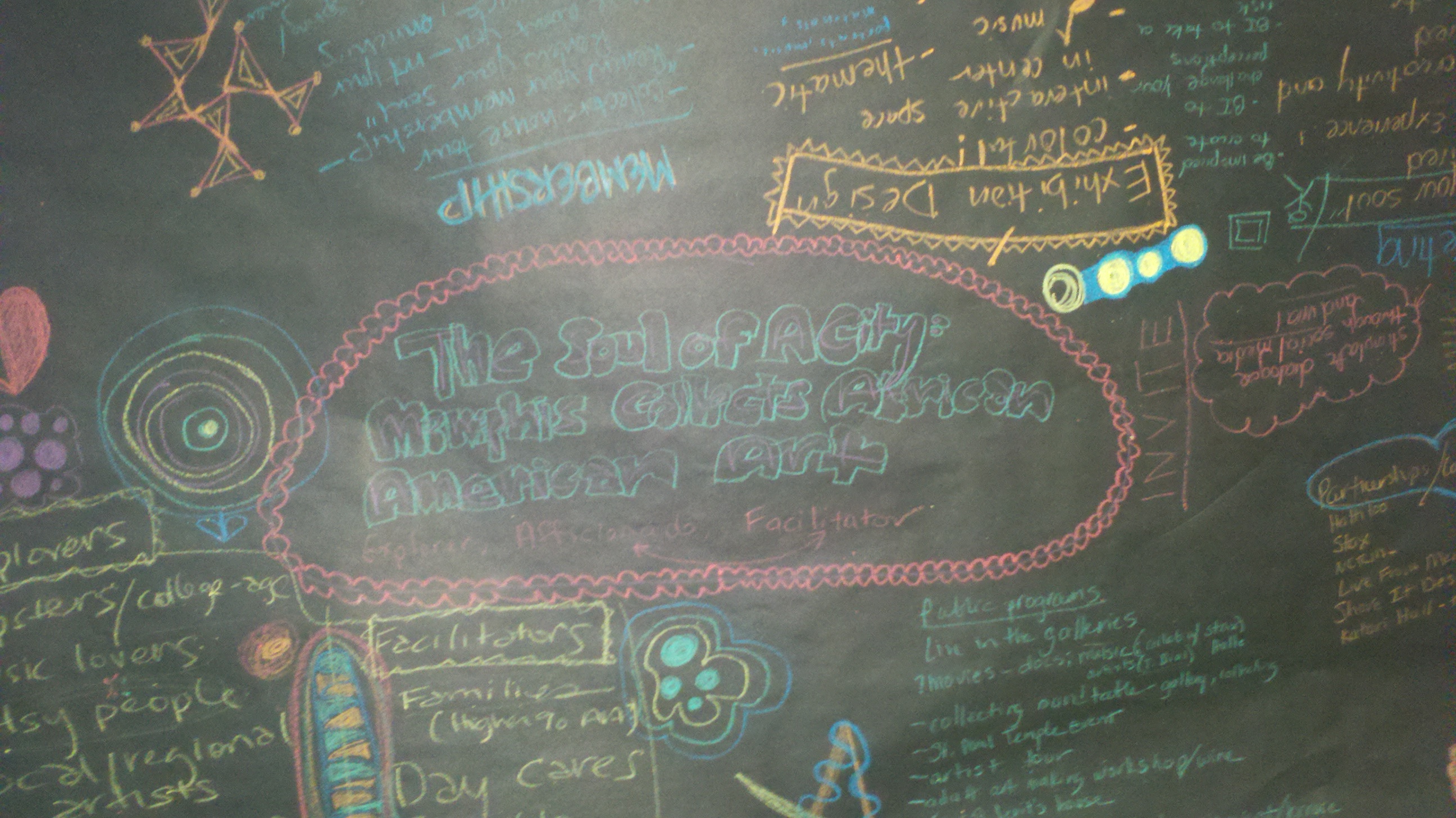
Interpretive planning at the Memphis Brooks Museum of Art.
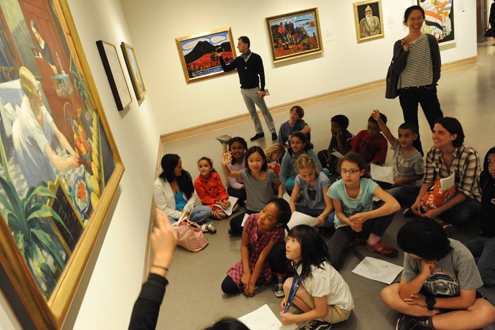
A school group at the Metropolitan Museum of Art. A google image search for school museum visits reveals myriad pictures of scenes just like this one.
A school group at the Metropolitan Museum of Art.

The second shift evidenced by these job titles is the shift from education to engagement. Participation and public practice do not signify an educational experience, but rather, an engaging one. What is the relationship between education and engagement? (Of note here is that museums derive nonprofit status from their claim to be educational institutions. However, nonprofit status is understood to be under siege from various forces – see, for example, Elizabeth Merritt’s posts on the topic and her related pinterest board.) Is the slow swing from education to engagement related to museums staking out a new position for themselves in the non-nonprofit market? Is the expertise needed to engage similar to the expertise needed to educate? Have we been engaging all along while calling it education? Are programs changing, or just vocabulary?

Nowhere in these titles is the idea that museum educator should take on the role of community or social worker – a museum role promoted by Lois Silverman, Elaine Gurian, and Gretchen Jennings, among others. Do museums not see this is part of their role? Or do they feel it belongs elsewhere in the museum?

I do not have an answer to “What does a museum educator do?” I do believe that museum educators are needed, but I am also convinced that as a field we need to come up with a more clear idea about our role in the 21st century museum, in order to avoid a future working as entertainers and marketers. I would love to hear other thoughts on this – and am also wondering if this has potential for a discussion session at the AAM 2015 conference. Thoughts?

What are the Goals of a For-Profit Museum?

A few months ago, I wrote about The Business of Museums, essentially arguing that museums need to identify ways to measure value other than income and visitor numbers. This stemmed from a lengthy discussion on linkedin, in which a colleague argued, “Are there reasons to mount an exhibition that doesn’t appeal to many or that appeals to people that can’t afford to come? Perhaps, but what would be the point? The point of exhibitions is numbers in the door (why have it if no one wants to see it?) even if the exhibition is free….I’m not sure how a museum shows how it serves its public successfully except by numbers “through the door” (whether digital or physical or some other measure).”

In one of my more emphatic moods I would argue that non-profits acting like businesses is ruining many of our cultural treasures, as well as hospitals, K-12 education, and universities. Perhaps this is why I was so fascinated by the Wheels O’ Time Museum, which is a privately owned business with shareholders, and still a model for how non-business-related priorities can drive practice.

The Wheels O’ Time Museum is in my hometown of Peoria — which, while not well-known as a museum mecca, currently boasts two museums, a zoo and a wildlife park, a botanic garden, and a historical society; a children’s museum is opening here in 2015. Wheels O’ Time is a privately owned, for-profit museum. As implied by its name, cars form the heart of the Museum’s collection, although they also collect clocks, musical instruments, and historical artifacts, and offer quirky displays like a barbershop quartet and a tiny motorized circus. I know very little about cars, but here are some examples:

1925-26 Velie
1925-26 Velie


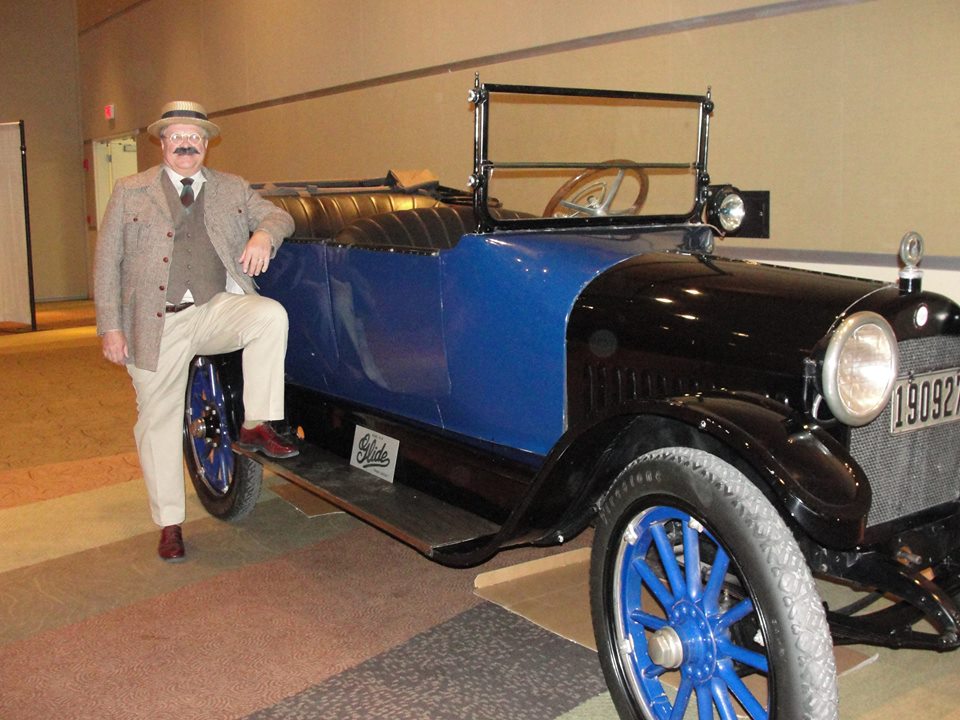
Glide Automobile
The Glide Automobile; in this photograph the car owner is dressed as Teddy Roosevelt.

Most of the cars do not belong to the museum. They belong to local collectors, who pay the museum to store their cars. Along with the cars on display, the museum stores additional cars during the winter, when it is closed to the public. By combining the functions of display and storage, Wheels O’ Time remains a profitable enterprise: storage fees and visitor admission fees ($6.50 per adult, $3.50 per child) are sufficient to fund the museum. Since its inception in 1977 the Museum has been able to balance income and expenditures. Wheels O’ Time operates with a paid staff of two, supported by about 50 volunteers. They are open six months a year, and during that time welcome about 7,000 visitors. Last year, visitors came from 49 states and nearly 30 countries. They are listed as the first attraction for Peoria on TripAdvisor. The museum has even grown at a slow but steady pace – from one building to four, diversifying collections and exhibitions as they have grown. They take on projects based on the availability of interested and capable volunteers. They are only now involved in what Bragg considers their first fundraising effort, to restore a 1931 Ahrens Fox fire truck – and this fundraising effort is being spearheaded not by the museum, but by a local firefighters group. If you are a for-profit museum that makes money off of storing large objects, how do you measure success? Not based on visitor numbers or income: the site manager, Marcia Johnson, was unable to tell me how many visitors the museum receives, and had to direct me to a volunteer for that information.  While she would not discuss income, the museum does not set financial growth as a goal; rather, it looks to balance income and expenditures. When asked how she measures the success of the Museum, Marcia answered with this list:

  • the museum is extremely friendly
  • we enjoy our visitors
  • we enjoy our artifacts
  • we are able to maintain things, have nice working conditions, and draw volunteers who enjoy it.

She added, “Of course we want people to come and of course we want to stay in the black, but our stock holders realize when they invest that it’s not going to be a money-making proposition. It’s something that serves the community, and is a place for people to store their treasures. It’s a labor of love – the people who work here love the artifacts, love the history, love showing them to people.” I’m inspired by Marcia’s response. Maybe this reveals how new I am to the Midwest, and small museums (I moved here from New York City last year) – are there many museums around that would describe their goals in this way?

What do we talk about when we talk about art?

This spring, I taught undergraduate art history at Bradley University. I recently blogged about this experience on the site Art History Teaching Resources. As I considered how we teach art history to college students, and what we – or I – hope to accomplish with this, I naturally also thought about the practice of art history in a museum environment. Progressive, constructivist art museum education is, generally speaking, not dedicated to teaching art history, the discipline at the heart of art museum exhibitions. If museum educators are not teaching art history, what are they teaching, why, and how does this relate to the larger context of art museums?

Continue reading “What do we talk about when we talk about art?”

When is Inquiry with Art Philosophical Inquiry?


Isamu Noguchi, "Sun at Noon"
Isamu Noguchi, “Sun at Noon”

It looks like a donut.

It kind of reminds me of a desert, because of the colors. And since there are lines and cracks, it makes me think of canyons in a desert.

I know what it is: some type of porthole. Maybe there’s a whole world in there, you can go inside.1

Over the past decade or so, art museum educators have developed very sophisticated, widely used approaches to facilitating inquiry-based conversations around works of art. The resulting conversations with visitors are varied and wonderfully unpredictable. The best conversations lead us all somewhere new, often to ideas that shed light on the art but also on the world. We all – the educator included – leave the conversation with a deep, personal connection to the work of art, and the sense that it has a meaning beyond its formal qualities and art historical context.

Art educators are hesitant to judge responses to art. Sometimes we go so far as to claim that there are no wrong answers to an open-ended interpretive question. But, as Sharon Vatsky often reminds me, sure there are.  There are just lots of right answers, too.

But within the vast field of “right answers,” not all interpretive comments are equal. Some are more profound, more insightful, more meaningful than others. Even within a group of five-year-olds one sees variation in the ability to find meaning in art. How do we understand what makes a strong interpretation while helping visitors build their own interpretive skills?

The field of philosophy has some tools we can use.  A quick disclaimer here: There are unquestionably important responses to works of art that are not philosophical, and some that are not even verbal. In this investigation, I am interested here in a specific category of interpretation: interpretations that make connections between the work of art and ideas that explain something about the world.

Philosophy is the search to answer big questions about the world: What is time? Are humans free? Is change possible? Strong philosophical interpretations of art make connections between a work of art and the world.  They often do this through metaphor: one thing stands in for another. This is, very often, what visitors do in front of a work of art:

Isamu Noguchi, "Floor Frame: Remembering India"
Isamu Noguchi, “Floor Frame: Remembering India”

Maybe this is a person’s struggle between going to heaven and hell.  But I guess the person eventually gets to heaven because at the end of the chain of dark and light stones, the path [points to the branch and] leads up…..We are always going back and forth between doing right and wrong, this is a place where you sit and think about your choices.2

Once interpretations are assigned the status of philosophy, we can turn to the field of philosophy for guidance in understanding criteria for good interpretations, and ideas for helping people interpret art. This is a field I continue to explore, but one model worth considering is the idea of metaphor as philosophical hypothesis. Stephen Pepper wrote about this decades ago, and argues that a comment like “It looks like a donut” (see above) fails as a philosophical interpretation because it does not provide a hypothesis about the world. One then tests that metaphor by refining, expanding, and testing it.  Through this process, a successful metaphor grows into a true metaphysical hypothesis.

This theory is particularly compelling for art educators because it suggests that the better metaphor is one that explains more about both the world AND the work of art. Noguchi’s Floor Frame: Remembering India can only be interpreted as a struggle between heaven and hell if that metaphor can be expanded to explain aspects of the sculpture other than the alternating black and white marble, and the sculpture, in turn, can explain aspects of humanity’s, or at least the viewer’s, understanding about the struggle between heaven and hell. The speaker in the quote at the beginning of the post extends the metaphor in both of these directions.

Pepper’s theory is also appealing in its openness.  He argues that one hypothesis cannot judge another – each theory must find its own internal justification. This resonates well with the pedagogical approach of museum educators, who remain open to multiple interpretations. But it simultaneously offers criteria for testing the validity of an interpretation: What can it explain? How strong a metaphor is it?

During one conversation, a museum visitor looking at Isamu Noguchi’s Sun at Noon said, “I know what it is: some type of porthole. Maybe there’s a whole world in there, you can go inside.” This is a perfect example of a thoughtful interpretation ripe for testing. If Sun at Noon is a porthole, what can we learn about relationships between worlds from the work? What types of worlds might this work open us up to, and how? And what does this interpretation add to our understanding of Noguchi’s sculpture?  If museum educators intend to foster interpretive skills in visitors, problematizing metaphors such as this one is an excellent tool.

I am continuing to explore this topic, and welcome your ideas. Do you agree that often vibrant gallery conversations are those that lead to philosophical meaning-making? What philosophers provide ideas we should look at?

This was adapted from a talk given at NAEA in 2014. The original presentation is available here.


Why Blog? Questions to a Museum Blogger

This chain of questions, posed – in various iterations – to a number of museum bloggers, started with #Museum Blogger day on Twitter on March 19th. Thanks to Gretchen Jennings for asking me to answer these questions.

1. Who are you and what do you like about blogging?

After working for 15 years as a full-time staff member of various museums, I have moved to a new role, that of consultant.  As I no longer see and talk to colleagues every day, blogging provides me with a space in which to explore and share ideas.  And the world of museum bloggers has offered me a new set of engaged and informed colleagues.

2. What search terms lead people to your blog?

I’m new to this – I’d like to know that, too!

3. How long have you been blogging, and has your blog changed in any way since you began it?  How?

I started blogging in September 2014.  At first my blog was part of my consulting website, but I moved it to its own space.  Although the two sites are linked, I now think of it as a separate space – not part of my work for clients, but a space to hash out ideas.

Because I have always focused on finding and posing interesting questions, my blog is called “Museum Questions.”  Gretchen Jennings brilliantly suggested that I title each post with a question, so I now do that.  This also helps me think, with each post: What questions does this issue raise for me?  Why is it interesting?

4. Do you have a sense about what impact museum bloggers have in the field?

I am not sure that museum bloggers are impacting the field, as much as extending it. The blogosphere reminds me of the shared workspaces that are so popular now. Blogs are a space for those of us who want to share ideas with others. Some of these ideas catch and spread.  I think the world of museum blogging can be compared with any museum, which offers exhibitions and programs which serve visitors well.  A few of these might reach the broader field, but even those that don’t are important: both for the museum / blogger to try out ideas, and for those who visit / read.

5. If you had a whole week just to blog: which subject would you like to thoroughly research and write about?

My particular interest is in what types of thought processes help us constantly improve what we do. How can individuals and institutions ensure that they have feedback loops which constantly inform practice? How can these feedback loops promote and contextualize innovation?

Right now I’m also interested in conceptualizing art interpretation as a form of philosophizing. If interpretation is philosophy, what can we learn from the field of philosophy that will help us better facilitate conversations with visitors?

6.  If you could ask anyone to be a guest blogger, who would that be?

I’m interested in what we can learn from other fields. I have learned a lot from people in the education field. So perhaps Daniel Willingham, a cognitive psychologist at the University of Virginia. He writes about what we know about how people learn, and implications of this for educators.

7. Share your favorite photo with us that you took at a museum or historic site.


21C - sofa and wall text


I’m not a particularly good photographer, although I do use my camera to capture museum displays that intrigue me. This was the wall text at the 21C Museum and Hotel in Louisville, Kentucky. I used it in a blog post – I’m intrigued by how un-museumy this space feels, just by having a sofa underneath museum signage. To flip that idea around, what are the things museums unconsciously do that make displays less welcoming?

8.  What was the last museum you visited and what was the experience like?

I visited the Guggenheim Museum last week when I was in New York City.  I recently taught my undergraduate students about Futurism, so I was looking forward to seeing the current Futurism exhibition. I made a plan to meet friends there, and ended up barely looking at the art. It made me think about how hard it is to really look at art.  This is especially true in the Guggenheim, where the ramps exert a force that pulls you along, encouraging movement rather than pausing. But, more generally, careful looking is a lot of work, and is rarer in museums than we would like.

9.  If time and money were no object, what museum would you most like to visit?

The Uffizi when it’s closed to visitors (other than me, of course).

Closer to home, I’m very curious about the Crystal Bridges Museum, and hoping to make it there soon.  And I’ve heard wonderful things about the City Museum in St Louis, and am planning a visit there with my family in July.

10. What’s the biggest lesson you have learned from failure?

Failure, and how we can learn from it, is a very popular topic right now. But I don’t think it’s quite that simple. Labeling something a failure or a success is less useful than creating a reflective environment in which we are always learning and improving. Most projects are not flat-out failures or radical successes – and pausing to figure out what was successful, and what was not, and why, and where we want to go next, is how we learn.

11.  If you had to identify the biggest issue for museums (globally) today, what would it be?

Finding ways to measure success outside of visitorship and income. In our society we equate and express value with numbers. But some museums have so many visitors that it is nearly impossible to see the objects, and some museums do amazing work on tiny budgets. What new ways can we identify to measure success?

Can a Hotel be a Museum?

In late December, I visited the 21C Museum Hotel in Louisville, Kentucky.  It is a strange hybrid: a hotel that also functions as a museum, with a permanent collection, rotating exhibitions, and galleries open to the public. The largest exhibition on view in Louisville, Aftermath: Witnessing War, Countenancing Compassion, included work by established artists such as Carrie Mae Weems, Kara Walker, and Yinka Shonibare.

Art by Kara Walker on view at the 21C hotel in Louisville

Museum education programs often ask students to compare museums and other public spaces. How is a museum like a park? A mall? A church? A library? But I don’t think I’ve ever been asked to compare a museum to a hotel before.  Perhaps this is because a hotel is not really a public space: rather, an (expensive) hotel is a semi-private, inherently elitist space, charging large sums for access to its facilities.  The public spaces are liminal, the threshold between the private spaces of the guest rooms and the public world outside the hotel.

What does it mean to site a museum in a hotel?  What implications does this have for the museum experience?

Theoretically, a museum in a hotel offers an experience to people who might not otherwise be museum-goers. 21C is free, and there are no security guards checking bags at the door. This makes it democratic in a way that many museums (especially art museums) are not. Further, it fills a gap: it places an art museum downtown — particularly notable as Louisville’s Speed Art Museum is closed until 2016.

Interactive art at 21C.

A museum in a hotel might also have something to teach us about hospitality,since hotels are part of the “hospitality industry.” But as a 21C museum visitor (rather than a hotel guest), the galleries seemed strangely empty of staff: I did not see any guards, nor were there volunteers or museum specialists to guide me or answer questions about the exhibition. When I had a question about the museum, I asked at the concierge desk; they handed me a brochure, but were not able to answer questions about the museum or the exhibitions.

At least in this case, the museum / hotel hybrid feels like a hotel filled with art – some of it fun, some of it interesting – rather than a museum. Context is important, and art in a hotel is like art in a living room, blending into the decor. It is hard to tell what is a gallery space and what is a hallway; where the art ends and the elevator begins. This may be purposeful, problematizing museum practice and contemporary art. But it feels like compromise, art in a space where it is secondary to the more commercial, more lucrative business of renting rooms to business people and tourists.

21C - sofa and wall text
Wall text and photography above sofas in the lobby of the 21C hotel.

21C has art in the rooms; when I asked a colleague who has stayed in the hotel about the art in her room, she was unable to remember anything about the specific pieces that were in her room.  Likewise, when I browsed rooms at the 21C hotel, the list of amenities featured “original art” sandwiched between “Malin + Goetz bath amenities” and “plush robes.”  Art was reduced to an amenity, without further descriptors.

Museums are paired with many other spaces these days: witness the library gallery or the airport museum, for example. This is evidence of the popularity and appeal of museums — imitation is the sincerest form of flattery. And it complements a democratizing movement in contemporary art and culture, as demonstrated by artist Cai Guo-Qiang’s 2009 project Everything is Museum. But in some ways it weakens the power of what we offer. If everything is museum, what is a museum?

Are Ten Objects Better Than One?

I recently received an email from a colleague whose staff bring objects into schools for one-hour workshops.  He wrote, “We are encountering a difficulty in that the education team is often requesting 10-15 objects per one-hour workshop. While “diversity of objects” is a great topic, we’re trying to curb down the number of requests to 3-5 well thought out choices.”

Museum professionals want people to look closely at objects.   We hear that people spend mere seconds with a work of art or an important artifact; this seems problematic to many of us. In 2011 Judith Dobrzynski wrote, “The amount of time museum-goers spend looking at each art work is a subject of some study and much conjecture. Many years ago, a museum director told met that the average visitor spent 7 seconds looking at an art work in a museum. A few years ago, I heard that the number had dropped to 2 or 3 seconds.”

Time is limited.  No one will (or can) look at fifty objects for ten minutes each in a single museum experience.  Every time we linger at an object we make a choice: this object is worth more of my time, even though it means I won’t have as much time for something else later.

When structuring an experience for visitors, what is the argument for guiding them to look at five objects carefully instead of fifty quickly? And how do museums encourage the visitor behavior they want?

Looking and Thinking Take Time

As I prepare to teach an undergraduate art history survey course this spring, friends and acquaintances tell me that they took a similar course years ago and remember nothing but slides flying by.  Two seconds, or even a minute, per object is not enough to process or make meaning from the object. And without this processing, people do not remember what they looked at.

In an article entitled “Aesthetics and Astronomy: Studying the public’s perception and understanding of imagery from space,” Lisa F. Smith and her colleagues note: “If people do not spend time on the works, it is difficult for there to be a serious level of appreciation or learning.” Similarly, in a 2008 article from American Educator, cognitive scientist Daniel Willingham argues, “What remains in your memory from an experience depends mostly on what you thought about during the experience.” In other words, looking takes time.  That time needs to be spent thinking about what you are looking at.  Without this, you are unlikely to remember much of what you see.

Often articles, didactics, and tour experiences offer a visual analysis.  This is work that museum visitors can do for themselves. But it takes time.

charlemagne
Look at this bronze sculpture for two seconds. Then look at it for another three minutes. What do you notice by the end of the three minutes, that you hadn’t noticed in the first few seconds? What more might you notice if you had another ten minutes to look?

Thinking takes time, too.  And often, for the visitor who is a novice, it takes prompting. Why was this made? How does it fit into its historical context? What makes this object special? What do I think about this object?

Careful observation and extended contemplation are also hallmarks of critical thinking. And they cannot happen in the two seconds the average visitor spends in front of the average object. 

Context is Important

Museum exhibitions can feature tens, if not hundreds, of objects. They do this because it is hard to have a sophisticated understanding of an object when it is offered out of context. How can a visitor contemplate how an object fits into its context without knowing that context? How can he or she understand what makes this object special?

When the Metropolitan Museum offered an exhibition about a single work of art Johannes Vermeer’s The Milkmaid, the curators included other paintings by Vermeer, didactics explaining where The Milkmaid belonged in Vermeer’s oeuvre, work by other Dutch artists of the time, and ceramics from the same era similar to those featured in the painting. Thus, what was essentially an experience about a single object became an exhibition with tens of objects.

Some of the objects included in the Metropolitan Museum's exhibition about a single Vermeer painting, "The Milkmaid."
Some of the objects included in the Metropolitan Museum’s exhibition about a single Vermeer painting, “The Milkmaid.”

When facilitating a dialogue about an object, museum educators often carry large tote bags filled with supplementary materials.  Take the bronze sculpture mentioned earlier:

charlemagne

For a discussion about this object, an educator’s tote might include:

  • other equestrian portraits, in particular that of Marcus Aurelius, which is said to have inspired this sculpture;
  • images of both Charlemagne and Charles the Bald, since art historians are not sure which of these two rulers are featured in this work
  • images of the bronze casting process, and perhaps a piece of bronze that can be touched and held
  • images of other sculptures from Europe in the 9th century

The discussion – which might be ten minutes, or an hour – focuses on a single object. But ten additional objects might be used to provide context.

How Many Objects?

If both careful looking and broad context are important, how might museums offer both? Should an educator going into a classroom take fifteen objects, or just five? How can museums encourage people to look closely, yet offer a broad context that makes sense of these objects?

In Exhibitions:

One of the great ironies of museum exhibitions is that, by including so many objects, they teach visitors not to look carefully. How can a visitor possibly make it through the Whitney Biennial in a reasonable amount of time if he or she looks carefully?  The Museum of the City of New York’s exhibition about Hurricane Sandy, Rising Waters, boasts “more than 200 color and black-and-white pictures.”  Generously, let us imagine a visitor has two hours to spend in this exhibition. In order to see every picture, the visitor cannot afford much more than 30 seconds per image.

Exhibitions could be smaller. But presumably there are both academic and promotional arguments for any exhibition including hundreds of objects.  Aside from smaller exhibitions, how might exhibitions support close looking?

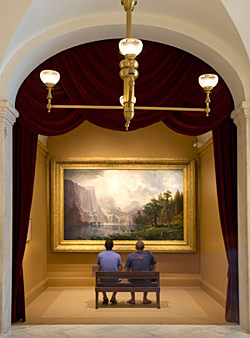
Exhibitions are often curated in a way which gives every work, or at least many works, equal value.  In order to make it through these exhibitions, visitors are often forced to move quickly. What would it look like to highlight four or five key works?  These would have benches in front of them, so that people could sit and look for an extended period of time. Didactics would be offered in a variety of ways – audio, text panels, brochures – so that people could look and get information at the same time. Supporting objects would be included, but arranged in such a way that visitors were cued that the museum wanted them to look at key works for longer than two seconds.

A gallery at the National Museum of American Art featuring Albert Bierstadt's painting "Among the Sierra Nevada, California".
A gallery at the National Museum of American Art featuring Albert Bierstadt’s painting “Among the Sierra Nevada, California”.

Of course, crowded museums lead to logistical problems with careful looking – which is one reason I believe that museums need ways other than visitor numbers to measure success.

In Programs:

In her blog Museum Commons, Gretchen Jennings wrote about a program at the Musee Bonnard, in which participants started in a lecture, which provided context related to a current exhibition. They then went into the galleries for a discussion about a limited number of works of art.  Starting with context allowed for an informed gallery conversation, which everyone could contribute to. It also allowed for a gallery experience that focused in depth on a few works.

Inspired largely by Rika Burnham, Director of Education at The Frick Collection, more and more museums are offering programs that engage visitors in an hour-long exploration of a single work of art.

And for tours, there is always that heavy tote bag, full of images and materials that might help visitors better understand the object.

How else might we teach visitors to look and linger, without compromising the contextual information needed to make an object meaningful?

And Just for Fun

Some museums are experimenting with ways to extend the times visitors look at a work of art.  These don’t relate to providing context or necessarily strategies for careful looking, but they are interesting experiments:

  •  In the exhibition “Museum Minutes,”Kunsthal Rotterdam has placed interventions such as treadmills in the gallery, so that visitors can walk and look simultaneously.

1. Museum Minutes beelddrager, foto Bianca Pilet

  • Daniel Willingham notes that a critical 21st century skills is paying attention, and that this s a skill students should practice.  In order to practice this skill, Willingham passes along a suggestion from Harvard University Art Historian Jennifer Roberts: Choose a painting to study, and study it for three hours.

The Business of Museums

In a recent on-line discussion, I found myself enmeshed in a prickly debate about whether museums should be operated as businesses. Some great points were made on the “pro-business” side: museums need income to keep the lights on; getting visitors through the door is essential to generating income both from earned revenue and from funders; museums need to stay on-mission; museums must weigh risk (such as mounting an exhibition on an unpopular theme) with reward (how does this benefit your institution).

I led the anti-business charge in this discussion, and continue to clarify this point: I am not anti-income.  Museums need income.  In fact, they need as much or more income as they have expenditures in order to survive.   Despite not having attended business school, I understand this simple math.

The problem with running a museum like a business lies in the question of how to measure success. In this light, the heart of the on-line debate was captured in this statement: ” I’m not sure how a museum shows how it serves its public successfully except by numbers “through the door” (whether digital or physical or some other measure).”

Continue reading “The Business of Museums”

Question Collection I

Recently both the New York Times and the Washington Post have published articles sharing great college admissions questions.  Of particular note are the questions from the University of Chicago, which solicits ideas from students, and then uses the best in their applications.  Here are two of my favorites:

“This is what history consists of. It’s the sum total of all the things they aren’t telling us.” — Don DeLillo, Libra. What is history, who are “they,” and what aren’t they telling us? (Inspired by Amy Estersohn, Class of 2010)

The mantis shrimp can perceive both polarized light and multispectral images; they have the most complex eyes in the animal kingdom. Human eyes have color receptors for three colors (red, green, and blue); the mantis shrimp has receptors for sixteen types of color, enabling them to see a spectrum far beyond the capacity of the human brain.

Seriously, how cool is the mantis shrimp: mantisshrimp.uchicago.edu

What might they be able to see that we cannot? What are we missing?

(Inspired by Tess Moran, Class of 2016)

mantis shrimp
Apparently mantis shrimp not only has receptors for 16 types of colors, but is also particularly vicious.

In an earlier post on this blog, I claimed that good questions (in both the museum context and in many educational contexts) are (1) relevant; (2) informed; (3) genuine; and (4) appropriate.  Do these questions hit all four?  

  • Relevance is a funny word in this context, but I would argue that these questions are relevant in that they offer the applicant an opportunity to share his or her individual ideas in intriguing ways. Their relevance is in their quirkiness and openness.  
  • They are informed in that they are rooted in existing information.  The second question could be phrased differently: “Imagine a creature could see four times as many colors as we could.  What would they see that we could not?”  But it doesn’t: it starts with the shrimp, and even provides a link to learn more.  
  • These questions are genuine – or at least, I perceive them as genuine: I really want to know how applicants answered these questions.  
  • And they are appropriate: They are not too simplistic, or too challenging, or too flat, for an 18 year old who wants to attend a highly intellectual school such as the University of Chicago.

Additionally, these questions are intriguing. They lead one (or at least, me) to want to learn more about DeLillo’s Libra and the mantis shrimp.  They make me think about big philosophical ideas about history and perception, and even in the connections between these ideas and the sources: I find myself trying to remember Libra, which I read decades ago, and to consider it with the quote in mind.

I am on a search for good models for questions that can inspire us as museum professionals.  College applications are one source.  If you know of others, please share!

Museum Boards

This week I had coffee with a former museum director, who spoke at length about his former museum’s Board of Directors. He said that when he began his tenure at the museum, the Board’s approach to finding new members was to invite their friends at the country club.  For him, the challenge was to diversify the board: how do you add representatives of minority groups? How do you have a board that looks like the community you want to serve?

Diversification is certainly laudable. But the issue of looking like the community is somewhat misleading. Most museums nominate board members based on their ability to donate or find large sums of money. So when this director began to diversify his board, he looked for a wealthy African American board member. This former director’s museum is in a city where over 25% of the city is African American, and 40% of the city’s African Americans live below the poverty line. I am not convinced this audience is best represented by someone capable of donating tens of thousands of dollars to a museum.

Continue reading “Museum Boards”