Why is self-awareness an essential leadership skill?

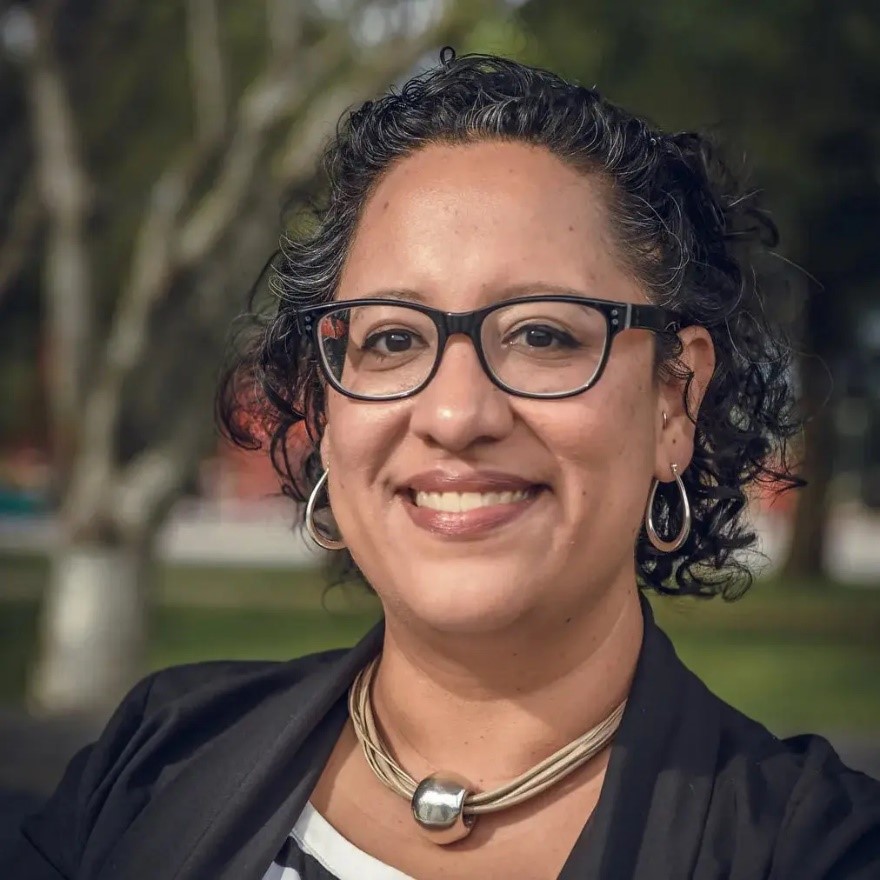
This post is by Jennifer DePrizio. Jenn has worked in art museums across the country for more than twenty years, leading audience-centered program development and interpretive strategies that are grounded in the belief that art helps people better understand themselves and others. She has held leadership positions at the Cleveland Museum of Art, Portland Museum of Art, Isabella Stewart Gardner Museum, and the J. Paul Getty Museum. She has recently shifted her career path to focus on executive coaching and leadership development, founding DePrizio Leadership Group in 2023. Committed to diversity, equity, and inclusion, she brings her passion for art as a tool to build emotional intelligence, empathy, and leadership skills. 

I am honored to be working with Jenn as part of a team of consultants focusing on organizational culture, and thinking about the support we can provide for museums in building their capacity to be great places to work.

The greatest issue facing museums is a leadership problem. Our field is built on a foundation of leadership myths. Until we debunk those myths and replace them with true leadership development, we will not realize the full potential of museums.


Research shows that 90 percent of the competencies that differentiate outstanding leaders and employees relate to the realm of emotional intelligence – for example, the ability to remain calm under pressure, resolve conflict effectively, or practice empathy. But because the museum field traditionally privileges knowledge and intellect above all else, these are not skills that most employees (our future leaders) are trained in or evaluated on.


While leaning on hierarchical power can achieve results in the short term, those results are rarely sustainable without the genuine faith of the people you work with. True influence is developed through trust, investment in relationships, respecting the unique contributions of others, building consensus for ideas, and positivity. To influence others effectively and sustainably, you must understand yourself, have empathy, and know how to genuinely engage with others.


The most essential leadership quality is self-awareness. According to research by organizational psychologist Tasha Eurich, only 10-15% of people are self-aware. The good news is that with intention and effort nearly everyone has the ability to build this essential skill. The first step is to understand and manage ourselves.

What is self-awareness?

“We cannot adjust the wind, but we can control the sails.” Dolly Parton

According to psychologist Daniel Goleman, there are four aspects of emotional intelligence: self-awareness, self-management, social awareness, and relationship management (or social skill). The above quote by Dolly Parton illustrates a core tenet of emotional intelligence: We cannot change or control anyone else’s behavior. The only thing we can control is ourselves and how we respond to other people’s behavior. Self-awareness is elemental in embodying this concept.

Self-awareness is the ability to understand your own thoughts and feelings, consciousness of how they impact your behavior, and understanding the implication of those actions on others. It involves recognizing your strengths and weaknesses, and how your actions align with your values.
There are many factors to consider in relation to self-awareness:

  • Your values and beliefs
  • Your motivations and desires
  • Your character traits
  • Your sense of purpose
  • Your strengths and weaknesses

A self-aware person owns their strengths and limitations; they are neither overly critical nor unrealistically hopeful. Rather, they are honest with themselves and with others.

Self-aware people can also recognize that how they see themselves may differ from how others see them. This can be illustrated by a tool known as the Johari Window.

Image of the Johari Window, a grid with known to self / unknown to self on the X axis, and known to others / unknown to others on the Y axis.

As you can see in this diagram there are four aspects to our identity. Ideally, the open (known to self and known to others) area is the largest. Understanding yourself and being open with others is the best way to build productive, cooperative and trusting relationships.

A hallmark of self-aware people is that they are open to and able to incorporate both positive and negative feedback. This is essential in tending to our “blindspots,” aspects of ourselves that others see or perceive but that we are unaware of. Most often when we receive any critical feedback, our natural reaction is to become defensive. There are many individual reasons for this – I find that what makes me most defensive is being confronted with something about myself that I am not proud of. But all feedback can be helpful regardless of the source. Finding ways to learn how others perceive you is essential to building your self-awareness.

The impact of self-awareness on leadership characteristics

Self-awareness is to leadership as putting on your life vest is to assisting other passengers. We cannot truly be great leaders unless we are self-aware. To understand others and manage relationships, you must first understand and be able to manage yourself.

The twelve characteristics of a great leader: self-awareness, compassion, respect, vision, communication, agility, collaboration, influence, integrity, courage, gratitude, and resilience.

First and foremost, in order to operate with integrity and courage as a leader, you must be grounded in your own truth: What core values drive your behavior? How do you show up in the world? What unique worth do you bring to your position and organization?

Further, great leaders are able to develop a vision for the team’s direction and share with clear, direct communication. A recent survey by MuseumExpert.org about barriers to human-centered workplaces found a growing disconnect between leaders and the daily work within museums, particularly between leaders and front-line staff, suggesting a lack of shared vision and clear communication. The role of a leader is to bring a team along to enact an articulated vision through influence. In the context of good leadership, influence means persuading others through logical, emotional and cooperative means; without trust this is not possible.

And without a keen self-awareness, particularly about how their behavior and actions impact others, a leader cannot successfully build the rapport with their team needed to build trust. To build this rapport a leader must demonstrate genuine respect, compassion and gratitude. When a leader is clear about their strengths and limitations, they are more naturally able to see and value the skills and perspectives of others, thus strengthening their empathy for others and willingness to show appreciation.

Finally, self-awareness is essential in supporting a leader’s response to others, especially in times of stress. Understanding one’s self includes an acknowledgement that everyone’s perspective is unique. This mindset allows for curiosity and empathy, thus supporting collaboration. Further, a self-aware person embodies an appropriate level of self-confidence, especially in the face of stress or opposition. Self-confidence impacts one’s agility, or ability to think on one’s feet, and resilience which in a leadership context is more than the ability to bounce back from a tough situation. It is the ability to respond to challenges with a positive outlook in order to maintain the emotional health of the team.

How can you expand your self-awareness?

The best way to build one’s self-awareness is through intentional reflection and feedback. Here are some ways that you can strengthen your own self-awareness, which in turn will impact your leadership.

  • For one week, take 5-10 minutes at the end of each day to write about situations throughout the day that brought you great joy, as well as situations that were challenging for you. At the end of that week, look back over your notes. What patterns can you find that may have impacted your feelings? Where do you see opportunity for adjustment?
  • Reflect on your values, and how they align with your professional situation and aspirations. A misalignment of values and context can impact the way you show up in the world. There are many resources to support exploration of one’s values – this is one I particularly like.
  • To better understand how you are perceived by others, find ways to gather feedback from those around you. True feedback is information about someone else’s reaction and response to your behavior. Unfortunately much of what is shared as “feedback” is in fact judgement. To receive genuine, helpful feedback, ask a trusted colleague to share their observations and reactions on something specific about your behavior. For example, if want to lead meetings with more confidence, create a list of what you want confidence to look like for you. Then in advance of the meeting, ask a colleague to look for and note if/when you show these signs. In this way, you are less likely to receive judgment. All constructive feedback is useful, regardless of the source. Listen to the feedback you receive with openness and humility. Pick one piece of feedback you’ve received to work on—what small changes can you implement?
  • Prioritize training opportunities that explore skills beyond the typical content focus. Find workshops or resources that encourage emotional intelligence and leadership skills. For structured support, consider working with a leadership coach, who can support you in reflecting and creating a plan for intentional growth.

Leadership is not a promotion — it is a career change. It therefore naturally requires a different skill set, including some skills that may come naturally, and some that may require work. Beginning with focused attention on your own self-awareness sets you up for success in leading with integrity, empathy and compassion. This is the leadership model the museum field needs to live up to its potential for both its audience and staff.

How can different groups in the museum agree on impact?

Is alignment around impact just a luxurious fantasy? Photo by le Sixième Rêve on Unsplash

This post is by Robert Weisberg, the author of the blog Museum Human. I have had the pleasure of talking to Rob about museums, museum problems, and how we can do better. Last week, he shared my post on “Museums as Workplace Communities” on Museum Human.

A little more about Rob: Robert J Weisberg (he/him/his) has worked at The Metropolitan Museum of Art in New York for nearly 30 years. He began writing online in 2012 in a shared blog about digital publishing for museums; as he wrote more about the growing organizational culture movement, he began his own blog in 2015 about the organizational culture of cultural organizations, which eventually became the free-subscription-based Museum Human. He lives in New York City with his wife and a host of interdimensional entities. Find him on social media at Mastodon and Bluesky.

His credo, to paraphrase Winona Ryder in Heathers, is, I just want my workplace to be a nice place.

Robert Weisberg on the Metropolitan Museum of Art’s rooftop exhibit space.

How can different groups in the museum agree on impact?

Museums—and their departments and workers—are increasingly concerned about impact beyond the institution. But can museums have impact externally when they may not agree on just what it means—or how to get there—internally?

What is impact?

There is an old saying, often miscredited to Mark Twain: “Everybody talks about the weather, but nobody does anything about it.” A museum-field version might be, “Everyone in museums talks about ‘impact,’ but no one agrees on what it means.” 

Museum practitioners often agree on how to achieve impact, however. Randi Korn’s masterful Intentional Practice for Museums: A Guide for Maximizing Impact doesn’t appear to be concerned with defining impact; rather, she focuses on how museums can be intentional once they’ve decided what they want to achieve with the public. 

In a 2020 writers roundtable with Korn for Kyle Bowen’s Museums As Progress group (still called, at that time, SuperHelpful), 30 museum professionals circled around the real-world truth that impact only exists where there is alignment. What are the steps that align the museum’s desires and work – across departments, exhibits, and programs – to the audiences’ (and communities’) needs? 

Perhaps noting a trend towards treating museum outcomes as social phenomena, this article from the American Alliance of Museums defines “social impact” as:

“the effect of an activity on the social fabric of a community and the well-being of the individuals and families who live there. … Social impact addresses how museums may strengthen a community through education and lifelong learning, helping visitors understand multiple perspectives, and emphasizing the importance of personal and community well-being.”

Circular views like this are echoed in articles like this one from Blooploop, with a similarly fuzzy concept—impact is what museums do when they matter to some group, whether audience or community. And Dr. Lynda Kelly had a recent blog post with a host of definitions from social and economic impact studies, including measures from the Australian youth-focused organization ReachOut: reach, engagement, and outcomes

These valuable works by esteemed museum professionals beg the question: do museums have a shared definition of impact? Are attempts to have consistent and pervasive definitions tied up in internal museum dynamics and disagreements between various departments and professions? 

Personally, I’m partial to one view, courtesy of my wife, that the purpose of museums is (or should be) to inspire current and future artists, historians, scientists, and thinkers to rebellion. That may be antithetical to the usual way that museums define themselves, but I certainly believe that museums need a more pointed role in a society in the throes of collapse, to quote Robert R. (Bob) Janes

Differing understandings of impact

To follow up on Korn’s point, is the importance of impact in its intentionality and practice—the process and practice of alignment, rather than the impactful goal itself? I’ve learned from colleagues in many museums about the differences in vision and priorities among people from various parts of their institutions and different levels of the org chart. 

Some of this is to be expected—museums are filled with different people, backgrounds, perspectives, and skill sets. (Though this diversity can continue to improve.) A version of this disconnect can be seen in the core values exercises that museums have undertaken in recent years, often as part of the process of developing strategic plans.

These explorations can surface fundamental differences in how departments and workers view themselves in their institution and how they extend this identity to their audiences. While core values are different than strategy, mission statements, vision, or priorities, it’s not always made clear to staff just what these differences are—or why they matter—and these exercises can leave staff with the persistent sense that their input was performative. 

These core values endeavors are also usually top-down, starting from the leadership playbook of well-established organizational terminology: words like “excellence,” “customer-centered,” “community,” and now “DEI” (I prefer the term ABIDE) figure prominently. 

The process is rarely worker-centered, and therein lies the problem with institutional alignment: the workers who make the most impact—often the ones, such as front-of-house staff, who are busiest with just plain working—are least represented in discussions about values. These discussions are helmed by leaders (or their immediate team) or outside consultants who can cherry-pick staff with particular outcomes in mind. 

Curatorial, education/interpretation, visitor experience, digital, external affairs, and publications teams, just to name a few, truly experience the work of the institution in varied ways. This diversity of experience affects the way that goals and vision get interpreted by different departments in the museum. For all that organizations like to say we’re all in this together, the reality can be very different. This variety can be okay; it’s useful to have a diversity of outlooks and mindsets. However, organizations rarely acknowledge these differences nor consider them in evaluating the workplace. 

Attempts to align an understanding of institutional impact can be further hampered by staff differences—not just in broad generational groupings like boomers, GenX, millennials, and GenZ—but in career experience, digital familiarity, and, especially, marginalization and trauma

How workers pushing back affects impact

Controversies over pay transparency, equity, and compression are perfect examples of this. Organizational leaders may have the best of intentions in making pay more fair around the institution, but decades of job-description decay, unclear career pathways, and cost-of-living increases turning into merit-pay rewards have undermined the ability to compare any two jobs in an organization. These, and other issues with the current museum business model, can also hamper alignment around the institution towards impact—overworked and under-resourced staff can’t be consistently effective. 

Just as importantly, there is also a measurement gap when it comes to impact and outcomes. (A great read on the importance of measuring outcomes is DEI Deconstructed: Your No-Nonsense Guide to Doing the Work and Doing It Right by Lily Zheng, which I wrote about here.) What exactly should museums be trying to do, and what does success look like? And the gap is multi-dimensional, both between leaders and staff and between different teams around the museum. 

Zheng’s book discusses the organizational culture that surrounds ABIDE efforts and spends considerable time differentiating organizations based on trust levels in the institution. Without delving too deep into Zheng’s argument, they analyze high-, medium-, and low-trust organizations, and I believe that strategic plans and vision statements, developed by leaders, passed through managers, but imposed upon workers who rarely feel these values in their everyday work, contribute to the lack of trust. 

There’s no regular mechanism for keeping workers, managers, and leaders aligned, whether around strategy, core values, vision, or impact. Remote and hybrid work, for all of their positives for many people, have exacerbated the disconnect between the C-suite and workers. This isn’t to say that a return-to-office mandate would make alignment issues go away, but increased flexibility requires more active communication from leaders and managers to keep everyone reading from the same page. 

There is also an increasing cultural difference between managers and workers, whether emerging professionals or long-term staff outside of senior management, as described in the Museums Moving Forward report Workplace Equity and Organizational Culture in US Art Museums (which I wrote about here). Museum unionization drives are compelled by US labor law to reinforce that worker/manager dividing line. Adding to all of this is one of the central paradoxes of the museum field, that many workers toil in the expectation of low pay while donors and board members are extremely wealthy. 

More workers are calling this legacy out, as are more activist groups in the cultural sector. While some leaders in the field do see things differently, their hands may be tied by the museum business model and the prerogatives of the majority of leaders and important staff who have different political views, or at least different views about the moral dimension of great wealth. 

What this means for impact—assuming we can finesse the definition of what impact is, and stick with Korn’s emphasis on it requiring institutional intention—is perhaps the primary challenge of our field at the moment. Leaders bring in visions of different exhibitions and programs, or better community relations and ABIDE, but they may not understand, appreciate, or address the everyday work of the museum. 

Impact is a process that should involve everyone in the institution, and it starts with aligning staff around communication, which increasingly is about data and documentation. We know what might happen if a gallery or wing is poorly maintained or past its prime, but what happens if archiving practices are outdated, whether historical documents or computer files? What if there are too many technology platforms and communication preferences within the institution? Do workers get asked about and acknowledged for what they can contribute to these questions? In the end, workers feel that no one wants—or listens to—their input, leading to defensiveness, cynicism, and resentment, and all of these blunt the potential impact of a museum.

Many museums have upped their data game, but it’s not clear that this is being communicated throughout the organization or leading to aligned outcomes. Do different departments share the data that’s most important to them and their understanding of what outcomes are really desirable? Without time for respectful conversation, it’s unlikely that impact will be a shared endeavor.

Why impact matters

Impact needs to be a collective narrative and a shared understanding. Desired outcomes need to be developed and explained thoroughly and consistently in order to generate, if not complete agreement or even consensus, at least consent (willingness to acknowledge and abide by decisions they may not agree with) among all staff that these are a set of current priorities. Workers should also have an opportunity to explain their work to manager and leader levels, as well as other groups around the institution. 

What are some ways that good outcomes can be developed jointly? What do they mean to colleagues, visitors, even non-visitors? Each museum can and should have their own goals and outcomes, and these need to be more a part of everyone’s work than just all-staff meetings and emails. This takes time and attention, as does giving workers more of a say in impact. Some portion of everyone’s day has to be spent on impact: telling stories and sharing narratives of things they do that relate to institutional impact. The idea of work and productivity needs to change.

Alignment is a slow and difficult process, but it’s as important as being a customer-centric workplace. Museums need everyone on the same page, while allowing for different readings of the text. It’s what makes every museum special.

How can workplaces function when employees are recovering from recent COVID trauma?

Photograph by John Cameron / Unsplash

This post was first published on Museum Human. I have had the pleasure of a few conversations with Rob about the state of museums, and as a result, we are sharing some of each other’s ideas on our blogs. Stay tuned for a post by Rob on alignment and impact, which will appear here next week.


Recently, I attended a workshop about trauma and communities which positioned communities as needed spaces for healing from trauma. Our workplaces are communities; in our fractured modern age, for some individuals the workplace may be one of their few communal group resources, as individual friends or far-flung families often do not act as communities.

COVID caused widespread trauma, and we are still addressing the impact of this. When people are traumatized they are frightened; they reenact moments of trauma and struggle to connect with others. We don’t want this for our museum communities, internal or external, as individuals or as employees. So how can museums better meet the needs of employees still recovering from the trauma of a pandemic?

COVID and Trauma

My research on trauma is taken from Judith Herman’s book Trauma and Recovery, originally published in 1992 and considered a seminal resource on this topic. (You can find a PDF of this resource here, and the page numbers below refer to the pages of this PDF). Herman writes, “Traumatic events are extraordinary, not because they occur rarely, but rather because they overwhelm the ordinary adaptations to life…. The common denominator of psychological trauma is a feeling of ‘intense fear, helplessness, loss of control, and threat of annihilation.’” (p 24) Trauma is the result of feeling powerless in a moment of fear.

Individuals deal with trauma in different ways. People initially respond to danger with either a flight or fight response. “When neither resistance nor escape is possible, the human system of self-defense becomes overwhelmed and disorganized…. Traumatic symptoms have a tendency to become disconnected from their source and to take on a life of their own.” (pp 24–25)

The COVID pandemic caused wide-scale mass trauma. In 2021, Tedros Adhanom Ghebreyesus, the World Health Organization Director-General, said, “Each and every individual on the surface of the world actually has been affected…. And that means mass trauma, which is beyond proportion, even bigger than what the world experienced after the Second World War. And when there is mass trauma, it affects communities for many years to come.”

Psychologists and health researchers agree. According to a team of psychologists writing in the Journal of Affective Disorders, “Current research suggests that in the aftermath of the COVID-19 pandemic and associated measures, one in five people could develop clinically relevant psychological distress.” The article also cites research that refers to COVID as a collective trauma, “defined as the psychological response of an entire group to a traumatic event.” The pandemic has impacted not just individuals, but communities. Even though this is a shared experience that “emotionally connects people around the world through helplessness, uncertainty, loss, and grief… [it] can unsettle community connections, and fundamentally alter aspects of community functioning.”

Herman wrote about terrible occurrences that many of us can only imagine: war, rape, domestic violence. We understand these as events that lead to fear, helplessness, and loss of control. But it turns out that recent events impacted many of us in the same way: provoking a fear of death for ourselves and for our loved ones; fear caused by sudden unemployment or the loss of one’s livelihood; and the profound losses of control and community.

COVID, trauma, and museums

Herman tells a story shared by a veteran of the Navy. His ship went down, and when rescuers arrived, the officers were rescued first. Although this sailor recognized this as normal military procedure, he was still horrified to realize that his life was expendable. Herman notes, “The rescuers’ disregard for this man’s life was more traumatic to him than were the enemy attack, the physical pain of submersion in the cold water, the terror of death, and the loss of the other men who shared his ordeal.” (p 40)

During COVID many museum staff members, especially front-line and junior staff members, were abruptly laid off by their employers. Suddenly, people who chose museum work because of a passion for the field were deserted by their institution. They had no idea when the pandemic would end, whether they would ever get their once-valued jobs back, or how they would support themselves once government funding ran out. For many museum workers, the workplace community is a precious, supportive environment; with layoffs, the loss of work emails and contacts, and the general isolation caused by COVID, many people lost these communities, as well.

The impact of layoffs on individuals was beautifully illustrated in a March 2024 recorded conversation between Mike Murawski and Joe Imholte entitled “Life After Layoff.” Mike spoke about his own experience losing his job at the start of the COVID pandemic. “It was an intense moment. At the same time you’re being laid off from your job, you’re looking around and thinking, you know, I’m in the largest global pandemic and economic shutdown in my lifetime, so it isn’t like I can turn around and look for employment elsewhere. It was a really challenging and difficult moment.” And later he says, “Our identities get so tied to the work and these positions, to an unhealthy level, to a moment where then when that tie is severed and that identity is cut off you’re kind of like, ‘What am I going to do? Who am I?'”

Both Mike and Joe talk about the loss of community they felt after losing their jobs. Joe said, “You lose a community. I was a part of a community for 25 years, for 5 or more days a week, and then suddenly they’re gone.” And Mike added, “There are people that you actually see more frequently during the week than your family, and all of a sudden you’re just, gone, and almost like you can’t even… you don’t feel like you can communicate with them, they are now on the other side of some invisible line.”

In June of 2020, a group of individuals in the art world launched the Instagram account @ChangeTheMuseum. This was in direct response to the murder of George Floyd, another moment of collective trauma, and was part of a wave of anti-racist protests against police brutality and the institutional racism that Floyd’s murder rendered unignorable. Within a month @Change the Museum had 63 posts and nearly 4,000 followers. The themes this group found in the stories being shared included that “museum’s human resources departments ‘don’t protect individuals, they protect the institutions they serve,’ and predominantly white boards ‘are the true rulers of our public institutions.’”

@ChangeTheMuseum represents a complicated movement in museums. Some of the stories shared on this platform may evidence not only inequity, but also a known psychological reaction to trauma—the unconscious reenactment of traumatic events in disguised form. Through this dual lens, many of the posts on @ChangeTheMuseum can be read as a reenactment of the trauma of sudden, field-wide and inequitable layoffs—an experience which, like the sailor’s experience shared earlier, demonstrated with brutal clarity that existing structures and authority held so many individuals were expendable. @ChangeTheMuseum is just one, very public, space in which these reenactments take place; they are also happening regularly at museums, impacting the way people engage with each other and understand the actions of others.

Healing from trauma happens within communities. Herman writes, “Trauma isolates; the group re-creates a sense of belonging…. Trauma dehumanizes the victim; the group restores her humanity.” (p 154) Traumatized museum employees, abandoned by their former work communities, are creating new ones. These include communities of protest engaged in lobbying for fair treatment, ethical practices, and often for staff unionization. (Although some museum workers unionized prior to 2020, this work has increased, impacting many more museums since the pandemic.) The response of museum leaders to these actions is mixed, with a few supporting union efforts but most struggling with groups protesting against the practices of some donors and board members, and for higher pay and fair treatment.

Herman notes that, historically, society has dealt with trauma responses by discrediting the victim. For example, “When the existence of a combat neurosis [shell shock] could no longer be denied, medical controversy, as in the earlier debate on hysteria, centered upon the moral character of the patient.” (p 14) While employees are sharing perceived threats to their value and sense of autonomy as well as to the integrity of museums, museum leaders often dismiss these complaints, either assigning them to youth or a lack of understanding of the pressure museums are currently under, as decreases in post-COVID audience numbers and contributed income threaten budgets and programs.

Museums as spaces of healing

Many museums have programs for visitors and communities that explicitly address healing. Claire Bown of The Thinking Museum has covered much of this work. She dedicated an episode of her podcast “The Art Engager” to prescription programs in museums and MoMA “Artful Practices for Well-being” in her blog.

Museums rarely address employee healing with the same energy and intentionality as they address visitor programs. It seems evident that in order for staff to represent the museum in helping visitor communities with healing, they must feel the same care and attention from their employer. But here museums run into a conflict of roles. Workplaces need to maintain a level of professional distance in order to function. The School of Social Work at the University of Iowa has a web page on which they talk about professional behavior, which includes appropriate attire, punctuality, respectful and deferential interactions, professional language, maintaining boundaries, and “avoiding the expression of raw emotions.” Thus, while a two-hour program can function as a therapeutic space, a staff meeting cannot.

But a workplace is a community, and arguably, right now it’s a community full of people (from entry-level staff to leadership) that is recovering from trauma. A March 2024 article about Pixar in Harvard Business Review notes the relationship between authenticity and mental health: “The research suggests that feeling more authentic at work is associated with greater well-being and a sense of belonging. In contrast, covering up your authenticity can feel stifling and lead you to search for safer work environments. Furthermore, research reveals health impacts of silencing yourself. If you’re constantly calculating and on high alert, the cognitive load can feel exhausting.”

How can a workplace give employees what they need right now—a space of connection and healing—while still functioning? How can a museum be a space of healing for staff and still create and mount exhibits, run programs, conserve objects, welcome visitors, offer tours, generate revenue, solicit donations, cultivate new members, and keep those white-cube spaces clean? How can museums offer every individual what they need, including those leaders who are not adept at dealing with the emotional needs of their staff?

I am a proponent of using program design tools to think about and improve employee experience. With this in mind, I reached out to Windy Cooler, the leader of the workshop referenced in the first paragraph of this post and a doctoral candidate in Divinity who leads conversations in Quaker spaces about trauma and conflicts, to discuss how museums might address trauma and healing. (Read another conversation with Windy here.) Windy noted that if the current workplace culture is not working the way it needs to in 2024, then we need to develop new structures for the workplace and be very clear and transparent about these structures. What spaces for healing can the workplace offer? Where do people need to leave their emotions at the door? 

Here are a few ideas from Windy and others for how museums (and other workplaces) might address trauma and foster a community in which people can heal:

  • Build understanding of this topic: of the challenges employees may be facing, and the human, community work that needs to be done. For example, a group of staff members that includes leadership and human resources representatives might form a study group to read and discuss Judith Herman’s Trauma and Recovery and how these ideas resonate in 21st century museums. Windy has also found family systems theory and polyvagal theory worth learning about and discussing.1
  • Offer discrete spaces and times to share and connect in a personal way. For example, hold an annual retreat, or even monthly or quarterly meetings, where people are allowed and encouraged to bring their whole selves, not just their professional selves. These are moments when supervisors can hone their listening and empathy skills as well as moments where problems are identified and compassion is shared, with problem-solving saved for a separate time. Clarify that this is different from other meeting times—while everyone needs to leave some of their own personal life at the door for a workplace to function well, these are opportunities to focus on the full person, rather than the individual as an employee.
  • Create new policies that allow and encourage individuals to identify and manage their own needs. This requires trust and generosity. For example, encourage employees to take note of when they are having a difficult time and take a mental health day instead of coming into work, or, if this is not possible, reschedule any difficult meetings and work from home or in a space where they can practice self-care.
  • Ensure that people who need it are getting help from trained professionals, so that managers are not put in the position of dealing with mental health struggles they are unqualified to deal with. For example, offer staff (all staff, not just full-time staff) access to quality therapy services (including the option of in-person, ongoing therapy) as a benefit of employment.
  • Put safety and connection first, because these are essential to healing. Encourage communities within the workplace—such as reading groups, lunch groups, and other social opportunities—where connection-making can happen. And prioritize expressing concern and understanding. If someone is visibly having a hard time, say something about what you’re noticing, and ask if they need to take some time to themselves or skip or reschedule a meeting—help them process and deal with the emotional turbulence they are dealing with, which ultimately helps maintain boundaries around work meetings as spaces for focusing on work.
  • One aspect of trauma is the lack of autonomy felt in the moment of crisis. Help employees recover their own autonomy by allowing them as much control over their area of work and their work style as possible. For example, identify up front what ideas need to be vetted, and where employees can run with an idea. Their ideas may not be the same as the ideas of their managers; find the spaces where this is ok and the spaces where it is not. For the spaces in which consensus is needed, help create processes upfront so that individuals do not feel like they have done work and expressed ideas and then are undercut.

People heal from trauma through connections with others, individually and in their communities. Herman writes:

“Commonality with other people carries with it all the meanings of the word common. It means belonging to a society, having a public role, being part of that which is universal. It means having a feeling of familiarity, of being known, of communion. It means taking part in the customary, the commonplace, the ordinary, and the everyday. It also carries with it a feeling of smallness, of insignificance, a sense that one’s own troubles are “as a drop of rain in the sea.” The survivor who has achieved commonality with others can rest from her labors. Her recovery is accomplished; all that remains before her is her life.” (p 170)


  1. Windy warns that polyvagal theory is not entirely accurate regarding human anatomy. However, she says, this theory notes that we behave in predictable ways given our own history of trauma and stressors; these behaviors escalate and deescalate in a predictable order; and that what we most need in order to stay connected and curious is for connection and security to be offered to us. We need to be offered a hand to guide us through the stages of collapse, fight or flight, and back to a place where we can offer the same guidance to others. ↩︎

What is Dialogic Questioning? Interview with Sarah Pharaon

In 2010 I published a book that outlines one way of teaching with works of art – a thematic, inquiry-based approach. Although my ostensible audience for this book was teachers, this book was developed from practice in the museum field, and is used by museum practitioners. Since then, although I still use this approach, I find myself very interested in other methods of teaching with objects, and a number of Museum Questions posts have explored alternate approaches to talking about objects, or using objects to spark conversation. These include: 

In January I had the pleasure of talking to Sarah Pharaon, Principal, Dialogic Consulting. Prior to launching Dialogic Consulting in 2020, Sarah worked at the Lower East Side Tenement Museum and the International Coalition of Sites of Conscience. 

Sarah Pharaon facilitating a workshop

Sarah, what is dialogic questioning, and why might museums want to use it?

Dialogic interpretation is a way of communicating that is uniquely equipped to address two important contemporary museum issues. 

First, over the last few decades we’ve seen a steady increase in museums willing to take on the challenging portions of their own histories as institutions. But nonprofit institutions that don’t have a history of strong activism tend to be conflict avoidant, and Boards tend to be conflict avoidant. And so that movement to confront our own institutional histories, and also larger histories within our world, has pushed institutions towards something like dialogue as a result. 

The other issue is a more focused interest in community engagement. In order to be more community-driven, we need to look at our communication styles, and redefine them in order to shift the power hierarchies that have been in place for decades.

In dialogic interpretation, one of the core principles of building effective structures for dialogue is that we rely on a shared experience. Most of the time when we find ourselves in disagreement with each other, the basic facts, the information that we have that is leading us to be in disagreement is not the same. So if I’m someone who watches the BBC and you are someone who watches MSNBC, there will be differences in the way that the news is selected and narrated that have led us to believe different things. Or we might have read different historical accounts.  Or we might have very different lived experiences. 

Museums and cultural organizations are uniquely equipped to be venues for dialogue, because we have content. This content can become a shared experience. So in an art museum, a work of art becomes the the shared experience that people can discuss. You may never have seen a painting by, for example, Vasily Kandinsky, before coming on my tour. However, I know as a facilitator you have all seen this painting that we are looking at together. So I can start my dialogue from that space.

What does dialogic interpretation entail?

Many museums currently use Tammy Bormann & David Campt’s Arc of Dialogue, because it mirrors the way that we tell stories. At the beginning of a story we introduce our cast of characters, make sure we all know the setting, and make sure that we all understand the narrator’s voice. The story builds to an incendiary incident, and then continues until the climax. It then moves through the denouement and resolution. 

Dialogue asks us to follow much the same process. In the very beginning we’re going to introduce ourselves and our role as a facilitator. Everyone who’s involved in the dialogue is going to introduce themselves in some way as well, so that we have an idea of who’s participating within the conversation.

And we’re also going to talk about setting. What are the guidelines?  Guidelines are not rules about how to treat the objects or move through the galleries. Guidelines are about how we’re going to treat each other, as resources. It might include, for example, a guideline like: You are not the only one who is right. A facilitator then uses scaffolded dialogic questions and techniques to move a group through the remaining sections of the arc.

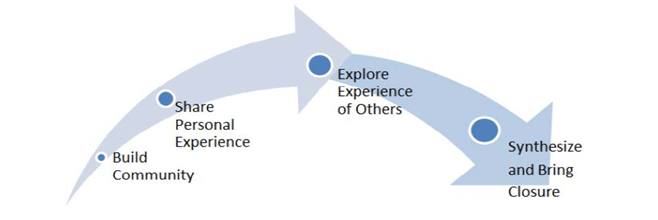
The National Park Service talks about this in four phases:

The Arc of Dialogue, from the  Forging Connections through Audience Centered Experiences Workbook by the Interpretive Development Program of the Stephen T. Mather Training Center, Harpers Ferry, WV Spring 2018

Phase 1 – Build Community. The first question should be low vulnerability “I”. These are questions in which the only right answer comes from lived experience. Everyone in the group needs to answer this question. 

Phase 2: Share Personal Experience. Next, you get to questions that are high vulnerability “I”. These are questions that are a little harder to answer. They ask more of us as participants. There is a little more risk in answering them. We’re going to reveal a little bit more about ourselves and how we think.

Phase 3: Explore the Experience of Others. We talk about this as high vulnerability “we”. Now we are asking folks to think about the collective, the structures that underpin why those personal experiences that people shared in Phases 1 and 2 differ from the experiences shared by others in the group. When we’re at 3, that’s where we have the most potential for disagreement. So it’s really important that we work in the “we” in that space, looking for collective discussion around some of the challenging issues that we’re working through.

Phase 4: Synthesize and Bring Closure. This is the denouement, you’re bringing the conversation to a conclusion, through a low vulnerability “we” question. We can’t really expect agreement, but we can work towards a conclusion. In this phase we are synthesizing and bringing the conversation to a place where people can step away acknowledging where they learned something about themselves, and what they have learned from the larger group.

What does this look like in the context of a museum you’ve worked with? 

One of the things I tell folks is that I shouldn’t be able to take your dialogue questions and put them anywhere else at any other institution in the country. The actual nature of the questions, the focus of the dialogues that you want to have, should be related to your unique competitive advantage.

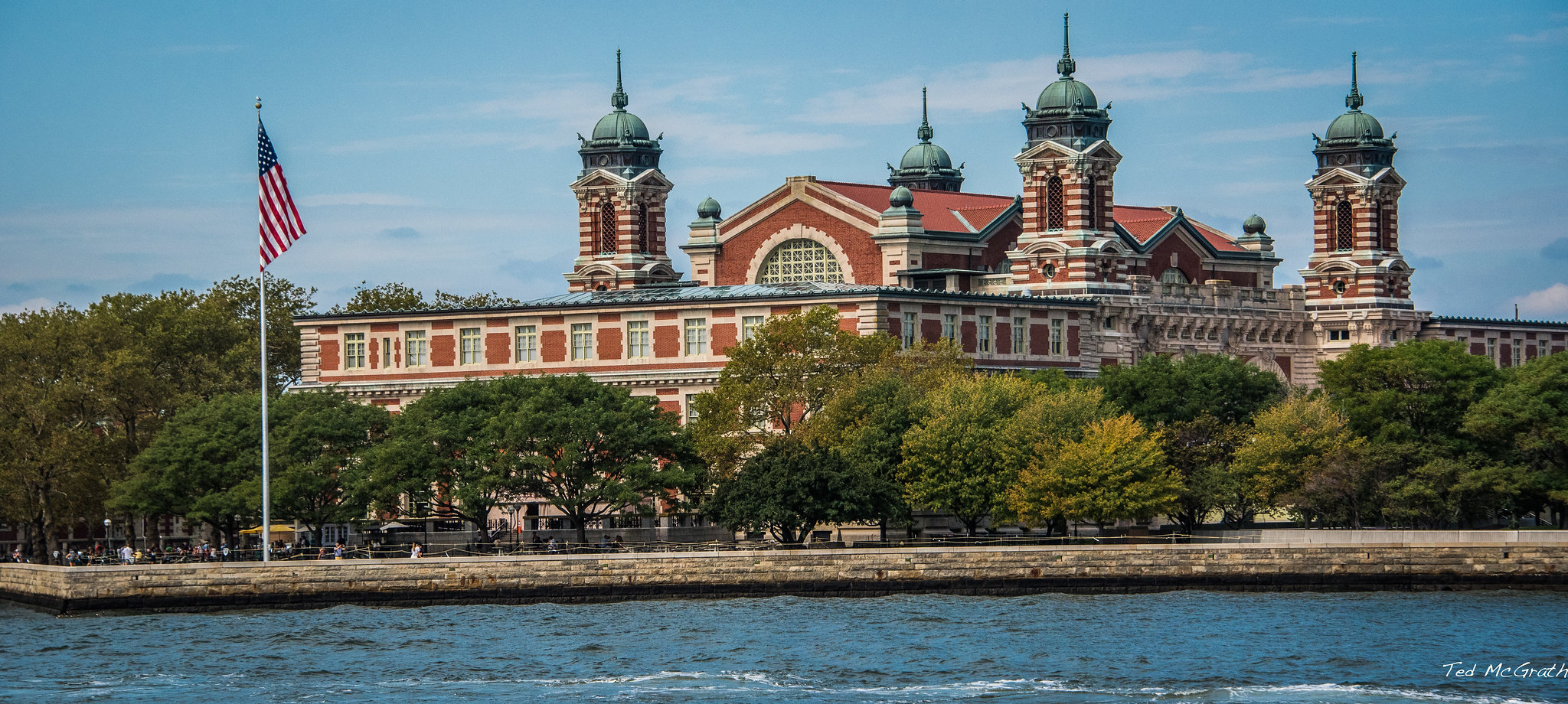
Image of Ellis Island by Ted McGrath, September 9, 2016, from Flickr.

Years ago, while with the International Coalition of Sites of Conscience, I worked with staff at Ellis Island. There are a lot of museums across the country who can and should be talking about immigration – whether they’re showing art that was created by an immigrant, or have an exhibit about new immigrants to their local community in the past 20 years. But Ellis Island is a place where we as a nation determined and implemented immigration policy. This, along with other gateways to the country, like Angel Island, is their unique competitive advantage. The conversation about immigration and contemporary immigration is one that their content allows them to have in ways that not every other institution can have as authentically and with as much integrity. 

At Ellis Island, a Phase 1 question is: When people ask you where you’re from, how do you answer that question? And why do you answer it the way that you do? This is a question that starts the work of surfacing deeper content. You might hear answers like, “I hate when people ask me that question,” “When they ask me that, they’re only asking because of my accent.” Everyone in the group answers the question.

In Phase 2, you might ask something like, Tell me a little bit about what immigration looks like in your community today. This is a harder question. Not everybody is going to want to answer it. This question is built to help me understand why I might have different views about contemporary immigration than you do.

The answers in Phases 1 and 2 give me as a facilitator a deeper knowledge about who’s in the room. They also help everyone understand whether this is a place where, and people with whom, they want to invest their time in dialogue.

Phase 3 is a question like, What factors, if any, should the United States be considering in determining who is allowed to enter the United States and who is not?

In Phase 4 I might ask, What value should be the driving value crafting our immigration policy?  And I’m just asking participants to name the value for me. Or I might ask, What is one of your personal values that you would like to see reflected in American immigration policy? It’s not a discussion. If I were to say “belonging,” and the person next to me were to say “security,” that’s ok. 

Any other tips for educators who want to try this approach?

Museums already have a wealth of valuable interpretive techniques and methodologies. So if a museum is using, for example, Visual Thinking Strategies (VTS), we would still engage visitors in VTS, but within a dialogic context. We might use VTS to help visitors describe what they see and how it makes them feel. Their shared observations and feelings then become additional shared content. I’d build the dialogic arc from those responses. 

I talk a lot about dialogic interpretation as jazz. You learn all the structures, just like you do with other forms of interpretation, so that then you can riff. You know  that the group may not be ready for a Phase 3 and use another Phase 2 instead.  Or someone might say something at Phase 1 that pushes you immediately to Phase 3.  Understanding how dialogue is built allows you to recognize visitors’ needs and make decisions in the moment with greater success.   It helps reduce our fear of conflict – a boon for conflict-avoidant institutions. 

What is Burnout? A Conversation with Mike Murawski

Last week I had the pleasure of talking to Mike Murawski about burnout for his Agents of Change conversation series. You can listen to our conversation here.

We came together to talk about burnout because it’s such a pressing topic in museums right now. I hope my previous post on burnout, along with Mike’s interview, help shed some light on both the causes and treatment of burnout. Spoiler alert: this is an organizational issue, not an individual problem, and should be treated as such.

I am continuing to research burnout by collecting stories of what it looks like right now in museums. If you work in a museum and have your own stories to share about burnout, please share them here.

Mike has written a number of posts recently about burnout, including:

I encourage you to read his work and subscribe to his Substack, if you haven’t already. And stay tuned for more to come from both of us on this topic…

How can we grow membership programs in a way that strengthens and connects the museum as a whole?

Becky Pierson Davidson is a community-driven product strategist. Her background is in digital transformation tech working with both Fortune 500 companies and startups before she pivoted to the information industry and was Head of Product at bossbabe, managing a membership program for female entrepreneurs. She has taught user experience design courses with General Assembly, and has recently launched her own program teaching customer journey mapping & product ideation. 


My favorite interviews on Museum Questions are those that bring expertise from other fields into the museum space. When I first approached Becky about an interview, I thought we would talk about education, because in most museums, community partnerships primarily live in the education department. But Becky surprised me by asking to focus on membership. This appeals to me for a few reasons. First, it is a way of moving community partnerships into the focus and work of the larger institution. Second, it is a way of thinking of community partnerships as an economic benefit to the museum, not just a theoretical, mission-focused benefit to the museum (and as much as I like to prioritize museum mission over income, income is essential and many museums are currently struggling for income). Membership is an important source of income for museums, and membership numbers are an indicator of health. How can we grow membership programs in a way that builds the strength of the museum as a whole – strengthening connections to communities and diversifying members and visitors?

Prior to conducting this interview I revisited the work of Nina Simon, who has has been an important spokeswoman in this area. Nina is an advocate for community relevance, and shares stories of how this builds audience and income. The nonprofit she founded, Of/By/For All, focuses on co-creation of content – exhibits and programs.

Nina Simon on community relevance – view the video here.

Her recommended first steps in doing this work are (1) self-assess; (2) specify the community you want to work with (start with just one); (3) empower others. As you’ll see below, Becky’s tips are: (1) Talk to people, and collect data from the community that you want to work with; (2) Analyze and use that data as a space for experimentation; (3) Use those partners not just to collect data, but then to reach their audiences. Both emphasize creating an environment in which it is safe to experiment and take risks. Nina focuses more on empowerment; Becky, on data-driven decision-making.

Becky, thanks for talking to me about how community marketing works in the digital, for-profit world, and how this relates to museums. You mentioned that for you, museum membership programs feel like familiar spaces in which to do this work. Can you talk about how the work you do relates to museum membership programs?

In the online space, when I say “community products,” a lot of times I mean a membership. One of the things about memberships is that often businesses set them and forget them. For example, a museum might create a membership that includes admission, a monthly event, the opportunity to attend quarterly openings. Those are the perks, end of sentence. They are not doing experimentation with their programming and events in order to figure out what gets people in the door, what gets people excited, what brings in the people that are not otherwise visiting. There’s a lot of opportunity for experimentation there.  

Let’s think through growing museum membership through your approach. Imagine that you have a museum that wants to grow their members. Perhaps they want to engage Millennials in the growing tech industry, or parents of young children, or young Black professionals. What would be your recommendations for the steps that they should take?

I start my work with clients by developing an idea of who that ideal person they want to reach is, and write that out. What are some qualities about this person or this group of people, what do they care about? What are their goals and challenges? What do they care about? What are their pain points? What are they trying to solve for? Is it loneliness? That sort of thing.

Then you want to recruit people to talk to. Online, I use groups on sites like Facebook or Reddit. But if I wanted to find a local group of people that were interested in something, I would go to relevant community organizations who already serve this audience to ask people to help with recruitment. I would tell these leaders or organizations that I was looking for ten people to talk to that fit the description I had written up, and share the profile we had created. I might also ask community leaders to participate in coming up with ideas. Hold a roundtable or a workshop, where everyone lists ideas and then you discuss the ideas shared.

Working with these community groups, I would find ten people in this demographic who haven’t visited the museum, and five or ten people who have. I would offer a participation incentive that’s related to whatever you’re talking about, not something random like an Amazon gift card. Then I would ask each of them to visit, and have a one-to-one conversation with them asking, what was the most interesting? What stories or objects stuck with you? What did you enjoy about being here? What did you find less exciting about your visit? Do they belong to any other museums?

The goal is to suss out what made it worth it for them and what would make them come back. Maybe you give them a list – is it small programs? Social events? The first glimpse of an exhibition? You ask them to pick the three that they are most interested in – but make sure the list is shuffled every time, so you’re always presenting it differently to people, and then see what kind of responses they pull out. You need to interview at least five people – that’s when you start to see trends within a specific segment. So five interviews with existing members or visitors, more with non-members. Do the same process with the two different groups and see how their answers differ.

The next step is really analyzing what you came up with. You are looking at the data you collected, but also at existing quantitative data. How many young Black professionals are there in your area? Can you find data about this group and what they are members in? Because you really want to pair qualitative data with quantitative data to help you make decisions about the membership.

What are your tips for data analysis?

Often people will do a survey and then generate pie charts and say, here’s my data! But what’s actually interesting with quantitative data is posing questions that can be answered with the data, by exporting it to a spreadsheet and playing with it. For example, you might ask, “How did the people ages 22-25 answer a specific question, and were their answers different than those of people 26-30?”

With qualitative data, one of the best things you can do is record your conversations, because then you are less likely to add your own bias to the answers. You can go through the transcripts and highlight and pull out their exact words, identifying themes across these conversations. That’s called affinity mapping. I use online tools to do this – a program called Miro – and I put each insight on one sticky note. Then you map your data by dragging it into groups, and you start to see the themes. This is a design thinking exercise you can do as a team – put insights into groups and categories to generate takeaways.

So now you have your data analyzed – you’ve answered questions and pulled out takeaways. What next?

Next is the ideation stage where you ask: What ideas are coming out of this? It’s great to do this as a team, and even to include a couple of your museum members there – have it be a community experience where you share what you learned and then come up with new ideas to invigorate the membership experience.

Be careful about group think. You’ll want to have individuals do their own thinking before they share – have everybody write down a ton of ideas, put them up on the wall, and then step back and look at them. Group them, see what people came up with, and then talk about it. This is what I do with my clients, and it’s really a full day workshop. And at the end of the day, you have a decision-maker in the room, and they choose the thing they want to focus on.

The next step is refining your idea and coming up with a way to test it. And before you run the test, you set your criteria for success. If your idea is for an event that is intended to bring in a specific audience, you need a goal for how many will attend. You set a minimum requirement goal to consider the event a success, and also a stretch goal – this is how many we want.

Let’s imagine this works, and you get new members. How do you retain these members?

The membership department should set targets for retention as well as new members. There are lots of strategies for retention that you could experiment with and try. So, for example, what special things can you do for people who have been members for three years?

People love to feel like VIPs. If I were coming up with ideas for a museum, I’d probably do some kind of promotion with the cafe or something like that. If somebody told me, hey, thanks for being a member for three years, come in and have lunch on us and bring two friends I would love that, and I’d bring my friends. And you can experiment – do this with a section of your membership – you just want to be careful about data bias, so you’d need to randomize your list to get a percentage of them.

You also want to keep collecting data. During the membership application process you want to limit the number of questions so people actually complete their membership. But after people sign up you can send them an email and say, if you complete this membership profile you get access to something additional – maybe four free guest tickets to an upcoming event.

I would do interviews with long-term members to find out why somebody has been a member for a long time, and also when someone churns – doesn’t renew – I would send an automated email asking them to have a 15-minute conversation with me.  Probably most people will ignore it, but you will get some responses.

A lot of your ideas center on data collection. Often museums struggle with productively collecting and using data. What tips do you have for museums in this area?

Data-driven decision making is central to my way of thinking. That comes from my experience working in user experience design and product for huge companies building custom software.

Only collect what you need. I think one of the reasons people get stressed out by data is they’re collecting too much, and then they’re way overwhelmed with it. When you are building a survey, you want to look at every single question and be able to answer the question, what am I going to do with the answers I get from this? I write down every single question I can think of and then I just critique the hell out of it until I’m happy with it. Then get a couple people to take it as a test, and make sure that they don’t get tripped up on any questions. Start the survey with really easy answers because if people get quick wins, then when they get to a harder question they’re less likely to abandon the survey.

Create a research database that you can reference. Because if you make decisions based on data then you’re more likely to be successful. Keep a spreadsheet or a document to enter in the interviews and your main takeaways and insights from them, that you can look back at and collect over time.

How Can Museums Help Visitors Effect Social Change?

Museums have long sought a role for themselves in changing our society. For example, art museums once aimed to acculturate the working class by fostering specific ideas about high art and high culture, understanding themselves as “an agency for molding as well as for reflecting public taste and opinion1” intended “to educate and uplift the public and to improve the skills and taste of those who worked with their hands2” . 

In the 21st century, museum professionals still hope to impact visitors, just in a different way. Museums are now often places to change narratives and foster dialogue. Sometimes museums work to acquaint visitors with the stories of traditionally overlooked, historically (and often currently) oppressed groups. Sometimes programs are intended to bring different groups into dialogue with each other, in the hopes that shared dialogue and understanding can help us move forward as a society. My recent interview with Johanna Jones about measuring social impact at OCMA highlights one museum’s efforts at “increasing people’s connectedness, their willingness to interact with one another and to take action together, valuing each other, getting to know each other, and enjoying being around each other.” 

I’m proud to be part of a professional community with these goals, and also fascinated with the often unexamined tension between ensuring museums tell stories a certain way and make choices that respect the values we espouse, and trying to engage visitors who see the world differently in discussion. To put this bluntly – and having seen this in action as a museum director – when a visitor walks in the door and is offended by an employee wearing a facemask decorated with a pride flag, I’m going to defend that employee’s right to wear the pride flag, but that visitor may turn around and leave. I’m willing to lose that visitor for the sake of doing what I know to be right, but it does shut the door to bridging that divide. Similarly, during a flag making activity when a participant draws a confederate flag I’m going to take it down, not hang it up with the other images made by visitors (more on this story here). But again, I am choosing to take an arguably political stance over engaging a visitor with dramatically different views in dialogue.

Last year I encountered a different model: instead of the museum taking on an activist role, this model teaches people how to be activists for their own causes. This is the model of the Center for Artistic Activism (C4AA), led by Rebecca Bray, who came to C4AA from the Smithsonian National Museum of Natural History, where she was the Chief of Experience Design and Evaluation for eight years. Rebecca Bray shared information about what artistic activism is, and how museums can use this model to help visitors become activists. 

Rebecca Bray, Executive Director, Center for Artistic Activism

What is artistic activism? 

Artistic activism is best shared through a few examples: 

C4AA worked with artists at the contemporary art center in Skopje, the capital of North Macedonia, a small country just north of Greece. The museum sent these out into rural areas to bring contemporary art to people. They would go to these places and people would say, “We don’t want your art: We don’t have roads that work. Our schools are falling apart, and our government is so corrupt we can’t do anything about it -when we protest nothing happens”. These artists thought: maybe we can bring our skills as artists to these challenges. They focused on potholes because there are really extraordinary potholes in North Macedonia, potholes people can’t get around — they are a serious, functional problem. So these artists found a huge pothole that was two years old, and they threw a birthday party for it. They brought a cake and streamers and balloons, and made a whole scene which felt joyful. It didn’t feel like a protest, but most of the town showed up and gathered round this pothole, and then the media caught wind of it, and they came and covered it. Within a week the pothole was fixed. 

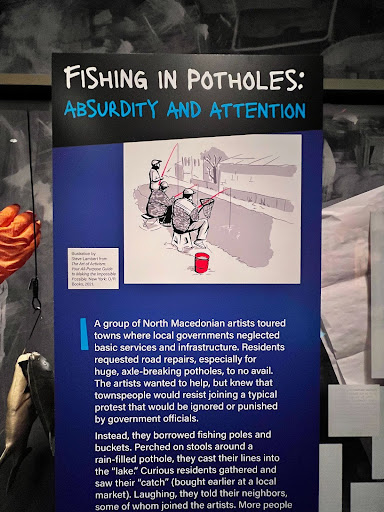
After that these artists went to another town, and they had a fishing contest in the pothole. They brought fish that they put into the pothole, and then fished them out. Again, it generated media. In the end mayors of towns were calling them to say, “Are you going to come to our town? Because if you are, we will fix the things before you come, because we don’t want the press.”  Through its interventions, this group ended up getting the equivalent of 12 million Euros worth of infrastructure fixes over the course of a few years. 

In Bogota, Columbia, in the early 1990s, a new mayor wanted to address traffic fatalities. At the time, there were numerous car accidents and pedestrians being killed by car. Nothing the government of Bogota had tried (increasing money to the police force, imposing fines) was working. The mayor knew the populace of his city, and he decided to try something totally different. He fired all the police officers, and he hired mimes and clowns to take their place. These mimes and clowns would stand at the intersections and make fun of people who were breaking traffic laws. They would do really silly walks behind them, or make fun of the drivers. And it worked. It turns out that people in Bogota do not like humiliation even more than they don’t like being fined. Within two years, traffic fatalities dropped by 50%. 

People have tried to replicate these actions. In one country there are people dressing up as zebras at in the middle of intersections (zebra crossings) and stopping traffic. But it’s important to note that some of this stuff can’t be replicated. If you put mimes at intersections in New York City, the mimes might get run over. It’s about understanding an audience and creating actions that are culturally specific. We we go all over the world with this work, but what we do NOT do is not come in and say, here’s what you should do. Instead, we say, let’s dig into the culture, the stories, the symbols, the spectacles that resonate with people here, in this place. 

How can a museum engage visitors in social activism?

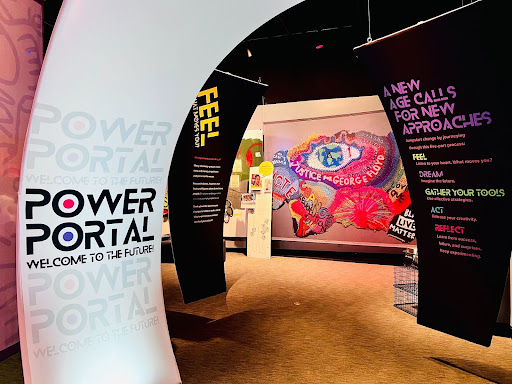
Recently, we collaborated with the Anacostia Community Museum, which is part of the Smithsonian Institution, to create The Utopia Project. This temporary exhibit took people on a journey that led to imagining their ideal world, and also taught the principles and the skills behind artistic activism. 

In the exhibit, we offered tools and stories for how social change happens effectively, but in no way were we telling people what kind of social change they can or should be doing. We brought the visitors through five steps to artistic activism: engaging emotions; imagining Utopia, or a more perfect world; brainstorming creative approaches to change; prototyping and reflection.

Image of the portal to the exhibition “The Utopia Project” at Anacostia Community Museum. All photos by Rebecca Bray and Andrea Jones.

Engaging emotions

Artistic activism understands that change happens because people feel a certain way, because they feel propelled to act because something touches them and an emotional level. It’s not just facts. It’s not just rational. People take action because they feel urgency, hope, connectedness.

When we do trainings, we ask, what is a thing that you feel passionately about? Can you identify these feelings? Often it’s a combination of anger, fear, hope, desire for change. When we see problems in the world we often go to a place of despair or fear and anger, and focus on reacting to things that are bad. But we ask people to take a next step of tapping into the hope that’s in there. 

Imagining Utopia

When we ask people to image Utopia, what we’ve found with working with people all over the world is that people’s Utopias look remarkably similar. There’s a lot of really good food. There’s music. There are people who have a lot of leisure time and are helping each other. And these stories of the world that we want to create are so important to tell for ourselves, because one of the problems in activism is burnout and despair. But also, they are important to share with anyone we want to go along with us on the journey. Advertising does this really well – commercials create one idea of a Utopia, and invite us to go along with them. When we invite people take time to think specifically about the better world they want, they’re much more effective at creating it.

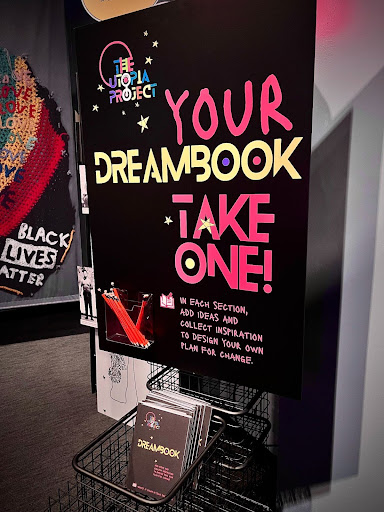
Image of the invitation to take a “dreambook” in “The Utopia Project” at Anacostia Community Museum. All photos by Rebecca Bray and Andrea Jones.

Brainstorming creative approaches to change 

And then there’s a practical step. You know what you want to change. Let’s say you want to stop bullying in your school system. What are some steps we can take to get there? Who can make this change in your community? You break it down to something that’s really specific and doable around bullying. Maybe you want to get a hundred kids to sign a petition about bullying, or you want to get a new training in your school for everyone around bullying. In the exhibit, we show how to come up with specific objectives, and why that’s important to making change. 

Here’s we bring the creativity into it: We brainstorm unusual ways to get to our objective. We bring in elements of theater, elements of visual storytelling, brainstorming how to invite people into a space in a way that makes them excited to be there. These exercises and prompts bring in creativity and strangeness and weirdness and new ideas. In our research on effective and affective activism, we’ve seen how innovative approaches help social change movements achieve results, because they’re not just protesting in the usual ways, but really connecting with people culturally.

Prototyping 

At the Anacostia Community Museum we had a space where  of visitors could actually prototype their ideas using simple materials. I come from a technology background and think a lot about user experience design and doing iterations and testing to refine your concept through interaction. So we enouraged people to get out there, try something, see how people respond to it and then do it again and again, and see it as a series of experiments. In the exhibit, visitors – adults and children alike – made incredible things that demonstrated how they were thinking about manifesting the change they want to see.

Reflect 

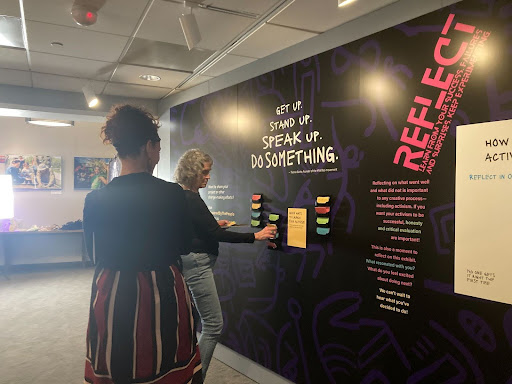
The last section of the exhibit invited visitors to reflect on what they experienced, and make concrete plans for how they could bring it into the world outside the museum space. There were take-away cards with information about local advocacy groups and volunteer opportunities. And a space to write down intentions about what to do next.

Image of reflection area in the exhibition “The Utopia Project” at Anacostia Community Museum. All photos by Rebecca Bray and Andrea Jones.

Teaching artistic activism through an exhibit format helped people understand how they can use their desire for social change and their own creativity to make a difference. A number of visitor comments reflected that the exhibit helped them connect the dots between things they had been thinking and feeling with actions they can take, and expressed feelings of empowerment and relevance to their own lives and things they hope to accomplish.

The work that we’ve done in the museum space on this has been so successful in terms of impact, and we’ve had so many people come to us as a result asking for more like it. Museums and other informal learning spaces can be incredible resources for people to learn not just the results of social movements, but also the tools and principles that visitors themselves can use. We would love to do more with museums and informal learning spaces, which are wonderful spaces for people to explore these ideas and come out at the end feeling transformed and feeling like they have new skills and ideas and inspiration for things that they can do in the world.

See more photos and learn more about the Utopia Exhibit here. Interested in sharing creative activism at your museum? Contact Rebecca Bray at c4aa.org

  1. Morse A. Cartwright, 1939, cited in Theodore Low, “What is a Museum?” (1942) in Reinventing the Museum ↩︎
  2. Harold Skramstad, “An Agenda for American Museums in the Twenty-First Century,” in “America’s Museums,” Daedalus, Summer 1999 ↩︎

What Is “Burnout”?

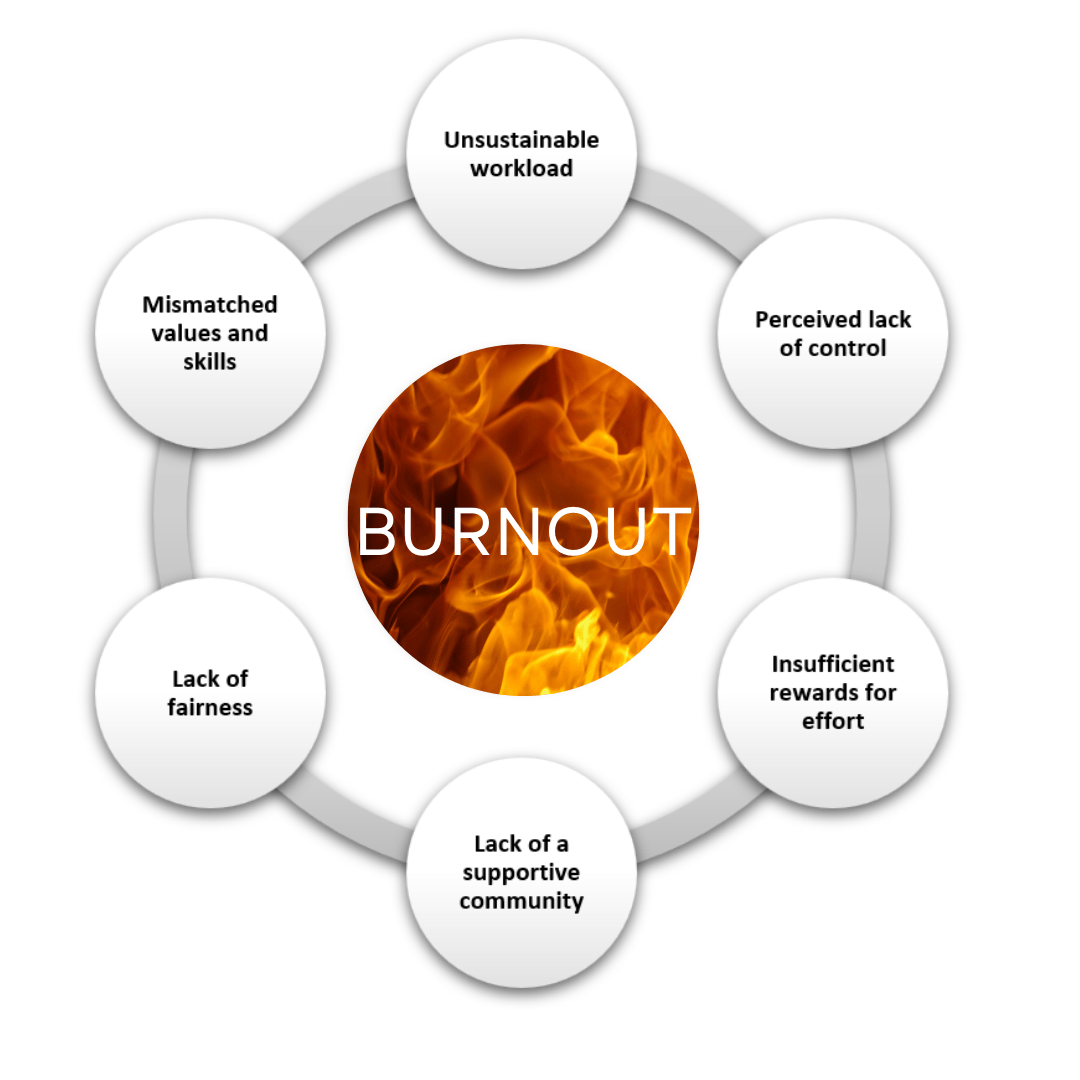
Image with “burnout in the center of a ring featuring the causes of burnout: Unsustainable workload; Perceived lack of control; Insufficient rewards for effort; Lack of a supportive community; Lack of fairness; and Mismatched values and skills.

Burnout was a hot topic in 2023. Attention to burnout was prompted by COVID-19, which made nearly everybody’s life more complicated and difficult, and post-COVID changes to the work environment and feelings about work.1 But even before 2020, the World Health Organization (WHO) included burnout in it’s 2019 revision of “International Classification of Diseases.”2 And, further back, the journal Burnout Research was active from 2014-2017; the first sentence of the first issue is, “Burnout has been a longstanding issue of social concern.”3

In the museum community, the Museums Moving Forward 2023 report on “Workplace Equity and Organizational Culture in US Art Museums” notes that “two-thirds of art museum workers are thinking about leaving their jobs, if not the field altogether, and that low pay and burnout are the top reasons.”4 Writer and museum consultant Mike Murawski has brought attention to the issue of burnout in recent “Agents of Change” posts. On November 6, in  “How are you doing at Slowing Down?” he wrote, “burnout has been the biggest issue that has come up in my consulting work with museums and nonprofits all year long…. And recently, in a 4-week Changemaker Intensive with staff at one institution, it emerged as a core barrier for effectively implementing change.”5

Mike has focused on the overwork aspect of burnout, and in response, he has launched a “Slow the F*ck Down” movement. Robert J. Weisberg of Museum Human has also noted the frenetic culture of “activity levels, overstuffed schedules, and time scarcity.”6 Rob adds issues of climate change and destruction to the issue of overwork, citing indi.ca who points out that more work requires more energy leading to heating up the world.7

I am grateful to Mike, Rob, and others who are drawing attention to this issue: there is no doubt that museum employees are overworked, and that this needs to be addressed. And overwork is a critical part of burnout. Let’s please lobby for slowing down (you can buy your “Slow the F*ck Down t-shirt or coffee mug here). And let’s also take a more careful look at burnout, to better understand and address the other components of this pressing problem.

So what is burnout, and what causes it?

The WHO notes that burnout is not an individual condition but an occupational issue, indicating that it needs to be addressed systemically in the workplace, rather than at the individual level.8 Its definition notes three dimensions of burnout: overwork, cynicism, and a sense of inefficacy.  These dimensions are what is tested by the Maslach Burnout Inventory, developed by Christina Maslach in 1981. In order to understand each of these variables, here are just a few selected questions from the Maslach Burnout Inventory (there are 44 questions total in the “Maslach Burnout Toolkit for General Use) shared on an October 2023 episode of the podcast “No Stupid Questions”9 and in Maslach’s book “Burnout.”10 The answers are rated on how often you experience these feelings (not on whether you experience them or not).

Exhaustion:

  • I feel used up at the end of the workday.
  • I feel tired when I have to get up in the morning and face another day on the job.
  • I feel emotionally drained from my work.
  • Working with people all day is really a strain for me.

Cynicism:

  • I’ve become less interested in my work since I started this job.
  • I doubt the significance of my work.
  • I’ve become more callous toward people since I took this job.
  • I worry that this job is hardening me emotionally.

Inefficacy:

  • I feel I’m making an effective contribution to what this organization does.
  • I feel exhilarated when I accomplish something at work.
  • In my work, I deal with emotional problems very calmly.
  • I feel I’m positively influencing other people’s lives through my work.

In a 2016 issue of the publication Burnout Research, Maslach and co-author Michael Leitner noted that “the Burnout profile … is associated with a … more negative experience of worklife than is the experience of exhaustion alone…. Therefore, exhaustion does not seem to be a sufficient proxy for burnout.”11 Another way of saying this: the opposite of burnout is not vigor or energy or right-sized workload – the opposite of burnout is engagement.

If burnout is not solely the direct result of too much work, what causes it? Maslach has found that the causes of burnout include the following:

  • Unsustainable workload
  • Perceived lack of control
  • Insufficient rewards for effort
  • Lack of a supportive community
  • Lack of fairness
  • Mismatched values and skills

How well does your museum do in these six areas? What stories do you have of museums doing a good job or museums struggling to support staff?

I have my own theories about what is happening in 21st century museums related to these six areas, and in future posts, I would like to take a look of these areas in the context of museum work. But before doing so, I would like to broaden my understanding of the situation by collecting stories from people across the museum field. Please help me out by sharing your stories! Use this form to share stories which illustrate any of the six causes of burnout, OR something your museum is doing that is a positive example of limiting workload, offering employees control, rewarding individuals for effort, supporting staff, demonstrating fairness, or aligning staff and institutional values and skills.

Resources:

  1. Jennifer Moss, “Beyond Burned Out,” The Burnout Crisis, Harvard Business Review. https://hbr.org/2021/02/beyond-burned-out ↩︎
  2. World Health Organization, ICD-11 for Mortality and Morbidity Statistics – see https://icd.who.int/browse11/l-m/en#/http://id.who.int/icd/entity/129180281 or https://www.who.int/news/item/28-05-2019-burn-out-an-occupational-phenomenon-international-classification-of-diseases ↩︎
  3. Michael P. Leiter & Christina Maslach. “Editorial.” Burnout Research, 2014. https://www.sciencedirect.com/science/article/pii/S2213058614000047 ↩︎
  4. Museums Moving Forward, Workplace Equity and Organizational Culture in US Art Museums, 2023. https://museumsmovingforward.com/data-studies/2023/ ↩︎
  5. Mike Murawski, “How are you doing at Slowing Down?” Agents of Change, November 6, 2023. https://agentsofchange.substack.com/p/how-are-you-doing-at-slowing-down ↩︎
  6. Robert J. Weisberg, “What Might Be in Store for Museum Human in 2024.”, Museum Human, January 2024, https://www.museumhuman.com/what-might-be-in-store-for-museum-human-in-2024/ ↩︎
  7. Robert J. Weisberg, “Links of the Week: December 1, 2023: We Can’t Grow Our Way Out of This.”, Museum Human https://www.museumhuman.com/links-of-the-week-december-1-2023-we-cant-grow-our-way-out-of-this/ ↩︎
  8. World Health Organization, https://www.who.int/news/item/28-05-2019-burn-out-an-occupational-phenomenon-international-classification-of-diseases ↩︎
  9. Angela Duckworth and Mike Maughan, “Are You Suffering from Burnout?,” No Stupid Questions, October 8, 2023, https://freakonomics.com/podcast/are-you-suffering-from-burnout/ ↩︎
  10. Christina Maslach. Burnout : the cost of caring. Malor Books, 2003. ↩︎
  11. Michael P. Leiter & Christina Maslach. “Latent burnout profiles: A new approach to understanding the burnout experience.” Burnout Research, 2016. https://www.sciencedirect.com/science/article/pii/S2213058615300188?via%3Dihub ↩︎

How can museums measure social impact? Interview with Johanna Jones

Johanna Jones is the Director of Evaluation and Visitor Insights at the Oakland Museum of California (OMCA).  Johanna leads the Museum’s audience research, evaluation, and social impact measurement work.  Before joining OMCA in 2016, Johanna was an evaluation consultant for 20 years.

All images courtesy of OMCA

In 2020, you wrote about the work OMCA has been doing to evaluate its social impact. What does social impact look like at OMCA?

Back in 2017, after collecting feedback from a lot of different stakeholders, we drafted an impact statement that we felt pretty good about: The Oakland Museum of California helps create a more equitable and caring city.

Then we took this statement to non-visitors. They asked questions like, “How does a museum make the city more equitable? Are you going to get me a better paying job? Are you going to change unfair housing policy?” Our board asked very similar questions.

I know why we landed on that statement. But we had to go back and ask ourselves, what can a museum really do? We aren’t going to change the minimum wage in Oakland. And we also wanted to be more than just a place to gather people, because a lot of places do that.

What is different about a museum is that we have content, we have objects, and we have stories that we’re trying to tell. At OMCA we tell under-told stories, so people’s experiences feel validated, and we make others aware of those issues. As we were talking to stakeholders it dawned on us that this museum can be the place where we bring people together to feel more connected, to develop empathy, to see other people’s perspectives and see the community challenges that they might not otherwise be aware of. Our content, programs, and exhibits can genuinely foster those conversations. So, we defined our social impact as fostering social cohesion: increasing people’s connectedness, their willingness to interact with one another and to take action together, valuing each other, getting to know each other, and enjoying being around each other.

In 2016, the United Nations came out with a report saying we’re never going to address world poverty if we can’t get people at the table to talk about world poverty. There are so many problems that OMCA can’t change. We are not going to change unfair housing policies; that’s not our wheelhouse. But we can bring people together and have exhibits and programs that get people talking about this problem, acknowledging that it’s a problem, and seeing the different perspectives. And in an ideal world, participants might decide, let’s work on this together and take action.

After you articulated the museum’s social impact, what came next?

After we articulated our social impact we created a framework and metrics. We spent a year collecting data in order to fine-tune those measurements.

Our social impact measurement is extremely specific to the work that we do. It is really a tool for us to use to improve our practice.

Every single week our post-visit survey was sent out to OMCA visitors. This allows us to see months where our social impact was really high, and ask, which programs did those folks attend? Which exhibits were on view?

We did that for a whole year, and we adjusted some of our language and our scales to improve the survey. And since 2019 we have been using the same instrument so that we can make comparisons across years.

What are some of your findings?

We have a Friday night program that used to be year-round (this year we have a winter hiatus). We’re open until 9PM and we have food trucks, live music, and art activities. Everything that’s outside is free, and you can purchase a ticket to visit the galleries, which are open. At these events we see a much more diverse audience than we see for other kinds of museum programming. We see strangers talking to strangers – families will put a blanket down in the garden next to another family. We hear from visitors that they have their Friday night friends who they meet and see regularly at this event. So that’s one example where we see social impact.

Friday nights at OMCA

Once we started this work, staff started programming with these outcomes in mind. They want people talking to each other, so they ask, what can they include in their program that is going to get people talking to each other?

We have also found that our exhibits that tell under-told stories often have the strongest social impact on our visitors. This is true both for people who say, “Oh, that’s my story, and nobody’s ever told it before,” and for visitors who say, “I didn’t know that story, and I’m so glad that now I’m aware of it.”

We embed things like talkback exhibits. We ask a prompt and people respond, and that’s really effective at getting people talking. We also have “take action” cards with provocative statements on the front and resources on the back, to foster conversation both onsite and once visitors take the cards home.

Question Bridge Talkbalk Exhibit

We have one prompt for an artwork called Question Bridge: Black Males, which is a video installation. The talkback station asks the question, “What does it mean to be your true self?” We don’t ask about the work of art – we ask visitors a question about identity. The question is at a station that consists of little nails around the wall and nicely-printed cards on high-quality paper stock.  This station is in a hidden corner – a lot of nonsense could happen back there, because it’s not being closely monitored. But we don’t get nonsense: we get very little profanity, and very little that is off-topic. We get a lot of rich personal reflections in that space.

I think the quality of the paper and the experience matters. But even more important is that we ask people to reflect on their own experiences rather than asking their opinion of something we have created. I think this is much more conducive to those thoughtful responses.

Talkback stations generate a lot of responses on small pieces of paper. Occasionally staff notice a cool comment or say, “Oops, better take that one down, that’s profanity.” But, at least at our museum, no one was systematically analyzing and cataloguing responses. Now that is something that my staff do regularly. The Talkback Exhibit comments are proving to be a very rich data source that’s helping us understand how visitors respond to and connect with our content.

Jazmine and Helen, Visitor Insights Specialists, collecting talkback comments in the Gallery of California History

What is the most surprising thing you have learned doing this work?

I’m very interested in examining for whom social impact is stronger or weaker. When national museum studies don’t show differences by race, ethnicity or income, it’s usually because their samples are skewed – there is not a diverse enough audience response being captured.

Pre-pandemic we distributed all our surveys face to face, so we only got about 1,500 visitor surveys back each year. With that amount of data I was limited in how I could analyze it. I could run the data by BIPOC visitors vs White visitors, and low income vs high income, but I couldn’t get more granular than that. We consistently saw that BIPOC visitors and visitors with lower income rated us lower for social impact. They felt less of a sense of belonging, they felt less welcome, they felt less like their stories were reflected.

That was hard for staff to hear. But I also said to them that if we didn’t see differences I would question our metrics, because we know that museums have not historically served these audiences well. So of course they are not going to feel as connected to us and to museums in general. So, for me, this validated the work we are doing – it demonstrated that there is nuance in our scales.

After the pandemic we went to an all-emailed survey, and now we get almost 6,000 surveys a year. So now we are able to tease out data by specific racial and ethnic groups. We’re finding that our Asian American and Pacific Islander (AAPI) visitors are the ones who feel the least social cohesion at our museum. I like to look at other national trends when studying data. There are reports out there showing that Asian Americans feel the least sense of belonging in America. Those studies are helping us put our data in perspective, and letting us know where work needs to be done.

Sometimes it’s hard for OMCA staff to hear that not all of our visitors are feeling as strong a social impact as others. But then they turn around and say, “Okay, what are we going to do differently? What other community partners are we going to reach out to? What content might we include? We have a shared goal of changing the museum so the data looks different five years from now. Staff are able to pivot and address the challenge of making change.

For museums that are interested in this approach, what are a few important take-aways to keep in mind? 

  1. Think carefully about what your impact really is. It might not be what you initially say. Take a step back and think about what your organization can uniquely do in your community, because you can’t do it all. Take time talking with internal and external stakeholders to get a sense of their perceptions of this place. Why do people come here? The more precise you can be about what your impact is, the more useful it will be for your staff.
  2. The data that’s hard to hear might be the most useful. Data that shows that everything is great is probably bad or incomplete. Data showing that different groups are responding differently, and that different things work differently, is harder to hear but much more useful.
  3. The point of evaluation is improvement. The evaluation process isn’t just about gathering data to say, this is what our impact is. You’re gathering data to show what your impact is and what it isn’t, and how you can get better. And that’s a full staff project.
  4. Each museum needs to define their social impact for their own work in their particular context. OMCA is a local museum – 90% of our visitors come within a 50-mile radius, and we have a really diverse audience. You can’t bring different kinds of people together if there aren’t different kinds of people at your museum. Context matters.

What are alternatives to traditional strategic planning?

The other day I mentioned strategic planning to a colleague, and got an eye roll in response. The eye roll (paired with some clarifying words) said, “Yes, I know, we have to do it. But is it really helpful? Is it really a good use of my time?”

Strategic planning is a systematic approach to making decisions about organizational growth or change. There are some fairly standard practices in this field, which often include:

  • Starting with conversations (generally but not always exclusively with organizational leadership) that help identify a general direction for change, along with research to understand the organization, including unearthing competitors and obstacles that threaten the existing business plan;
  • Engaging stakeholders (everyone from Board to staff to community members to people who don’t use an organization’s services but might) to hear their thoughts and perspectives in an ongoing way during the planning process;
  • Reviewing mission, vision and values to confirm, tweak, or change them;
  • The crafting of a problem statement or theory of change that will drive the strategic plan (where is this organization going? what is it you want to achieve in the next three to five years?);
  • Identifying strategic priorities that will lead to envisioned change, and designing clear goals that will help realize these strategic priorities.
  • Operationalizing the plan, which includes leaving the organization with clear steps for actualizing the plan.

I know that list just bored a lot of people. It doesn’t convey the excitement of engaging people in the work of envisioning, crafting generative and open questions, talking to many different people (and helping them talk with each other), coming up with a plan that brings a vision to life, and working on the nuts and bolts that can turn a plan into reality.

Many non-profit professionals have had experience with strategic planning initiatives that, during the process or later, in retrospect, have felt like a poor use of time and money. Maybe the process led to internal grumblings. Or the completed plan sat on a shelf and gathered dust. Or attempts to actually put the plan into action were frustrating and didn’t accomplish what they were supposed to.

Partly because strategic planning has become a-thing-I-know-I-need-to-do-but-doubt-it-will-get-the-results-I-want, I have been researching varied approaches to planning, and grown curious about alternative forms of planning. What are some other ways to plan that engage people in a meaningful way and lead to a plan of action? What can an organization do if it knows it needs a plan, but for some reason isn’t excited about or invested in the process outlined above?  

Below are three alternate approaches to planning that I have found. If you know of others, please share them in the comments below!

Appreciative Inquiry

In Fall 2022, I took an online certification course in Appreciative Inquiry. This approach addresses a specific issue outlined by the organization, which is then transformed into a compelling question by the facilitator. It is rooted in the idea that positive ideas, stories, and conversations are critical for positive change.  Through Appreciative Inquiry, the facilitator leads a team to collaboratively construct and move toward an ideal future.

The process starts with “Discovery.” What does it look like when the organization is at its best, as it relates to this issue? During this phase, participants share stories from past work situations. The focus is on collecting stories rather than facts, diagnoses, or ideas. Participants then move on to the “Dream stage. What might the organization look like in the future, when it has succeeded in the area related to this specific issue? What are specific ideas for realizing this “dream”? After they have dreamed, they begin to design. Participants decide on the most compelling ideas from the “dream” phase – ones on which they are willing to commit to immediate, team-based action.  The final phase of the process is entitled “Destiny,” which is the process of sustaining this work, which looks different at different organizations.  

Image from Chris Corrigan, found on Flickr.

Appreciative Inquiry is different from most strategic planning approaches in that it is extremely focused: it takes one important issue or area, and engages individuals from across an organization in making change in that one area. The product does not look like a traditional strategic plan with multiple priorities, each of which branches into multiple goals. Instead, the product might include a vision of the future with stories of what the organization looks like at its best and a positive vision for how it might look in the future; experimental approaches for how to move toward this future; and lists of team members with a plan of action for their shared experiment. One of the beliefs underlying Appreciative Inquiry is that this positively-driven team action makes change, and importantly, is the change. Thus, the ultimate product of Appreciative Inquiry is to engage staff members at all levels in the work of taking it upon themselves to engage in and drive collaborative projects that lead to organizational change.

I love the emphasis Appreciative Inquiry places on positivity and narrative, and the power of people to create change; itis a great alternative to strategic planning for organizations that have big challenges that need addressing before they can move forward with other planning initiatives.

Intentional Practice

This approach was designed by Randi Korn, and it is outlined in the book Intentional Practice for Museums: A Guide for Maximizing Impact. Intentional Practice very specifically plans for audience impact. It is rooted in a number of principles about organizational work and culture that must be in place before beginning the impact-planning process: the organization wants to impact its audience in meaningful ways; that staff have articulated and know what this intended impact is and take actions to achieve it; that staff regularly evaluate the impact of their work and reflect on what they learn for the purpose of improvement; that staff across departments and up and down the organization work collaboratively (because no one person or department is responsible for achieving impact); and that staff are willing and able to listen to, understand, and accept varying points of view.

To engage in this work, the museum or organization must be willing to identify a finite number of audiences—usually three. Following that, they participate in three exercises: a passion exercise which includes identifying what about their work they are most interested (if outsiders are invited to join in the work, and often they are, the question has a caveat so they can respond); a distinct quality exercise where they are asked to brainstorm a short list of what makes them unique and relevant to audiences; and a visioning exercise where they identify the ways in which they intend to impact on the three audiences/communities . While many strategic planning processes focus early on confirming or changing the organization’s mission statement, Intentional Practice focuses on crafting an impact statement that answers the question, What impact do you want to achieve, or concretely, what positive difference do you want to make on X audience’s lives?

This impact statement is then used to drive planning for the organization as a whole, as well as at the program level. Once the organization achieves clarity about its intended impact, it can then envision more specific outcomes for the work it does and identify indicators that will show that this work has been successful. The written product of an Intentional Practice planning session differs from other strategic plans in that instead of mission, vision, values, strategic priorities, and goals, the plan includes impact statement, specified audiences and associated outcomes, and sometimes, indicators (how you will know that you have achieved success). Beyond this written product, Intentional Practice planning is designed to re-center an organization and its work so it revolves around achieving impact on its audiences, and embed a cycle of reflection that includes aligning work with impact, ongoing evaluation of impact, and build a culture of continual improvement—personal, professional, and organizational.  

Randi Korn’s book from 2018

So many museums these days are struggling with who their audience is and how to best serve them. Intentional Practice is tailor-made for these museums, as long as they are willing to focus both on genuine impact and genuine investment in the internal culture that needs to be created to achieve this impact.

Question-Based Planning

I cannot find any reference to this approach through searching the internet, but I participated in it as a staff member at a small DC organization in the late 1990s. As someone invested in the power of a good question, this approach intrigues me, and I think aspects of it are valuable and could be incorporated into other approaches.

This process begins by working with the team to create an organizational vision for the next 3-5 years. It then asks, what questions do we need to answer in order to achieve this vision? Participants then brainstorm questions, which they post on the wall. Questions can be of any variety and size, as long as they are responsive to the vision – from “What hours do we need to be open to the public?” to “What expertise do we need on staff to make this happen?”  to “Is a teen program really valuable in meeting this vision?” to “What benefits should we be offering staff?” 

Participants then discuss and group like-questions together; sometimes three or four or more questions can be grouped into one powerful question. The goal is to end up with a manageable number of questions – perhaps 10. Once the questions are confirmed, they are placed onto a board and participants go through a process to identify which questions need addressing first. The result is a list of questions, which are really problems, that need to be worked through to achieve the vision.

In this approach questions replace priorities and goals, and the work of implementation is understood as answering questions. I like that this approach lays bare the things that need to be discussed, which are often taken for granted (“What expertise do we need on staff to make this happen?”) or only discussed by a small subset of staff (“Is a teen program really valuable?”). I like that it sets an organization up for grappling with these questions slowly, thoughtfully, and sequentially. While this approach doesn’t seem quite robust enough to do all the work of developing a plan to guide an organization forward, it could work well in combination with more traditional strategic planning exercises to engage a team in curiosity, collaborative discussion, and problem solving.

What other approaches to planning should organizations consider, when they know they need to pause and plan, but don’t think a traditional strategic plan will get them where they need to go? Please share other approaches in the comments below!