As a museum educator who has spent two decades thinking about object-based education, I found the shift to children’s museums challenging. Where are the objects? Why is this a museum? What allows us to claim special educational status for these charming play spaces? To find answers, I turned to the literature.
Sometimes I write things that appear somewhere other than Museum Questions! To learn more about why children’s museums are the way they are, I looked through the Curator archives, which turned into this virtual issue. Take a look, not only at my article, but at the articles from the archives, many of which are really wonderful. Happy reading!
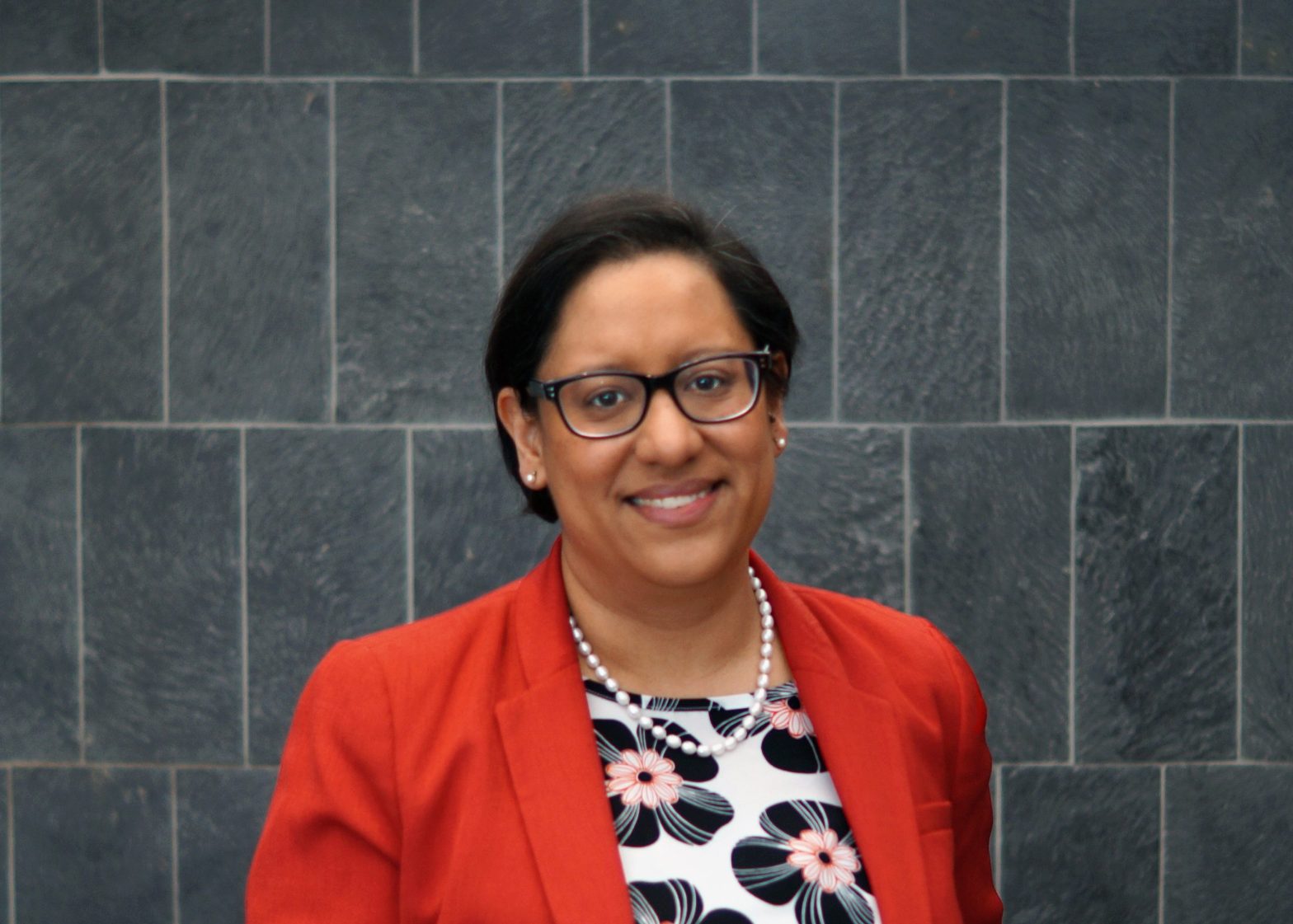
Laura Huerta Migus is the Executive Director of the Association of Children’s Museums (ACM). Prior to joining ACM, Laura was the Director of Professional Development and Inclusion Initiatives of the Association of Science & Technology Center, where she was responsible for the planning and implementation of all professional development and equity and diversity efforts.
In January, ACM hosted a day-long conference in Chicago for Illinois participants in Museums for All, a program through which museums offer free or reduced price admission to low-income families. That program sparked a discussion that led to this interview.
I know you are deeply involved with the Cultural Competence Learning Institute – can you talk about that?
The Cultural Competence Learning Institute (CCLI) is an IMLS-funded project led by the Children’s Discovery Museum of San Jose (CDM) and involving the Association of Children’s Museums (ACM), the Association of Science and Technology Centers (ASTC), and the Garibay Group. The approach of the institute is informed by the cumulative learned and lived experience of the different partner institutions around promoting inclusive practice in museums.
Traditionally in the museum world when issues of diversity, inclusion, and access have come up at individual institutions, the focus has been public-facing efforts – access programs to get certain people in the door, programs like free nights, cultural festivals, and exhibits around cultural content. But a museum can have a robust portfolio of those activities, and it still does not really add up to being an inclusive organization. CCLI helps institutions spend a whole year identifying a particular space in the museum that they think is the key to the lever for really promoting organizational transformation around cultural competence and inclusion.
When museums participate in CCLI they are asked to put a team together. We require that the CEO or an equivalent executive team member is an active member of the team, and we take a cohort approach. We spend a year together helping teams work through and implement these strategic initiatives. The idea is that for institutions to really make this change they need to have four things: the right internal team looking at an issue; dedicated time to do that continuous work; accountability; and external support and coaching. We are really focused on how we catalyze organizational change – how do we help to support the shift in organizational culture that can open up the opportunity for the museum to understand how it has to change itself, and become a truly inclusive organization from the inside out?
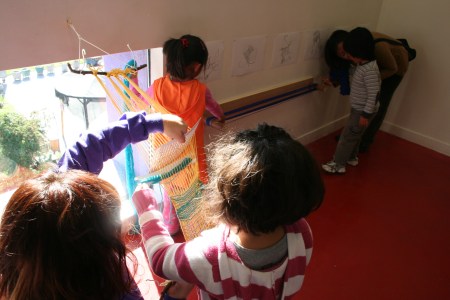
Children weaving with paper looms at CDM. Photo by Lisa Ellsworth.
When we spoke in January, we discussed a tension that is evident in many museums that want to invite lower income families into museums, but are simultaneously made uncomfortable by this audience.
When efforts to bring in new audiences start, and those people actually show up, it can be a very conflict-ridden experience. When you bring new visitors into the museum the assumptions that were invisible before become visible. This can be uncomfortable because it challenges the mindset that there was nothing wrong with the way things have been, when those groups were passively excluded.
Museums want to be seen as good, just, and virtuous organizations, and so may take on these kinds of programs, but it will force a change, and uncomfortable dialogues, when you really take them on. There’s a lack of skill on how to have those conversations that keeps those efforts isolated, or keeps people from taking them on to begin with.
Museums staff generally are trained to serve visitors who come to the museum already knowledgeable about what is accepted in that environment. They have not been prepared for how to orient or welcome new visitors who might not bring that same knowledge, and so when these visitors don’t “behave properly” they can be seen as burdensome and problematic.
Museum staff have also shared feedback they have received from established visitors who don’t like sharing their space with new people who don’t know “the rules” of how it’s appropriate to behave in a particular museum space. Some museums that have really developed cultural competence in how to welcome diverse audiences are now getting a much more diverse cross-section of their community. As a result, visitors who consider themselves the primary museum audience are coming into contact with people from other backgrounds that they don’t normally have to interact with. This sometimes results in negative visitor-to-visitor interactions that staff then need to deal with.
You talk about the challenge of welcoming “new people who don’t know the rules of how it’s appropriate to behave.” Can you talk more about this? What are the specific challenges?
Learning in children’s museums was based on this idea of children playing, and parents as teachers to their children. That only works if, as a parent, you have some capacity to take on that role. If you come from a lived experience where you were given a grounding to advocate for your child’s intellectual and cognitive development, then you can engage. This is the unspoken understanding with staff at children’s museums about your role as a parent.
If you come from another culture in which the traditional dynamic between child and parent skewed in a different direction – for example, the parent is more of the authority figure, and their role is more about values development rather than teaching academic content – then when you come into a children’s museum you may assume that you can let your child loose because there are staff there, and those staff should be in charge of your child.
Another dynamic that can contribute to differences in expectations relates to poverty. There have been a number of studies about how poverty and financial stress affect parenting. For a parent who is under-resourced, their big effort may be just getting their family to the museum. Negotiating the time, financial, childcare, and transportation resources for a visit represents an exponentially higher investment for a resource-stretched family than for a middle class family, who is likely to have reliable transportation and funds available to support a visit. In some cases, this increased emotional investment can result in adult caregivers that arrive already exhausted at the door, ready to hand over responsibility for the experience on the museum. If floor staff are not aware of this as a possible reality, again, it is easy to think of these parents as not engaged in their child’s learning or, at worst, being irresponsible.
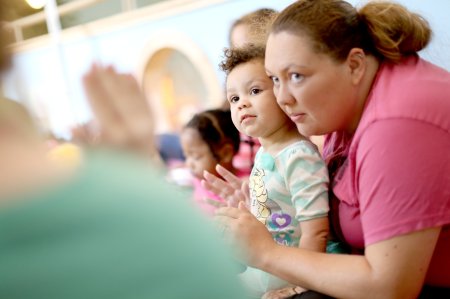
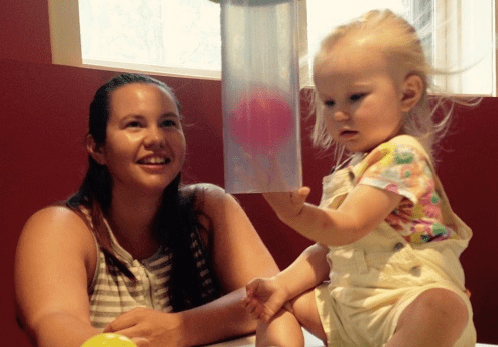
Parent and child participating in a program at the Peoria PlayHouse Children’s Museum
What little we know about learning in children’s museums tells us that learning happens when experiences are facilitated by adults. An article by Louise Archer in the most recent issue of ASTC’s Dimensions magazine looked at the experiences of five disadvantaged families to science centers, and found that while all families seemed to have “fun,” only one of these families had a “meaningful” visit, as determined by measures of engagement and learning; this was attributed to differences in family discussion. Why are we working so hard to get these families into the museum if they are not getting this facilitated experience, and therefore most likely not learning?
I would agree, and our own professional standards acknowledge, that the highest quality experiences in children’s museums are well-facilitated experiences. However, just because a family doesn’t “learn” the academic content of an exhibit in the way we expect in a classroom setting doesn’t mean that learning is not happening. It’s important to embrace a wider definition of learning in museum settings to truly gauge impact and success.
For example, Cecilia Garibay, a museum evaluator and researcher, conducted a study of Latino parents. She worked with focus groups from a variety of different institutions, including museums, zoos, and children’s museums, to understand what motivated families to visit. For many families their motivation was around providing a positive social experience for the family. For these families the facilitating of access to the content was less important than the social aspect.
Another study examined a bilingual exhibit, and found that for Latino families one of the values of visitation was about parents being able to offer their children a well-rounded experience in the context of the family. It was about strengthening family bonds.
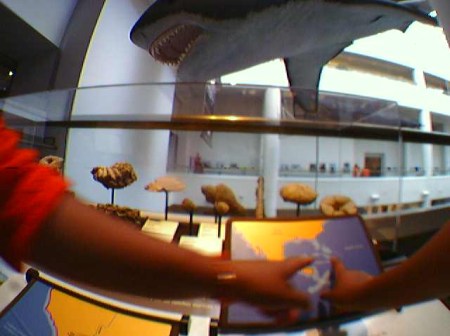
Participants in the Bilingual Exhibit Research Initiative study; this image is from a SenseCam worn by a participant, and was found here.
Learning outcomes framed as academic content acquisition is a red herring for early learners. In general, I am uncomfortable with tying children’s museums to specific academic outcomes, because the dosage, nature, and length of museum visits, along with the child’s developmental stage, is too variable to make this correlation strongly. Children’s museums are places to have positive, child-centered family experiences. And that is a learning experience. These are spaces where a family can engage in an educationally-rich environment and experience together. These opportunities don’t exist in other spaces.
Even parents will get more content if the experience is facilitated, but that doesn’t mean they don’t get anything without facilitation. Sometimes it’s the visit itself, not what happens on the visit, that’s of value.
So are you suggesting that the importance of children’s museums is NOT that they have educational value?
I think that children’s museum have great educational value, as long as education is defined more broadly than school-based academic outcomes. But children’s museums are so much more. Every children’s museum is four types of institutions under one roof. They are destinations – places that people visit to experience exhibits and programs. They are community resources – points of civic pride, as well as local employers. They are social service organizations, serving as advocates for children on topics such as accessibility and healthy living. And they are educational laboratories, testing, modeling, and promoting child-centered learning approaches.
Not all children’s museums function strongly in all of these areas, but there is a little bit of all of these things in every children’s museum, or at least aspirations toward all of them. I don’t think that other museums function across all of these areas, but children’s museums do.
In Fall 2014 I began an exploration of the relationship between schools and museums on this blog, with the goal of thinking about, and rethinking, the field trip model. At that time I created a page titled Ideas and Implications, optimistically claiming that I would update the page as I conducted interviews and posted new articles. I have not updated the page since that post.
While I reserve the right to revisit and continue this exploration, it is mostly concluded, with 41 related posts over the past two and a half years. And so in this post I am rethinking “Ideas and Implications” for schools and museums, based on the findings from these 41 posts.
Why rethink the relationship between schools and museums? I began this exploration because all too often field trips do not live up to their potential; they take large amounts of energy, time, and money for both museums and schools, and, as a field, we do not hold these brief experiences to very high standards. This concern was echoed by Cindy Foley from the Columbus Museum of Art, who said, “Field trips are problematic. But how do we mine them for something better? How do we allow them to advance our work in some way?” And Karina Mangu-Ward, Director of Activating Innovation atEmcArts, further underscored this concern by saying, “the assumption that field trips are the best exchange between teachers, students, and museums is so far beneath the surface that it no longer gets discussed. To wrench that assumption back to the surface to contest it is difficult. It requires looking at data, real trends in the environment…. If you have evidence that participation is declining, that’s powerful evidence.”
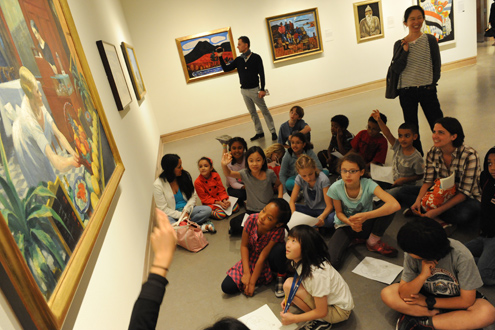
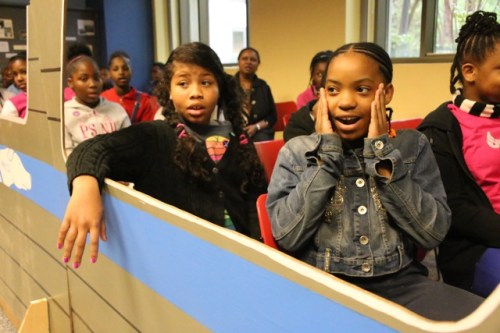
A school group at the Metropolitan Museum of Art.
Why might field trips be failing to live up to their potential? One possibility is that we have not properly defined what that potential is, so we do not have a goal to aim for, or know what success looks like. Another is that they have become such a high-volume offering that museums cannot afford the time to make these experiences meaningful for every class that visits. And a third possible reason was expressed by Jay Rounds, retiredfounding director of the Graduate Program in Museum Studies at the University of Missouri St Louis, who is working on a book which argues that museums are in a moment of paradigm flux. Rounds’s thesis is that museums are entering a third stage, or paradigm, and that we are in a moment of transition:
In sum, our problem now is not to choose among either of the previous two paradigms, but to find a way to transcend the very nature of the choices that they presented…. If “education” is a definition of a process for connecting society and individuals, we need to think beyond education to recreate our museums for the new world. The starting place for the museum field, I think, has to be in rethinking our assumptions about what happens when a museum visitor encounters our exhibitions or programs.
My 41 posts included 10 guest posts and 16 interviews, as well as 15 of my own articles. What are the ideas and implications to be found in these posts? How might we rethink the ways in which museums work with or program for schools?
What do field trips teach, or achieve for, students?
As I wrote in a January 2015 post, museum staff are more likely to have goals related to skill-building than content for field trips. The skill-related goals discussed by my guest-bloggers and interviewees are:
An understanding of or connection to the world in which they live
The ability to ask good questions
Self-understanding
Critical thinking skills
Interpersonal skills
The interest and ability to visit museums independently
I heard over and over again that the value of museums is not the way in which they reinforce the work of schools, but the ways in which they are different from schools. As Claudia Occello, President & CEO of Museum Partners Consulting, eloquently said, “Curriculum standards are easy pegs to hang our hats on.… But if schools and teachers are already teaching to, and meeting, curriculum standards, what do they need museums for?” A similar idea was expressed by classroom teacher Sarah Schertz, who said, “My students are in the same classroom every day; they see the same kids, play with the same toys, do the same activities. As a teacher you try to change it up but you are constrained within those four walls. Exposure [to a museum] is an important first step because it is something new, different – they see the world from a better point of view, see something they don’t yet know and can only try to understand.” And again by Anna Cutler, Director of Learning at the Tate, who said, ““We want to support teachers to extend their ideas and the curriculum content – we don’t want to deliver it or reflect it. If your purpose as an organization is to amplify and provide for the curriculum, then invite schools to do that. But I don’t think most cultural institutions are set up to do that – they are set up to invite broader thinking in the world.”
Being in a new and different environment also helps with interpersonal connection-making. Sarah said, “Field trips offer an opportunity to have real conversations with your kids, to get to understand what they are thinking and how they view the world. You can learn a lot about your kids in novel situations from what they choose, and how they problem solve.” Kylie Peppler, Assistant Professor of Learning Sciences and Director of The Creativity Labs at Indiana University Bloomington, argued that by visiting a museum and learning something new together, museums also help students see their teachers in a new way – as learners. And a podcast from the Moth shared a high school student’s experience on a field trip, during which she got to know her classmates in new ways.
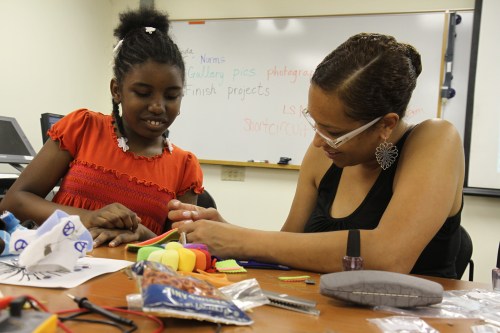
A student and teacher learning together.
But there is still the question of whether curriculum connections are essential for marketing field trips. If museums do not align their school programs with the school curriculum, will school groups still visit? One of my interviewees, Brian Smith, a teacher in North Carolina, argued that they would not. “[T]eachers are under so much pressure, that unless [a museum visit] connects to the curriculum, it’s hard for us to say that’s worth our time, even though we as an educator may totally agree.” But everyone else I spoke to – including the other classroom teachers – argued for museums identifying and promoting their own learning goals. Cindy Foley shared a conversation she had with Ken Kay of P21. “He said that instead of catering to schools, we need to be modelling what is possible in learning and education, so we give schools models and hope.” Anna Cutler shared the Tate’s success with field trips that do not explicitly relate to the curriculum:
We don’t tell teachers, “We don’t do this, we won’t connect to your curriculum.” We tell them what we do offer, which is beyond what teachers can do in the classroom. Which seems to be much more exciting. Teachers who have decided that they are going to bring their students to the museum, who bother to make this happen, are already committed. So why not do something really great?…. In the last year we have seen a huge increase in the percentage of schools that ask for a return visit within the year. In one instance it’s gone from 22% to 85%. Something seems to be working.
Brian Hogarth, Director of the Leadership in Museum Education program at Bank Street, shared similar insights: “Mizuko Ito’s group, Connected Learning, speaks eloquently about the need to stop chasing curricular goals, and to focus instead on the engagement of the learner…. museums are not extensions of the classroom, but rather engender exactly the kind of learning that we believe students should engage in.”
What does good museum teaching look like?
Contributors to this blog defined good museum teaching in ways that may be discipline-specific, but which are worth examining for their value for all museums. Here are some of the big take-aways regarding the planning and facilitation of school group experiences:
When planning a school experience, contributors recommended thinking about story or role play, and focusing on a big idea. These framing strategies make an experience cohesive and memorable.
Children learning about the experience of Freedom Riders during the Civil Rights Movement, at the Atlanta History Center.
Create an experience that gives students real agency. For example, pose a problem or a question and let students solve or address it, or dedicate the tour to letting them work independently to learn and use museum-going strategies that they can later repeat on their own. Part of this is introducing children to the language of the discipline, the importance of which was noted by both Marcos Stafne and Anna Cutler.
There is a significant difference in the work of trained staff vs. volunteers. Recognizing that some museums cannot afford to have staff lead all school experiences leads to the questions: should we be offering experiences if we cannot afford to implement them well? And if we decide to move forward with volunteers, how do we ensure that they are well and fully trained, and held to the same accountability as staff would be? As Ben Garcia, Deputy Director at TheSan Diego Museum of Man, noted, “finding a way to bring docents along that path when you only see them weekly or monthly is one of the structural problems that museums have.” It is also worth noting that museums need not only expert staff, but sufficient staff – for example, a science demonstration is most successful when staffed by two educators.
Part of the value of the field trip is in the reflection that happens (hopefully) in the classroom afterwards. For this reason, Kylie Peppler recommends keeping the entire class together for the experience.
Good facilitation of experiences for school groups (and perhaps any audience) includes:
A museum experience should not feel like a school experience, but educators still need strategies for managing large groups of students in an educational setting. Useful strategies include ensuring that students know the rules and that there are clear boundaries as well as clear expectations. Educators need to have reasonable expectations for student attention. And it is essential that students feel welcomed and wanted in the museum.
Finally, a small but important note: kids need to eat. Many museums don’t have a space for this, but need to find a way to provide it. Anne Kraybill of Crystal Bridges and David Bowles both speak to this.
How do we know what works?
Finally, it is important to note that museum professionals make a lot of assumptions about what works that are faulty. Some of these assumptions have even been proven wrong, yet we perpetuate them. For example, Holly Kerby, Executive Director of Fusion Science Theater, noted:
there is scant evidence that traditional demonstrations teach the concept that they are demonstrating. By traditional, I’m talking about demonstrations in the form of Introduce, Demonstrate, and Explain (IDE). People assume that they do – in fact they go to great lengths to cite learning theory. They also say that they may not teach a concept at the time of the demo, but that they promote future learning. But there is no evidence for that either. What evidence we have comes from classroom studies and that data shows that IDE demonstrations DO NOT result in increased understanding of the concept.
Similarly, museum educators sometimes suggest that we are teaching skills that can transfer to other arenas. But, as Kylie Pepper, notes, “[R]esearch is showing that kids learn things in one context, but have trouble transferring it to another context. Unless we make those connections for the kids, they won’t make them.”
Kylie also said that existing research can help us understand the importance of post-tour workshops, and how these are different than pre-tour workshops. And she noted the importance of adult facilitation in learning:
Here is something we know about high quality parenting: Watching Sesame Street in and of itself not consequential to kids learning. It is consequential if you watch Sesame Street with your parents. Why is that? Because of connected learning – when I travel with my child to another environment, I connect back to it. It is a way of creating a common language with your kids.
Lynda Kelly’s review of relevant research may be helpful to educators. However there is also important information from other areas of education that museum educators need access to, and strategies for ongoing updates on.
School in the Park in San Diego’s Balboa Park.
What next?
These posts illuminate important truths about museum tours, and have important implications for why museum school tours are important, how they should be led, and what we know about teaching in the museum. As always, new ideas lead to new museum questions, and I am left with questions such as:
How can we as a field better understand the impact of these tours? Is there a way to collaboratively engage in longitudinal studies that better illuminate what these programs achieve?
What other research exists in other fields that might help improve our practice?
If a museum implements the perfect tour, is there a significant impact? How many museum visits would it take to spark the imagination and curiosity of every student in a class of 30 children? What would this look like?
My last two posts (here and here) have examined the history and impact of children’s museums, and have led to a dialogue with Gretchen Jennings, who responded to last week’s post on her blog, Museum Commons, by noting that in order to achieve the learning goals that were put forth in their initial incarnation, play-based exhibits require trained staff, developmentally appropriate exhibits, and parental support:
Both the original Playspace and the traveling version had the three-legged stool … as the philosophical foundation for the exhibit: trained staff (whether paid or volunteer); developmentally appropriate activities and exhibits; and all kinds of support for accompanying adults, from the comments and context provided by staff, to parenting resources…and simple, readable label copy explaining the value and significance of what their children were enjoying so much.
Most children’s museums do a fairly good job creating or selecting developmentally appropriate exhibits, although we have the problem that what is developmentally appropriate for one age group does not always work for another age group, and the difference between a 3 year old and a 6 year old is vast.That said, children are remarkably good at creating their own developmentally appropriate challenges when given the space and materials to do so.
The other two “legs” of the “three-legged stool” (in Gretchen’s metaphor) – trained staff and parenting resources – are challenging to provide, particularly for museums with limited staff and budgets.
Some children’s museums are financially unable to have any staff engaging with visitors in their exhibits. For many museums with floor staff, I suspect that all too often these are low-paid positions with fairly high turnover. Meanwhile, many volunteers come and go, with brief commitments to volunteering defined by community service requirements at local schools, or corporate support for a certain number of volunteer hours per employee. These constraints make it challenging to have sufficient trained staff in the exhibits. I would love to hear from museums – especially those in smaller communities without a great deal of university support – who have found solutions to this.
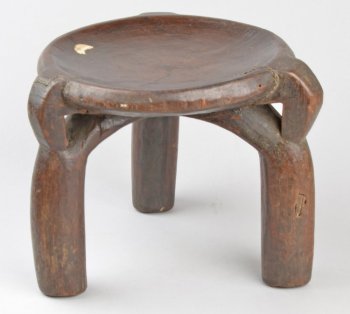
Three-legged wooden stool from Zimbabwe, from the collection of the British Museum.
The third leg of Gretchen’s stool is support for accompanying adults. A 2001 study at the Please Touch Museum in Philadelphia found that high levels of facilitation made a large difference in learning. Two types of facilitation seem to be particularly useful.
The first type of facilitation takes place in exhibits like the grocery store or the bus, where adults teach children information related to the world around them. So, for example, a child pretends to shop for milk in a model grocery store, and a teacher tells him that you need to keep the door of a refrigerator closed in order to keep the cold air in and the milk cold. Children’s museums provide these opportunities for teachable moments, but it is the adults with the children who are there to take advantage of the moment and do the teaching.
Grocery Store from the Pretend City Children’s Museum in Irvine, California. Image from Wikipedia Commons.
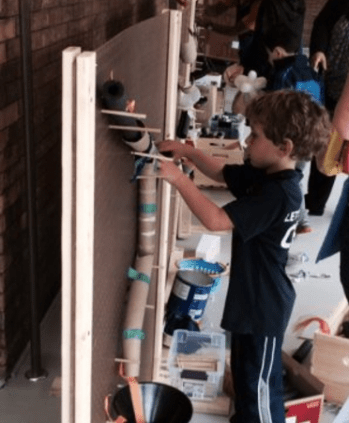
The second type of facilitation relates to procedural learning. When children are trying to build something like a marble roll, an adult might show them that when you do not line up the openings of the pipes or tubes, the ball gets stuck – the ball needs a sufficiently sized hole or gap to travel from one pipe to another. Children can then build on this information to improve their creation.
Child building a marble run at the Peoria PlayHouse.
When a parent arrives at the museum with children, our hope (the hope of children’s museum professionals) is that they will play with and teach their children. And often they do – there are some amazing and creative parents who visit children’s museums, and we should be learning from them. But other times there are barriers to adult/child interaction: Adults want a break, or are immersed in their own activities, talking with other parents or looking at their phones. Or they don’t believe they have the information to facilitate learning, especially in exhibits related to an area where they do not have expertise – construction, for example, or science.
With this in mind, I am using this post to brainstorm a few tools that children’s museums might create for parents. I have seen some parent guides from museums, often using the scavenger hunt model or the “look at this” model used in art and history museums. But how do we help parents help children when what children want to do, and the questions they ask, are so unpredictable?
Here are a few thoughts:
Parent guides that offer general tips for facilitation, as well as informational context for each exhibit, developmental context for different ages, and suggestions for extending the learning and experience once the visit is over. There might be a different guide for each exhibit, or each age group.
Wall text with stories and questions. At the PlayHouse our limited wall text mostly consists of sharing “what they are learning” and information about the interactives for children. But I wonder if there are ways to share stories as models, and ask parents to share their own stories with their children, or follow up with questions. For example, in the PlayHouse farm area we might add a few stories from family farmers, and a suggestion to parents to share their own farm stories if they have them. Ideally these would relate to the specific interaction – stories about milking cows near our cow – that would also help parents provide activity-specific information.
A board with visitor-created challenges in an area, to which families are invited to share their own. So, for example, in Motion Commotion, our exhibit with balls and wind tubes, I have watched children and adults create challenges such as how many balls you can get into the central hopper before it empties out, how many balls can balance on an air stream, or how many balls can go in a wind tube and still be able to rise up that tube. A wall panel with a few of these might also share information about WHY some things happen, in kid-friendly language that parents can use with their children.
Staff facilitators charged not primarily with playing with children (or cleaning up after them), but with engaging parents, identifying and pointing out the exciting things their children are trying or learning, and sharing context and learning.
I would love to know why these might work or not work, who has tried them, and what other ideas people have!
Elizabeth Kaplan is a lawyer who lives in Louisville, Kentucky and a college friend of mine. When she visited Peoria recently I learned that she has taken her children to children’s museums all over the country. With this in mind, I interviewed Elizabeth for Museum Questions. We so often hear from colleagues; this post is dedicated to learning from a museum visitor.
What museums have you visited with your children?
Usually when we go on vacation somewhere we go to the children’s museum if they have one, or adult museums if they have interactive exhibits. We have visited the Chicago Children’s Museum, the Boston Children’s Museum, the Indianapolis Children’s Museum, and, most recently, the Peoria PlayHouse Children’s Museum. We also visit science centers – we go to the Kentucky Science Center; the last time we were in New York we visited the New York Hall of Science in Queens. I see a lot of overlap between science centers and children’s museums. And our local art museum, The Speed Art Museum, has a children’s space – we went there a lot when the kids were younger.
What are some of the best things you have seen in children’s museums? What makes these so great?
Frankly, as a parent, I enjoy anytime my kids are interacting with something that is not a video screen.
Children’s museums are fun. It’s fun to play with balls, or sand. It’s hard to put your finger on exactly how that’s learning, but it seems to me that you are intuitively learning how the world works when you are interacting with your surroundings. It’s harder when museums are trying to teach them specific things.For example, we have been to art museums with interactives based on the art, but I’m not sure how much that clicks with the children.
Younger kids love exhibits like grocery stores, and museums offer far more sophisticated versions of these than are possible in the classrooms or in your own house.
What is the advantage of that sophistication?
It’s more fun, more elaborate, and so it helps pique their interest. They can really pretend to be in a store – a space like that is more special when it looks like a store. And they can interact in a way they could not possible have in a real store, without total chaos.
Preschool teachers talk about how children learn through play. I think that’s true. You can expose them to art and hope that later they remember, but I think that on a certain level they know when you are trying to teach them something, and they rebel – it’s too much like they are in school.
Are your children learning in children’s museums? If so, what?
What they learn in a children’s museum is more subtle than numbers or letters… I think they become exposed to things that reverberate later. Like the butterfly wall in the Peoria PlayHouse – they will see technology like that again in the future, and remember that experience. I know looking back on my childhood experiences, things will pop back into my head years later and I will think, Hey, I know that because of some place my parents took me to as a kid.
At a children’s museum they are using their brains more than they would at a playground. I think that the exhibits are often constructed to encourage a certain type of intellectual play. For example, the kinetic sand table – they are playing, but also thinking about how sand can hold together in a ball. And of course they are building, creating.
Children’s museums are also great starter museums. My kids are up for going to any museum, which I think is because they have spent so much time in children’s museums. They intuitively assume that a museum is a fun place to be.
How are they able to make a connection between a children’s museum and, for example, the Art Institute of Chicago? Is it because of the name? Is there something else?
I think it’s because they have been to a lot of places. Science museums are halfway in between. For example, the Museum of Science and Industry in Chicago is not a children’s museum, but it’s not a museum where everything is behind glass.
Sort of like the middle step in a staircase?
Exactly.
So your children have gained a love of museums, and also a broad range of memories and information which may someday come back to them when they encounter something new. Is there anything else they have learned from going to children’s museums and science centers?
They are spending time in a way that they have really enjoyed. It’s like an adult going to an art museum – you don’t need to be learning, it’s a sensual experience.
For the past few months I have been working an article related to children’s museums, and thinking a great deal about the period from the 1960s to the 1980s, when children’s museums transformed from spaces with collections-based exhibits aimed at elementary school children into play spaces for the under-10 set. At first I understood this transformation as the work of the Boston Children’s Museum, outlined below. But I now see it as a multi-phase transformation, and want to better understand the impetus and benefits of the second phase of change.
Phase 1
In this first phase, the Boston Children’s Museum introduced exhibits that were physically interactive (children could manipulate them), rather than in glass cases. Their work is outlined in Boston Stories, a book from the Boston Children’s Museum (BCM) that was available for free download on the BCM website, and now seems to have disappeared. (BCM staff – Please bring back this wonderful resource!)
Before this innovation children’s museums featured collections that were similar to those of other museums. The collections were displayed in cases, like those you would see at a natural history museum. Here is a description from Helen Fisher, Director of the Brooklyn Children’s Museum, from 1960, from an article in Curator.
A children’s museum does, however, look like a standard museum. With its collections and exhibit galleries, it is certainly similar in physical appearance. But from that point we take off on a tangent, because the basic purpose of a children’s museum is quite different from that of an “adult” museum…. In children’s museums the emphasis is very definitely on interpretation; our prime function is education.… For instance, we might be fortunate enough to acquire something on the order of Bell’s original telephone, but its greatest value for us would be its use in illustrating the development of communication, with less fanfare attached to its historic connotations. Our doll collection at the Brooklyn Children’s Museum does include many unique examples, but these dolls are used not as an end in themselves but to show aspects of other cultures. Actually, our visitors and their response to the exhibits are more important than the collections themselves.
By contrast, BCM’s groundbreaking 1960s exhibition “What’s Inside?” used interactive exhibit components to show children the insides of familiar objects and scenes, from a flower to a manhole. Spock writes:
I was looking for a topic that would move us away from displays in exhibit cases (the visitor experience at that time). I was interested in eliciting visible audience behavior that would indicate what was happening for the visitor. So, the purpose of doing interactive exhibits, for me, was in eliciting feedback as much as it was exciting kids about something.
Based on the success of “What’s Inside?” the BCM team designed other interactive exhibits, spending time thinking about what was important, and worth learning about. Another early exhibit was “What if you Couldn’t… An Exhibit about Special Needs,” which used artifacts – prosthetics, wheelchairs, braille typewriters – to help children understand what it feels like to have special needs, and how to treat people who are blind, or in a wheelchair. These exhibits were radical in their emphasis on interactivity, but still addressed older children (not toddlers) and had a clear teaching goal.
BCM’s earliest exhibit for toddlers, Playspace, emerged in the 1960s: an era of rapidly rising crime rates, when families were finding “that the [Boston Children’s] museum was one of the few places where you could find a good, safe, publicly accessible early childhood play environment.” The museum found itself needing to address the growing audience of very young children. Spock was at first uncomfortable with this exhibit:
I believed museums – all museums for all visitors – were about offering provocative experiences with interesting things and significant ideas…. In the 1960s we had elementary-school-aged kids learning how movies moved by animating strips of paper in a zoetrope, interpreting replica artifacts from an ancient Greek archeological site, participating as guests in a formal Japanese tea ceremony, stimulating cross-generational conversations in Grandmother’s Attic, or dissecting and matching up the parts of cut gladiolas at a table in What’s Inside?. All these were important and serious museum experiences that used interesting things to explore challenging ideas.
Playspace, by contrast, offered very young children a place to “practice their gross motor skills in a safe place.” But it also had another agenda. Spock adds:
By installing cozy seating at the edges of play spaces Jeri [Robinson, the creator of Playspace] thought it might encourage adults to observe, compare and speculate among each other about the developing capacities and learning behaviors of those kids…. I realized that for me if the parents were the learners, the preschool kids were the exhibit – the vehicle – for delivering sophisticated understanding to the adults in much the same way as the school-age child’s encounter with a challenging experiment at a science museum delivers science learning.
Clearly the success of this exhibit, and the growing audience of preschoolers at children’s museums, led to more exhibits like Playspace. But in an era of cell phones, in spaces that forego the atmosphere of object-based exhibits in favor of spaces like Playspace, we have lost the learner in this equation.
Phase 2
The second phase in the reinvention of children’s museums is still a mystery to me, and I am in search of articles or people who can illuminate this moment for me. It is the transition from “What’s Inside?” and “What if you Couldn’t…” to exhibitions like the water table and climbing toy.
The water table at the Peoria PlayHouse Children’s Museum.
I am concerned about this moment because I think this is the point at which children’s museums begin to focus on interactivity over content. Children love the water table – it is a fantastic sensory experience. With programming, children can also learn about boats and concepts around what floats, or the environment of rivers, or the physics of water flow. However, without adult facilitation, children are unlikely to exhibit significant learning. A 2001 study, again published in Curator, found that “while some exhibits… seem favorable to a wide range of types of learning, exhibits such as …the River [water table] show relatively few types of each [type of learning].”
The popularity of the interactive exhibit, and thus children’s museums, led to the rapid creation of hundreds of children’s museums which still continues today. It is fantastic that people love children’s museums so much. But somehow, between the early 20th century and now, we have gained popularity but lost something important. How can we cultivate a love of museums when children’s museums have little relation to art, history, or natural history museums? How can we teach problem solving when we don’t present problems? How can we teach information when we don’t curate around a big idea?
In What is the political role of art education in rural communities?Kate Baird, museum educator at the Springfield Art Museum, explored experiences with art education in conversation with three of her colleagues. In this week’s post, Kate continues sharing her ideas about how museums can play an essential role in cultivating much-needed conversation in our communities.
In the wake of the 2016 election, there is a lot of data to suggest that wherever you live and whatever your politics, most of your in-person conversations and online interactions serve to reinforce the views you already hold. Increasingly, many of us can make no sense of those who occupy the opposite side of the political divide. Art museums have something vital to offer citizens at this moment and in this landscape: they can provide the opportunity to engage visitors in conversations about all the things we’re having such a hard time talking about — race, class, history, identity, values, loss — in a (potentially) open and receptive environment.
Like many museums, the one where I work does this very intentionally with groups of visiting students. Below I offer an example of how a relatively short conversation inspired by a work of art can impact students’ points of view. But as much or more than students, American adults need forums where they can discuss important topics face to face. What lessons can we take from student interactions, and apply to conversations with adults? How can we maximize the potential of museums to get people talking to one another?
I work at the Springfield Art Museum, in southwest Missouri. Through Placeworks, a partnership with the Community Foundation of the Ozarks, we offer arts programming to rural schools in our region. Springfield is approximately 90% white, and in smaller surrounding communities that percentage is even higher. Many students that we work with through Placeworks have not spent much time outside of their hometowns. One teacher who brought her students to the Springfield Art Museum this past fall commented that it was the first time that several of her 7th grade students had ever left their town of 3000 people.
I had the opportunity recently to facilitate an installation project at a very small, very poor rural school. This project required a lot of teamwork, and I was floored by the ability of the students to assign each other roles, work through conflicts, and get things done. When I commented on this to their teacher, she chuckled and pointed out that they’d been together almost every day for 8 years, and for better and worse, they were more like a family than a class.
This closeness and ability to collaborate is an advantage, but it also means that it’s possible to get all the way through school in a rural community in southwest Missouri with few experiences with people from different racial, ethnic, or cultural backgrounds. Teachers from rural districts often ask Placeworks for programs addressing issues of tolerance and cultural sensitivity, so we think a lot about how to accomplish this in a thoughtful and effective way.
During one Placeworks field trip, 6th grade students were asked to create an image inspired by some aspect of Chinese culture. This was found by the teaching artist after the students had left:
The teaching artist, although deeply upset by the drawing, felt that showing it to the classroom teacher would not be helpful: she predicted that the teacher would punish the class, and that the kids would feel angry and defensive about being disciplined for something that they perceived to be a joke, and/or with which they had no direct involvement. Unfortunately, I think this is often what happens with conversations about race among adults in our area: conversations arise in response to problems, are charged or confrontational, and are therefore often unproductive.
The teaching artist felt that it was important to separate the objectionable viewpoint from the student who expressed it. We wondered how to push back against the idea without alienating the student. That little drawing resulted in a lot of thinking and talking about how to respond to bigotry, misinformation and bad jokes. We kept coming back to the idea that simple strategies might be best: start a conversation and keep it going. (Unfortunately in this particular case, we did not have the opportunity for a follow-up visit.)
What might such a conversation look like? In a museum context, the back and forth can arise from curiosity rather than tension. With a little time, consideration and information, student visitors to the museum often shift their own interpretations, attitudes and judgments about art, artists and even each other.
For example, consider Roger Shimomura’s Kansas Samurai:
Roger Shimomura, Kansas Samurai, 2004, seven-color lithograph. Copyright Roger Shimomura. Collection of the Springfield Art Museum.
Shimomura is an American artist of Japanese descent. At a young age, Shimomura and his family were sent to Minidoka, an internment camp, where they lived for two years. Much of Shimomura’s art addresses his own complicated cultural and personal identity and the experiences of Japanese-Americans during and following World War II.
When looking at the piece with students, I often lead a poetry activity involving two sets of words. When students first encounter the piece I ask them to write down the first thing that pops into their minds. This set of words often includes “evil,” “angry,” “bad guy,” “Chinaman,” “ninja” and “samurai.” Students then spend time looking at the piece, noticing its particulars and beginning to make sense of them. They are often able to make emotional sense out of the piece even when they are unaware of the history it references. I share some information about the internment of Japanese-Americans during World War II and Roger Shimomura’s story, which helps students better understand what they are seeing, and they often want to know more.
The second set of words that students generate, after our discussion, often includes terms like “unfair,” “injustice,” “trapped,” “sorrow” or “abandoned.” No one tells students how they should feel or what their interpretation of the work should be, and indeed there is generally still a range of interpretations of the work. But in the space of 15 minutes, Kansas Samurai can go from being an angry, evil menace to a figure with a more complex identity, deserving of empathy.
This kind of activity can open great discussions for adults as well as students. However, as many museum educators will tell you, adults and children behave very differently in a gallery setting. Many adults expect to listen and be given information on a tour. They come prepared to be told what something means but are not necessarily expecting to be called upon to construct their own meanings. More than younger visitors, adults seem to feel that if they don’t have a background in art or art history, they have nothing of value to contribute to a conversation about art. In fact, the opposite may be true.
Just last week, I was working with a group of adults in the galleries. Some participants had a lot of formal art or art history education, others did not. We began by discussing Alison Saar’s Black Bottom Blues.
Black Bottom Blues, Alison Saar, 2001, oil on carved wood. Copyright Alison Saar. Collection of the Springfield Art Museum
Participants were asked to find a connection with another piece in the exhibit. As we visited different selections, our conversation touched on 19th century trade, women’s roles in society, the gaze of the viewer, migration, techniques of persuasion, and formal considerations like composition. Towards the end of our conversation, one participant who had been mostly silent led us to Dayscape, by Jimmy Ernst.
Jimmy Ernst, Dayscape, 1967, oil on canvas. Copyright Artists Rights Society (ARS), New York/ ADAGP, Paris. Collection of the Springfield Art Museum.
She prefaced her comments by saying she didn’t know much about art history or what the artist meant, almost seeming to apologize for what she was about to say. She then proceeded to share a very poetic and personal interpretation of the painting: she saw two lands separated by a great distance and many obstacles, and felt a tremendous longing to get to another place. After a period of silence, three other participants indicated that her words had opened up a new way of seeing a painting with which they were very familiar. It was arguably the speaker’s lack of art historical context that allowed her to look at the painting in the way that she did. No one left the conversation thinking that the painting had been explained or that artist’s intention had been revealed. But I believe we all left the conversation feeling that we had learned something about each other and about the ability of art to hold many possibilities.
I share this anecdote because I think it illustrates both the difficulties and the payoffs of convening adults for conversation in a museum. Most adults don’t want to say anything stupid or wrong, so they may start out not saying anything at all. But many adults, no matter what their backgrounds, also want very much to share their experiences and to be heard. This is true regardless of where we’re from, what we do for a living or how we identify ourselves. When we eliminate those adult fears of saying “the wrong thing,” then art provides the occasion for discussing our experiences, ideas, opinions and feelings in relation to art. One of the reasons that conversations about art can productively cultivate empathy is that people think they’re talking about one thing, but it turns out they are discussing another. People think they are talking about a portrait, and it turns out they are reflecting on how we treat one another. People think they are talking about colors and shapes, and it turns out they are struggling to make sense of the past. In these conversations, we may find that we have space to be more open and less defensive than we might otherwise be. We are giving our time and attention to something larger than ourselves. In that moment of connection with the wider world, we might find the generosity to consider the experiences, ideas, opinions and feelings of others a little more carefully.
Certainly this doesn’t happen for everyone, every time. But Americans urgently need to find spaces where we can talk with one another, and a museum is a good place to start these conversations. Groups of adults, particularly from rural areas, are harder to convene than groups of students on a field trip. But perhaps there’s more that museums can do. What if we reached out to workplaces and congregations and invited group visits? Museums have long been places where people come together for discussion. But as lively, respectful, person-to-person discussion becomes increasingly rare, museums have an ever more important role to play in making sure we remember what it feels like to have a really good conversation.
Kate Baird is a museum educator at the Springfield Art Museum in Springfield, Missouri. She is also a founder of Placeworks, which offers art residencies and field trips at no cost to participating rural schools. Placeworks is a partnership of the Springfield Art Museum and the Community Foundation of the Ozarks, which is funded by the Louis L and Julia Dorothy Coover Charitable Foundation with Commerce Trust.
A few months ago, Kate wrote to me to say that through her work with Placeworks, she sees:
Amazing work being done by rural teachers and students, as well as some of the significant challenges they face…. Several of the teaching artists who work with Placeworks grew up in very small towns and/or with precarious economic circumstances. The election sparked some conversations which revealed that although all of us have what I would term liberal/progressive political views and values, they are not precisely same, and we arrived at them very differently. I’d love to pursue those conversations a little more.
With these ideas in mind, Kate arranged a conference call with three Missouri-based art educators:
Lillian Fitzpatrick is a sculptor who works in metal. She and her husband own a blacksmith shop in Highlandville, Missouri, and she lives outside of Springfield on a farm. Lillian’s family have lived in Highlandville since the 1950s.
Brian Fickett is an artist and a museum educator at the Springfield Art Museum. He works in metals, and also dabbles in clay. Brian is from Golden, in Southwest Missouri, although he lived near Chicago as a child, until the age of twelve.
Karen Craigo is from an Appalaichain region of Ohio she describes as a “poor river town which had no arts anywhere; the nearest mall was 45 minutes away.” Karen is a poet, and now lives in Springfield, Missouri.
We spoke on January 19, 2017.
Kate: Will you share an early arts or museum experience that had a lasting impact on you personally?
Brian: I lived in the Chicago area until I was twelve, and remember going to the Art Institute when I was 3 or 4 and seeing a work, I think by John Chamberlain, in which the artist had taken car parts, crumpled them up, and assembled them into a sculpture. As a child it blew me away because here was a car, something I was familiar with, that had been completely destroyed and transformed. I don’t remember it being beautiful (although it probably was), but it had a huge impact on me. I went home to our tool workbench and glued together nuts and bolts into an abstract paperweight-type thing.
Karen: I lived remotely – in Gallipolis, Ohio, two hours to Columbus and an hour to Charleston, West Virginia. I knew of no art museums, and I didn’t get a visual arts experience until I went to college. But my class we went to a reading at Ohio University, where we listened to a ridiculous man with a braid reading about his dog. My response was, “have you ever heard of anything sillier than a man with a braid reading about a dog? And it doesn’t even rhyme!”
Gallipolis, Ohio
Lillian: My family didn’t really do fun, leisurely activities together very often, but I do remember my mother taking us to the Springfield Art Museum once when I was in 4th or 5th grade – the only time I visited until I was out of high school. We went to see the work of a friend of hers, who my mother knew through an AA meeting. I remember being really impressed by old things – a chair made in the 1400s; Durer prints.
My elementary school art teacher, Sandi Baker, saw that I was interested in art, and she knew what my family life was like, so every time we had a project that I seemed really interested in she would send extra art supplies home with me so I could carry on at home.
Kate: What examples of tolerance or intolerance did you see in your community, growing up or now?
Brian: There was… I don’t want to call it ignorance, because it’s not, but a different kind of folk knowledge that people in this area have. A sense that they know everything they need to know and don’t need to know more. That stuck with me – I am a sponge, always about learning more, experiencing more, making my world bigger. That was my push-back toward the atmosphere / culture shock of moving from one area to another.
Karen: Appalachia is a place where the landscape is physically closed off. I didn’t know Black people, Jewish people – didn’t grow up around a diverse body of people. Where I am from people are less likely to accept outsiders, especially outsiders who have anything significantly different about how they look.
My mother once said in a bar, “Karen has never had any prejudice about anyone.” She was so proud of me. The fact that she was proud of that but found it hard to say in that culture…
It’s the artist’s spirit that makes you appreciate and embrace difference, and when you meet someone with a different upbringing, try to learn something. Whether or not you make anything, someone with an artist’s spirit continually expands their world views, so you don’t become atrophied.
Brian:I see art as a voice for the underdog. There is a weirdness that comes from needing to express the emotional roller coaster they are going through. The lucky ones are those who can focus that into artistic expression. What Karen just said about tolerance goes hand in hand with an artist’s sense that we can all be weird together. Someone predisposed to be an artist will be more empathetic, saying, I’m not going to hate on them because I know what it’s like to be hated on.
Holly Wilson, Can You Hear Me Now (detail)
Karen: Artists model a different way of existing. They make it desirable to have a new take on things. You get exposed to the art, to a different way of seeing, hone that in yourself, and discover it’s in you.
Lillian: When I was growing up I didn’t realize that that there was an atmosphere of intolerance in the community. My family was just totally different from most people that I knew. My mother did a good job of trying to raise us with open minds about other cultures, other ethnic groups, people outside Highlandville.
As I grew older I learned about terrible things that happened when I was growing up. For example, once in a while we had a black teacher at our school. I always thought this was very interesting because I wasn’t around black people often. But these teachers didn’t stay for long, and I found out later that it was because there were people trying to get rid of them. When I found that out I was horrified.
It’s very important to give people the opportunity to have experiences with people who are different. A few years ago I had a friend from Taiwan visiting, and we went to visit my father on his cattle ranch. My dad had never been around Asian people. After we left I spoke with my dad and he felt a sense of concern for my friend, just like he does for me, and that surprised him because he had never been around someone from a foreign country. That’s an example of someone learning empathy, and the importance of those experiences. It’s even better if you can have those experiences as a child, and carry that into your adult life.
Artists are people who are often living and thinking differently from those in their community. Because of this you might say something through your art that no one else has said before, or at least said to your community.
Kate: How can museums, arts educators, or artists better serve, reach, and respond to needs in rural communities?
Karen: I have seen people tour the Springfield Art Museum, and they will go up to a piece and there will be a moment of shock, like I had with my braided poet. After the moment of shock you get into it and try to figure it out. But you have to see it to have that moment of shock. That’s the biggest value of a museum – it allows you to witness weird things that become part of your catalog of reference points, and help you to grow.
Lillian: It is also very important to bring art to children, to go to their schools and offer experiences there. Through different projects we expose kids to things they have never seen before. For many students, these projects offer them their first opportunity to feel capable of making something worth looking at, to create something new.
Brian: The museum is important as a cultural hub, but not everyone has access to that space. By going to schools and teaching art there we smash barriers down. Objects on the wall are important, but we show individuals that they are perfectly capable of making things themselves.
It’s really amazing is that a child from contemporary Southwestern Missouri can experience a commonality with an artist from 1920s New York. Art is where we can make a connection. I don’t believe there is that much difference between someone living in Bolivar, Missouri – a town of 10,000 – and someone in New York City who has never left their 10 block area.
Rebecca: Why do they vote differently?
Brian: I think that gets back into this sense of identity. People don’t think they can step outside of themselves to even raise up their heads and say “wait a minute.” They don’t want to have to make a choice that requires them to say, “Maybe I am actually different.”
Kate: People in rural areas might have a pretty fixed idea of who they are, and a world view they feel strongly about. The distance from where they are to a different point of view, or a connection with art, may not be far, but people perceive it to be far.
Lillian: Art is just as important in big cities as in rural areas, helping both sides of the divide to understanding each other and not view each other as inherently different.
Kate: I have been wondering: What might help someone from an urban area appreciate the difficulties or joys of a rural person’s life?
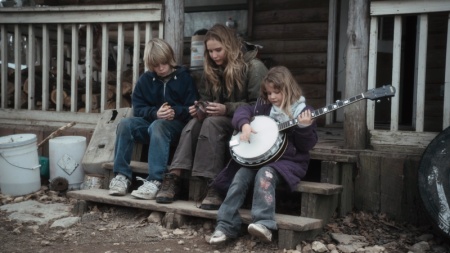
Lillian: The movie and book Winter’s Bone. My childhood shared some similarities with that of the main character, and I have met people whose lives were very much like the protagonist’s in that story. There are so many people in Southwestern Missouri, children, who really have to deal with those things. Those struggles are not all that different – people in cities need to deal with where their food comes from, or drugs or gang violence. Kids are experiencing the same types of stress, it just looks different on the surface.
Still from the movie “Winter’s Bone”
The participants in this conversation left with a sense that we want to offer urban and suburban dwellers the opportunity to view art that helps them understand people who live in rural areas. However, we could not find many works that achieve this. Below is a short list, and we call on readers to help by adding to it.
A few months ago I stumbled upon an IMLS blogpost sharing research about the impact of informal learning environments on academic achievement. Deanne Swan, formerly a researcher for IMLS, mined a large body of data – the Early Childhood Longitudinal Study, which collected data from 21,000 children over nearly 10 years – for the correlations between museum visitation and academic achievement. Controlling for socio-economic status, Swan found that children who visited a library or museum had slightly but significantly higher academic test scores. Interestingly this does not hold true for visits to zoos and aquaria. Swan posits that the visit to a museum is an indicator of a family’s investment in informal learning, so the impact is likely not from a single visit, but from a relationship to out-of-school learning opportunities.
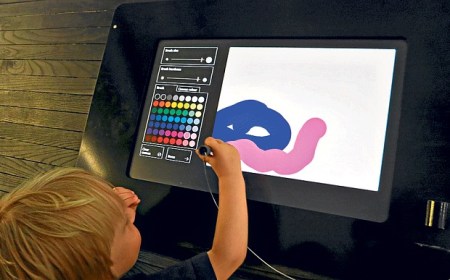
Child in the exhibition “Henri Matisse: The Cut-Outs” at the Tate Modern, drawing on a touch screen.
I remain intrigued by this article for a number of reasons:
(1) What existing data should we be studying and learning from as a field?
This research draws on the Early Childhood Longitudinal Study, conducted in the early 21st century by the National Center for Education Statistics. This study collected data on 21,000 students (although as the article notes, the sample size by third grade was smaller – 12,558 students). This is an enormous body of data.
Museum research is hard – it is very difficult to gather data in an informal learning environment, and generally data collection requires special government approvals (Institutional Review Board, or IRB, approval). Questioning visitors can impact their experience and processing of that experience, skewing the findings. Museum research based on large sample sizes and valid data is rare. And research can be very, very expensive.
Are there other large bodies of data are out there the museum field could look at and learn from? One or two questions related to informal education that could be added to new large-scale studies being conducted in education or other fields?
(2) How do we get the word out about important research?
It was ridiculously hard to find the research referenced in the IMLS blog post. I couldn’t find it with a google search, so I called IMLS. Because the researcher, Deanne Swan, is no longer there it took me a few layers of staff members to speak to someone who directed me to the paper sharing the research cited in the blog. This research has never been published in a journal.
In a field without a great deal of academic research behind it, a study like this one seems important. As Swan herself notes:
This is the first study to examine the effects of visitation to libraries and museums on academic outcomes at a population level. Evidence that suggests that the influence of informal learning environments, such as those found at public libraries and museums, can have long-lasting effects on academic achievement. Even though these effects were small, they were there.
Is there more research like this that I should know about? If so, how do I find it? How do we ensure that practitioners know about important research, so we can build on what we know, rather than re-inventing it?
(3) What is the correlation between informal educational spaces and family investment in learning?
According to this research, far more families are visiting libraries than museums. This is not surprising – libraries are free, and families are familiar with and understand how to learn from books. Of museum visits, zoos and aquariums are the most common destinations, and yet these visits are the only ones not correlated with academic achievement. (There is not research directly examining visits to children’s museums – I suspect that they are more in line with zoos than with art museums.)
What does this say about the choice to visit a zoo vs. a library? Why are visits to libraries, like art museums, correlated with higher academic achievement, but not visits to zoos? If Swan is correct that a museum is an indicator of a family’s investment in informal learning, why does this not hold true for zoos?
Is there a way to collaborate across museums and draw families from zoos to art and science museums? To make investment in ongoing informal learning a goal of a family zoo visit?
What museum-related articles have you read that lead you to new ideas or questions?
The full paper referenced in this article, by Deanne Swan, is entitled “The Effect of Informal Learning Environments on Academic Achievement During Elementary School” and can be found here.
For a while now I have been intrigued by the search terms people use to find this blog, which WordPress (the blogging program I use) shares as part of their statistics. As a way to reflect on 2016, I thought I would examine and share some of the search terms people used to find Museum Questions posts over the past year.
I find these search terms interesting because they evidence some of the questions people are asking about or related to museums and museum work. I believe these questions come from a combination of museum professionals, aspiring museum professionals, and the general public asking questions about museums.
However, this data is limited in a number of ways:
WordPress does not link search term queries to specific posts, but rather to time periods.
WordPress cannot identify many of the searches people use – for 2016 there are 620 recorded search terms, and 6,497 unknown search terms that led people to click on a Museum Questions post.
These are only the search terms that led people to Museum Questions. It would be interesting to see this same information from other museum bloggers and sites!
All together there are nearly 450 search terms recorded, reflecting over 600 searches; I have attached a full list in case anyone wants to further mine this data. (If you take a look, please let me know your thoughts!)
Here are a few trends that I found particularly interesting (numbers in parenthesis indicate the number of people who used that search term):
1. There are clearly a number of people out there interested in the field of museum education, Here are a few of the search terms that evidence this: what does a museum educator do (5); how to become a museum educator (5); what is museum education (4); museum educator job description (4); roles of a museum educator (4); how become a museum educator (2)
Along these same lines, it is worth noting that my most viewed post for the year is from 2014: What does a museum educator do?
2. Many people are searching for information about the relationship between museums and K-12 education / students. Here are just a few of the searches: importance of museum for students (9); role of museum in education (9); what skills are taught on school trips (4); why should students visit museums(2); learning from a museum different from their in school(2); goal in having educational fieldtrips.
3. There are many people trying to understand what meaningful engagement (in a museum and. presumably, elsewhere) looks like:meaningful engagement definition (5);museum engagement (4) what is meaningful engagement (3); meaningful engagement (2); visitor engagement in museums (2); what is engagement (2); what is visitor engagement; what is engagement?; measurement characteristics of the engagement in meaningful.
I should note that another of my most popular posts, also from 2014, is What is engagement, and when is it meaningful? I would love to write a follow-up post that captures stories on moments where museum staff knew someone was engaged, how they knew, and anything they can share about what caused that engagement! If anyone has done this research, or is interested in sharing some of these moments, please do let me know!
4. There is a potentially worrisome interest in for profit museums:for profit museums (3); for profit children’s museums (2); start a profitable museum; for-profit museum; for profit museum; can a museum be for profit; are car museums profitable; museums that are pro profit
And here are a few search terms that just intrigued or amused me:













 Museum Questions