Exhibition Review: What Works, and Why?

Last week, I flew to New York City and went on a museum-visiting spree. I visited seven museums over four days, immersing myself in art, taking notes and thinking about new ideas, meeting with colleagues, and re-establishing connections that are more tenuous now that I live 1000 miles away.

Upon my return I found myself thinking, What stuck with me? What exhibits or objects made me keep thinking about them? The answer, for me, is the “Manus x Machina” exhibit at the Metropolitan Museum of Art. Which has led me to wonder, WHY did this exhibit stick with me? I am not usually drawn to fashion exhibits – what is it that works about this exhibition?

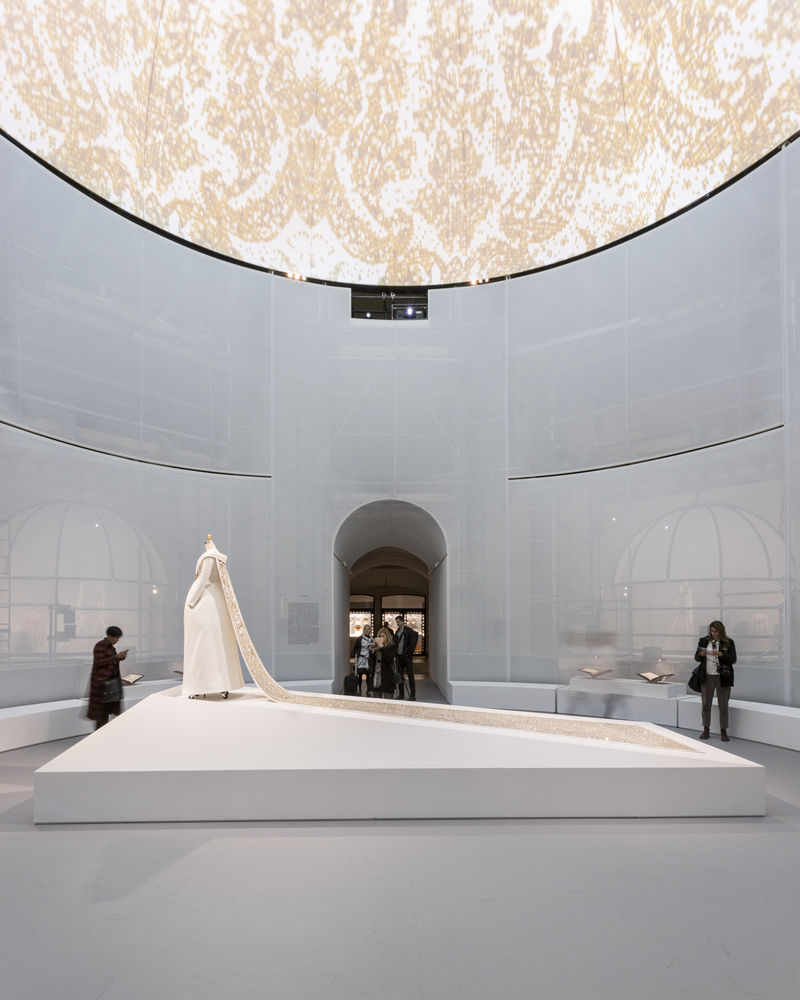
The exhibit is on two floors, in the Lehman wing of the Met. The visitor walks in to a domed space made of scaffolding covered with scrim. In that space is a single dress with a long, jeweled train. A detail from the train is projected on the ceiling, and music plays in the background.

01_ManusxMachina_Central_Atrium_copyright_OMA_photography_by_Brett_Beyer
Found at http://www.archdaily.com/787037/manus-x-machina-oma/572f771fe58eced4da00001e-manus-x-machina-oma-photo

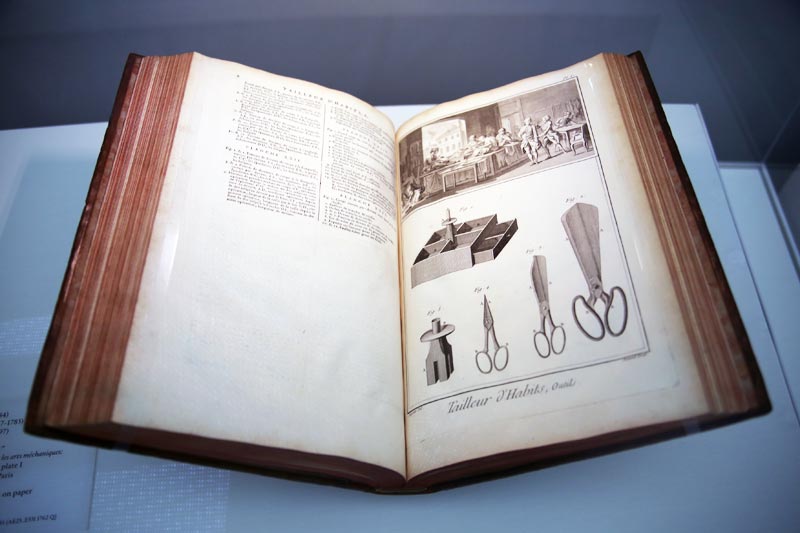
The introductory text (which is hard to find) explains that the exhibit takes its name from a 18th century book that details the tools and hand-skill of arts and crafts. This idea of tools and handwork frames the exhibit, which is broken into sections such as “lace,” “pleating,” and “flowers.” Each section contains examples of handwork and information about the labor and time that goes into it, information about how 20th and 21st century technology has mechanized the process, and objects illustrating how 21st century technology such as 3D printing is leading designers to play with an old idea in new ways.

So – why is this exhibit so successful? What made it so memorable? And how, as a museum professional, can I use these ideas in my own work?

Wow factor

On the blog “Jake’s Bones,” then-12-year-old blogger Jake shared “21 ways how I would create an amazing museum.” Number 5 is “It should have a bit of a wow factor inside.” This is one of of those “well, duh” statements that we may all know, but so often we ignore.

In “Manus x Machina” the wow is created through a scrim set that frames selected dresses, and projects detail from these dresses into domes over the objects. The wow is in the individual environments created: instead of being set against a white wall, the domed objects inhabit their own surreal spaces.

The “wow” is also supported by what the Observer describes as, “hauntingly beautiful music, its pensive melody echoing like a liturgical hymn.”

The music, projections, and fabric structure could easily be distracting, but in this exhibit, it is not. The exhibit design matches form with function, helping visitors identify key objects to look at, and, by separating these objects from the others, leaving space to look closely. The music creates a sense of personal space; in a crowded exhibit, the architecture and music work together to create a space in which visitors can linger and look.


Manus x Machina, Fashion in an Age of Technology, Exhibit at the Met, Location: New York NY, Architect: OMA
Found at http://www.archdaily.com/787037/manus-x-machina-oma/572f74d6e58ecead81000021-manus-x-machina-oma-photo


The second half of the exhibit is down a set of stairs, and has none of the “wow” of the earlier design.

Clear and consistent design cues

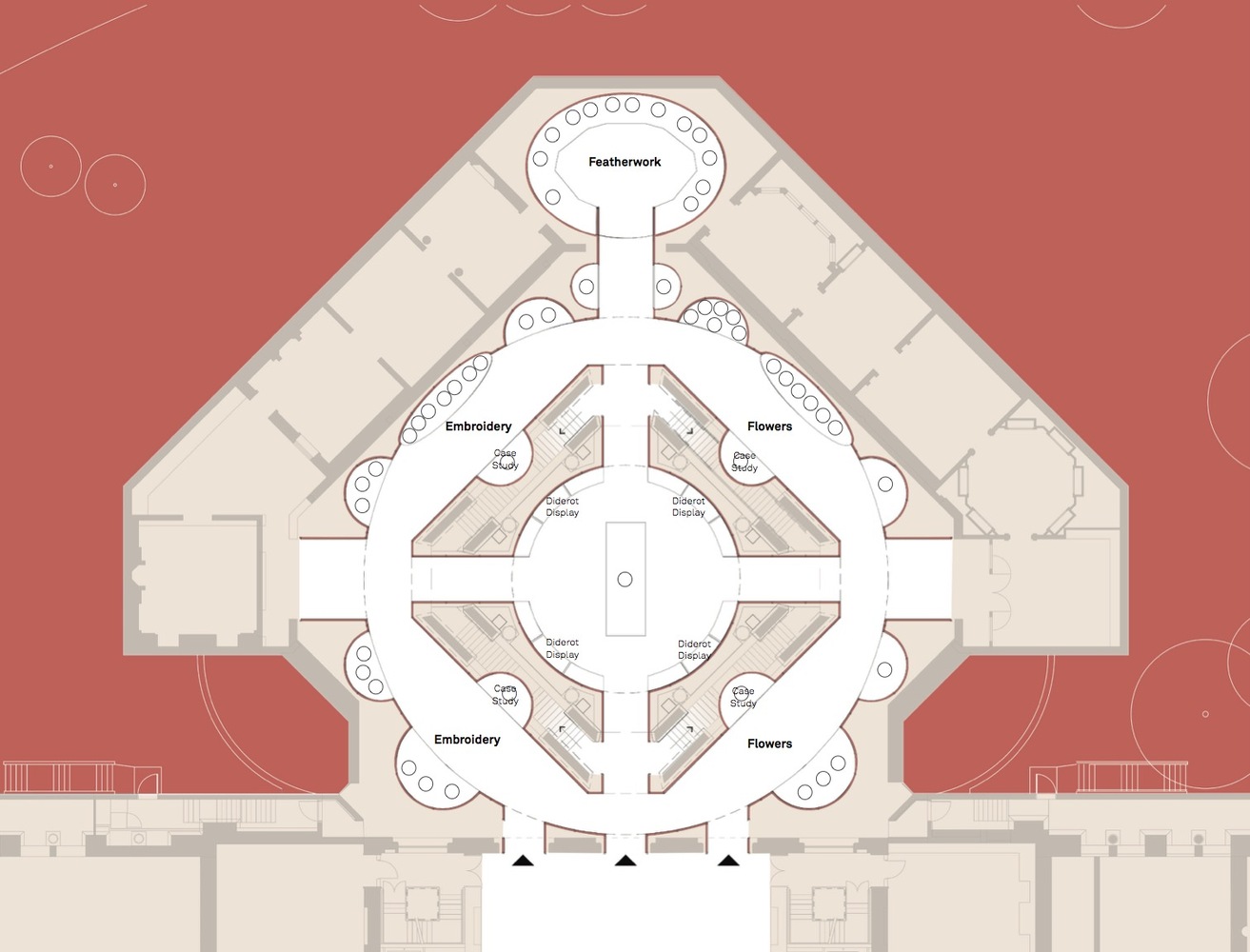
The architecture creates a pattern of display with its own set of rules. Once you figure out how to “read” a section, this knowledge leads you through the entry floor of the exhibit: One skill or subject (for example, “feathers,”) per section; one domed object highlighted in each subject, with text describing some of the details of its making; a more general descriptive text somewhere in section; objects lined up on display near that dome with both old and newer approaches to the subject.

I want to stress the importance of this clarity of the display. Rules are important – they help us make sense of a new space. Too often when designers play with sound and display in an exhibit, they vary the rules from one section to the next. I was at the Field Museum recently, and found the exhibit “Evolving Planet” hard to follow, partly because many of the design features varied from gallery to gallery.

03_ManusxMachina_Upper_Level_Plan_copyright_OMA
found at http://www.archdaily.com/787037/manus-x-machina-oma/572f7a0ae58ecead81000040-manus-x-machina-oma-upper-level-plan


A big, broad idea combined with discipline-specific information

Manus x Machina is an idea-driven show, illuminating the relationship between handwork and tools or machines, and demonstrating the value of both. This idea is carried throughout in a way that the lay-person can understand and appreciate.

Early ideas about handwork and tools are illuminated in the first gallery by copies of Diderot’s 18th century encyclopedia on view, turned to various different pages to illustrate the relationship between the fabric arts and tools. Each section shows both hand and machine-made examples of clothing, and occasional videos demonstrate how machines are used in contemporary fashion.

As someone who does not care a great deal about haute couture, the exhibit worked to make me think about the relationship between hand-made and machine-made, the possibilities afforded by new machines, and the idea of tools as machines. It challenged me to broaden my ideas about tools, something which I am currently thinking about in the context of maker-spaces in children’s museums. In other words, the idea was broad enough to allow me to make my own connections and meaning, while narrow enough to be clearly illustrated and teach me new things.

scissors


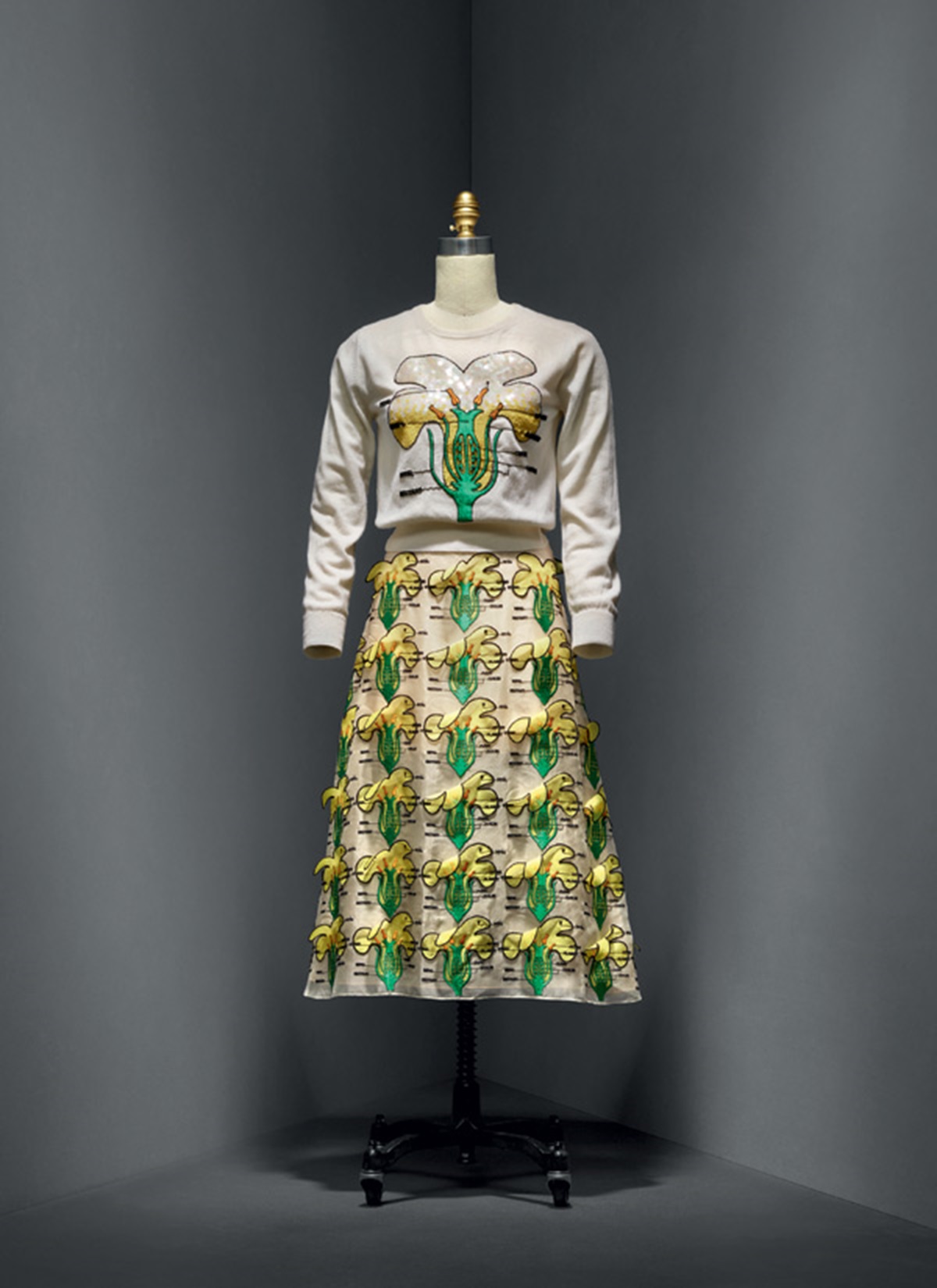
One wonderful example of the new information shared was about the use of flowers in dresses. I had never thought about this as a category of making, and learned a little about how it is done, that it is a specialization within the fashion industry, and the extraordinary amount of time it can take to hand-make flowers for a dress.

Then the exhibit shares how designers are riffing on this specialization. One of the dresses on display, by the designer Christopher Kane, features a repeated flower with its parts labeled, like a text-book illustration. I felt like I “got” the joke. It was extraordinary to see an exhibit include an insider joke, and be capable of transforming the uninformed viewer into someone “in the know” enough to get the joke. Really, one of the biggest criticisms of art museums might be that they often include artwork that comments on previous art, and are rarely able to present it in such a way that makes the art-novice visitor feel on the inside, rather than the outside, of that comment.


flower dress
found at http://www.metmuseum.org/exhibitions/listings/2016/manus-x-machina/select-images


So what?

For me, then, there are three things Manus x Machina did that worked:

  1. Wow factor
  2. Clear and consistent design cues
  3. A big, broad idea combined with discipline-specific information

Arguably, what constitutes success in an exhibit in a major art museum is very different from what constitutes success for an exhibit in a small children’s museum. But there are two reasons to try and apply these ideas from the Met to the Peoria PlayHouse. First, the more I learn about the history of children’s museums, the more I think we have lost something by moving so far away from an object-centered experience. I hope to think more about that in a future post or article. And second, while children are developmentally different from adults, we all exist on the same spectrum of responses. From a very early age (perhaps not infancy, but by 3 or 4), we appreciate the “wow” factor of the spectacular, we appreciate knowing what comes next, and we learn best when we have a context in which to place that learning. (If there are specialists in childhood development who think this is incorrect, please do let me know by commenting on this post or contacting me!)

The PlayHouse is now working on a “Discovery Zone” exhibit – a display of fossils, artifacts, and minerals. We have a concept design, and are now in the fundraising stage. But as we move forward, I will be thinking about the following questions:

  • How do we make sure that we have the “wow factor”? Our exhibit designers are wonderful about this, and have already asked us to identify our “wow” objects. What is the best way to display these objects, to ensure that the entire space and exhibit “wows”?
  • How do we create clear and consistent design cues? Is there an organizing principal that can be spread out among the different activities and interactives?
  • How do we combine a big idea – digging up and sorting these objects helps us learn about our world – with discipline-specific (and age appropriate) information? In what ways does this apply to a children’s museum exhibit?


What did I learn in my first year?

The Peoria PlayHouse Children’s Museum turned one year old last week. Amidst the birthday celebrations and thank you emails, I have been reflecting on the question: What did I learn from my first year as a museum director? What did we learn from the first year of operation of a new museum?

I came up with three answers. All of them may evoke a “well, duh!” response from some or all of my readers. They are all things that I may have intellectually known already, but which I now understand viscerally.

(1) Don’t do too much

When someone has a good idea for a program, exhibit, or resource, I get really excited. I want to make it happen NOW! But it turns out, too much is just too much.

One of the problems with taking on too much is that it’s hard to backtrack. I just lost an AmeriCorps position because of the Illinois State budget (or lack thereof), and that position managed two programs that I refuse to give up. I am confident that can find a way to offer scaled-back versions of the programs. But this would certainly be easier if we hadn’t launched so many programs in our first year.

At the Association of Children’s Museums conference I joined a break-out group discussing time management. I was very interested in the decision-making tools colleagues shared. One tool, from the Mid-Hudson Children’s Museum, was a great list of questions to ask when considering whether to move forward with a program or project. Another suggestion was to rate ideas on a “mission/margin” matrix. A third was to provide staff with tools to calculate both direct and indirect costs of a program, as the indirect costs often negate the income value staff assume a program offers.

Matrix-map4
From Steve Zimmerman and Jeanne Bell in Nonprofit Quarterly, at http://bit.ly/1sNb6uS


I’m excited to try these tools, but not yet sure of their use. It may be that I just need to go “cold-turkey” for a while and put a freeze on new programs. Because while I know that too much is just too much, great ideas are still so exciting!

(2) Everything is about relationship-building

The biggest learning-curve in my current role as a museum director has been fundraising. With the help of some wonderful mentors, I quickly learned that development is all about relationship-building. That once you identify potential donors, you need to take the time to cultivate – to get to know them, to figure out what about the museum might excite them, to learn enough about them that you can reference personal knowledge in a letter or email.

Cycle-of-Philanthropy
Cycle of Philanthropy from Causevox, at http://bit.ly/1sNbzx8

As I was learning this, it occurred to me that everything is about relationship building – and that is both wonderful and exhausting. Managing staff is about relationships – getting to know each of your staff members, and finding out what excites them about the museum, and what skills they have that can support current and future initiatives. We also need to build relationships with collaborators and potential collaborators – people and organizations who can we call on to help us let low-income families know that they can access the museum for free, or to help us plan special nights for children with special needs.

Each relationship takes time, and at some point, you have to delegate areas of relationship-building. But knowing what it takes to foster and maintain those relationships has been helpful to me in thinking about staff strengths, understanding how people spend their time, and why good management is so difficult. Also, the importance of relationship-building, and the time it takes, leads me back to #1, above.

(3) Leaders define an institution with their choices

I have always known that leadership is important. But I have been far enough away from leadership transitions to see how these transitions impact the direction of an organization.

The PlayHouse is part of the Peoria Park District. The Executive Director of the Park District just retired after 24 years in that position. In this moment of transition I have the opportunity to see how her choices, personality, and leadership style shaped the organization, and how another leader will make different choices that create both intentional and unintentional changes.

Being witness to that transition has inspired me to think about my own role as a leader, in shaping the PlayHouse. I am very focused on the museum’s mission – which I was fortunate to have the opportunity to articulate – of helping visitors become explorers and creators of the world. I take this very seriously, and can be very hard on staff when I don’t think that they are keeping this mission in mind. I am proud of this focus, but recognize that this is a very personal approach, and might not be the way someone else would approach this role.

how-to-master-innovative-leadership
From Alexander Hiam at http://bit.ly/1YBibuP; found at http://www.scoop.it/t/future-of-leadership

The impact of an individual on an organization make me wonder about succession planning, at least at the top levels, and whether it is possible to have continuity in an institution over time and across leaders. I have always thought of a leader’s job as sustaining an institution, but now I wonder if all institutions are radically unstable, bound to change as leadership changes.


In the coming year I hope that these new understandings will help me build an ever-stronger and more vibrant museum. I would be very curious to hear from others in leadership positions, and/or at new institutions – what have you have learned in the first years of your work?

How does information help museums build capacity? Interview with Eileen Setti


eileen setti

A few weeks ago, I heard Eileen Setti speak on the topic of capacity building. I was struck by her emphasis on information, and began to wonder about what information we are bringing into museums, and who has access to that information. I asked to interview her in order to pursue this line of thought.

Eileen Setti recently defended her doctoral dissertation on information absorption and nonprofit capacity building at Northern Illinois University. She is a partner in the consulting firm Ruby & Associates which specializes in nonprofit organizations. In July, Eileen will become the Director of Community Education at Methodist College in Peoria, Illinois.

What is “capacity-building”?

There are dozens of definitions for capacity building in academic research. I like using a very general definition: Capacity building is any sort of activity or effort that an organization intentionally adopts, with the desire to improve delivery of their mission. So, for example, a Board training, a staff member going to a conference, or converting to a computerized finance system are all examples of capacity building.

What is the relationship between information and capacity-building?

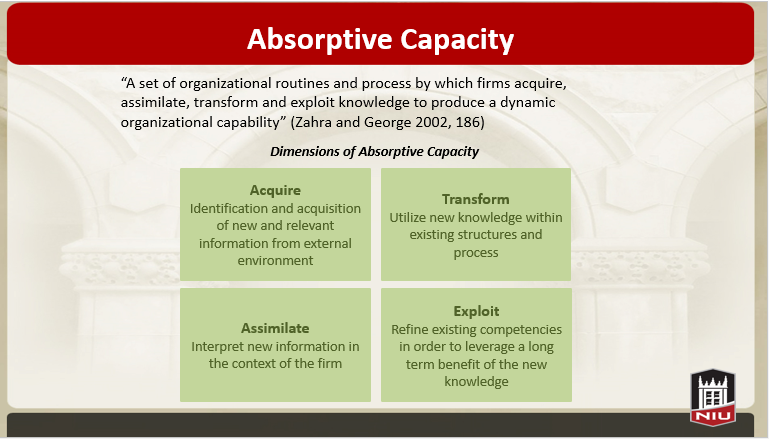
In order to build an organization’s capacity you have to first acquire new information, then figure out how it will be useful, and finally, change how the organization functions. If the information becomes part of the fabric of your organization, then capacity building is achieved. Essentially, new information is needed in order to build capacity of an organization. If we think about the example of adopting a new financial accounting system, you can see how selecting “the best” system for an organization involves acquiring new knowledge about the types of software available. Assimilating that information occurs when the most appropriate option for the organization is selected. Then staff has to be trained on how to use the software and the finances have to be entered and reports generated—which is how the new knowledge is exploited.

 “Absorptive capacity” – or an organization’s ability to use new information – is a construct developed in for-profit innovation literature. This literature establishes that organizations need a great deal of new information in order to just maintain their competitive edge. In order to be a leader in their industry, and to be innovative, they need to really focus on acquiring new information and bringing it into an organization at a fast rate.

Acquiring new information is the easiest part of this process. The most difficult aspect of information absorption is assimilation and transformation.

Assimilation requires you to sit down and think, “Is this relevant to my organization?” That can’t happen in a vacuum. It needs to be shared with staff or possibly with a Board. Information assimilation is like “chewing” on information to determine how it is relevant. For example, a staff member may attend a conference and learn about how a museum can facilitate pop-up or off-site programs around the city. However, for a very small museum with only one or two full-time staff members, this information is likely not relevant because the museum does not have the staff power to support off-site programs. Therefore, the information is not assimilated.

However, if the new information is relevant, the organization needs to determine how it can actually be used in the organization. This is knowledge transformation. How are we going to change our behavior? How can we create new materials or tools to make this work in our organization? In the case of off-site programs, a larger museum would consider how they could utilize staff and volunteers to leverage off-site programming. It’s not enough to just acquire new information. The organization must also assimilate and transform information in order to build their capacity.

Potential capacity is related to the information you take in. But realizing this capacity requires an organization to transform and exploit that information.

 Let’s start with acquiring information. Who needs access to new information? 

New information needs to be acquired at all levels – every staff person, volunteer, and Board member is an agent of the organization. A person working on the front line has a different experience of the organization than the Executive Director. The kind of information that they might capture is totally different than the information the bookkeeper would capture. Those differences are critical to the overall health of the organization.

Executive Directors and Board Chairs set the pace for acquiring, assimilating, and transforming new information. It is important that the Board be committed to staff development, saying “we value you going to this conference, taking this class, getting your degree.” In my research, organizations where the Board and the Executive Director send this message saw the benefit of everyone bringing information in.

Often in a museum there is a limited budget for professional development, mostly allocated to full-time staff. How important is it that a museum include part-time staff in this process of accessing new information?

Everyone needs to be contributing to all aspects of information absorption—part-time, full-time, front desk, board members, maintenance—everyone. I think part of the equation is first understanding the skills that individual staff members possess. Where are their gaps? Where are their strengths?

The first step in information absorption on the road to capacity building is just setting the time aside to have conversations about your work, and including part-time staff in decision making. If part-time staff or volunteers feel like they are valued and part of the decision-making process then they will naturally acquire new information. Information acquisition happens during work hours and outside of work hours in formal and informal settings. I think about the hundreds of conversations I’ve had in my career about my job with friends – the conversations naturally flow to information people give me that might help me in the future. “I’m having this trouble at work” or “Can you recommend a good consultant?” or “Do you have this particular policy that I could use as a guideline.” Part-time staff can be part of that type of information building as well, which is outside the bounds of a conference or a specific training session but can still be impactful to the organization.

The longer I am in my field, the less conference presentations seem useful – they often share already-familiar information and ideas. What makes a conference presentation useful? How do you identify valuable information?

In my research, I spoke to one Executive Director who took over his organization 25 years ago. At that time, the organization was very small. Today it has a multi-million dollar annual budget, and stretches far beyond its original service area. He said that for the longest time he wouldn’t hire someone unless they could work in one of the organization’s programs. Even a bookkeeper had to be able to hop on the floor and perform direct services to their clients. However, when he started hiring specialists – a trained bookkeeper or an experienced CFO– those specialists really impacted the organization and fueled the organization’s growth. The specialists couldn’t perform direct services, but their expertise radically impacted the capacity of the organization. He said, having specialists at all levels of the organization is what supported its tremendous growth.

I think this relates to the “quality” of conferences. It could be that, for certain positions in an organization or times in your career, the type of information that you need isn’t going to come from a museum-specific conference—or a sector specific conference. As a museum director you probably know how to manage exhibits and create educational experiences for your patrons. These and similar topics are likely covered at museum conferences. However, the museum director may have no idea how to fundraise. So maybe the director needs to attend a fundraising conference rather than a museum conference…or a Human Resources conference…or turn to Board Source to learn how to develop the museum’s governance structure. In essence you’re attending a specialized conference rather than a generalized conference.

Conferences are less fun when you don’t know everyone there.

I know! And the problem is that birds of a feather flock together. My dissertation is interdisciplinary, which is very rare in my department at Northern Illinois. I turned to sociology, the business school, and public administration because I was cutting across all sorts of theories and ideas in order to study information absorption and capacity building. My research would have been very different if I had just stayed in my speciality area of public administration—if I had flocked with my birds! But when I connected with other specialists, my research took off.

It’s the same with a museum. You are not just a museum – you are a business. So take a holistic approach to capacity building. Sketch out who does what in the organization. Determine the training budget and how it can be allocated. Be creative and identify “free” sources of information in the community—who can you take out to lunch in order to “pick their brain.” Don’t all going to the same conference, unless that conference has different tracks for different people in the organization. Then find specialized resources like community leaders, conferences and trainings to build all aspects of your business. Be part of several flocks!

How do you decide what information is worth assimilating and transforming?

Deciding what information is worthy or unworthy has a lot to do with the strategic directives of the organization. I’m working with a non-profit in the Peoria area that is planning a very aggressive expansion into several counties beyond their core service area. Because of this goal, they are hungry for information that has to do with sustainability, fundraising, and how to make new relationships in communities where people are unfamiliar with their mission. The strategic direction of expansion really focused their efforts on the type of information they needed in order to support expansion. This is building capacity by absorbing new information at its best. Looking at your strategic directives is one way to weed out unnecessary information.

You can also look at your museum holistically, by considering your programmatic capacity. Do you need new programs? Is it better to revamp existing programs? Are you paying your bills? Is your building getting clean? Is your building crumbling? This can guide what information is relevant to your agency or museum.

There is a lot of information out there – and too much information is not helpful. Museums need to decide what information is important by considering mission, strategic directives, or current capacity and needs. Picture by Brian - Flickr: Information Overload, CC BY-SA 2.0, https://commons.wikimedia.org/w/index.php?curid=19644507
How do you decide what information is important? Picture by Brian – Flickr: Information Overload, CC BY-SA 2.0, https://commons.wikimedia.org/w/index.php?curid=19644507

Are there tools for assimilation and transformation of information?

The literature about information absorption in a non-profit setting is not developed—to my knowledge my dissertation is the first consideration of absorptive capacity in a nonprofit organization. In the for-profit world, the literature talks about information-sharing across a large organization, getting departments to talk to each other, creating settings where sparks of innovation can occur, be assimilated, and then transformed.

One simple thing a museum can do is create intentional opportunities for new information to be acquired. Then look at how the staff creates time in their busy day to discuss some of these issues, to ask, “How could we use this information?” In non-profits is there is a tension between just getting through the day (often because we are all understaffed and underfunded) and long term thinking – like strategic planning, succession planning or fund development. It’s really hard to balance the everyday with the long-term planning that needs to happen. But information assimilation and transformation is the only way new information actually gets used or leveraged in the organization.

I think the best tool to help with assimilation and transformation is a meeting on your calendar with staff to process newly acquired information and then plan. Imagine you went to a conference about museum programming for pre-schoolers, and got great new ideas. We all fall victim to sliding the conference packet and the little stack of business cards you collected at the conference onto your bookshelf never to be opened again because we have emails to answer, bills to pay and staff to direct. But think about it. You already have the most powerful information absorption tools at your disposal. Schedule a meeting with staff and sit down to discuss your newly acquired information from the conference. Is it relevant? How can you use it in YOUR organization? What would need to change? Just take one little tidbit and use it! To me, that meeting and a simple plan of action are all you need to absorb new information and build any organization’s capacity.


What is the role of museums in educational change?


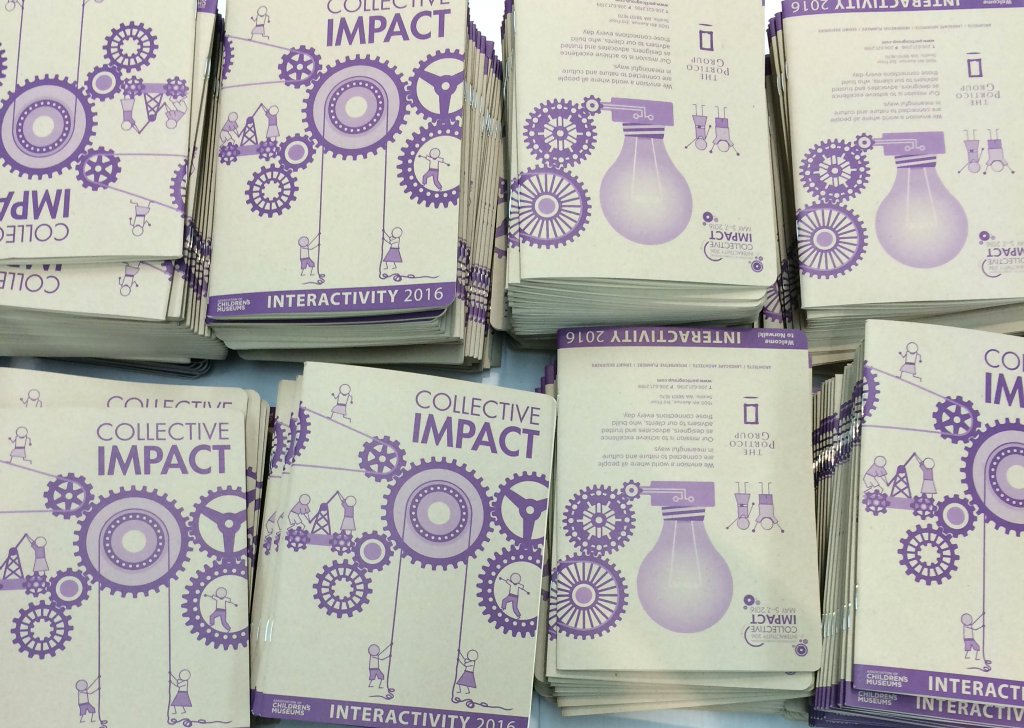
Notebooks distributed at InterActivity 2016

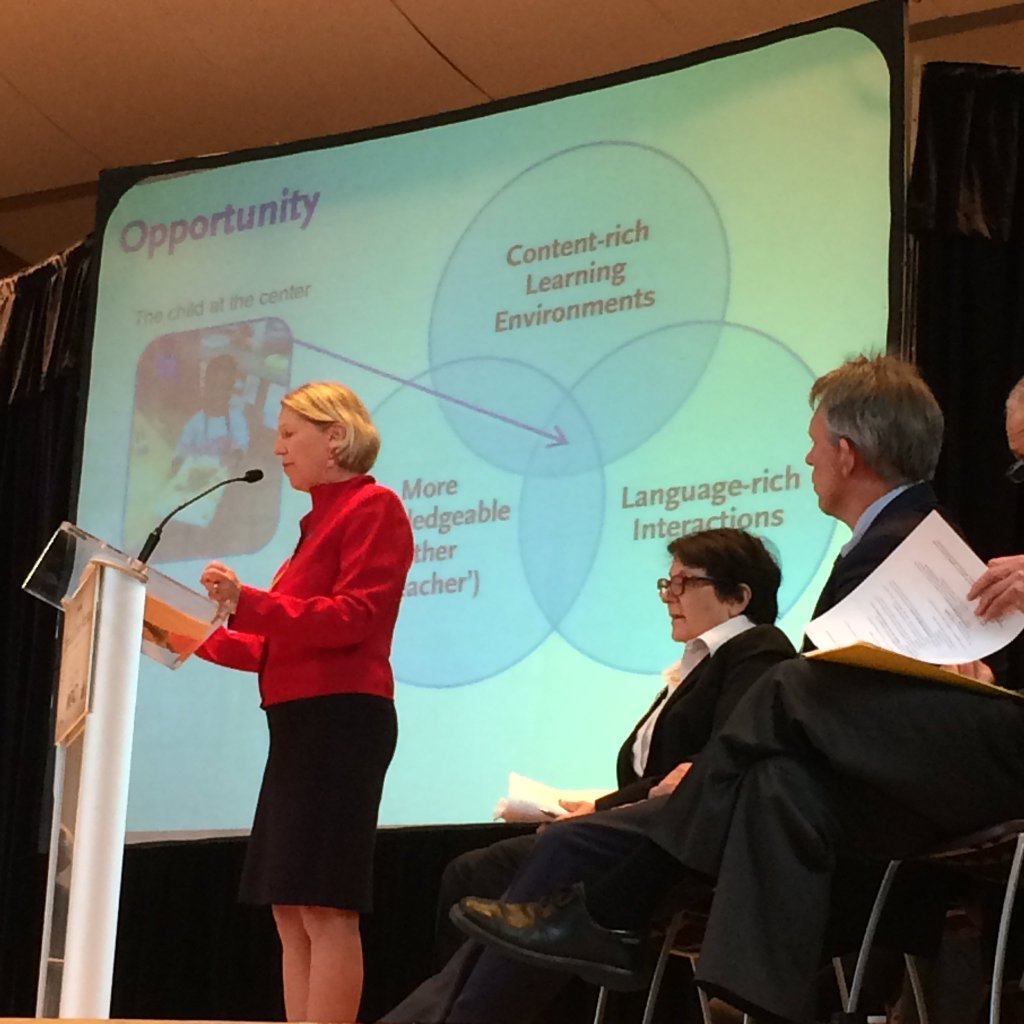
Last week I attended “InterActivity,” the annual conference of the Association of Children’s Museum (ACM). This was my first ACM conference, and I learned a great deal from presenters and colleagues. I was impressed by the organization of the conference, ACM staff’s attention to the needs of each conference attendee, and the challenging questions posed by ACM Executive Director Laura Huerta Migus.

The theme of this year’s conference was “Collective Impact,” and included a 7-hour experience entitled “Collective Impact Live!” Collective Impact Live included a session at Norwalk City Hall, followed by a visit to the conference host museum, Stepping Stones Museum for Children, which has been actively working with its community on a citywide project using the collective impact model.

The session at Norwalk City Hall was entitled “A Special Town Meeting: Children’s Museums and the Achievement Gap.” This session attempted to teach ACM members about, and engage them in, the collective impact approach to social change, in particular social change relating to K-12 education. It took the format of a historical New England Town Hall, including guest experts who spoke on topics related to the achievement gap and panelists who asked questions of the speakers. The three-hour session ended with a vote on a resolution to engage ACM members in closing the achievement gap.

I have two concerns about this session, and the culminating resolution. My concerns are with the highly-popular collective impact approach to collaboration, and with designating the collaborative goal as closing the achievement gap, as defined by school-based skills and tests. I elaborate on both of these concerns below.

Collective Impact

Collective impact is a new approach to city-wide collaborations to address social issues, which has quickly gained in popularity around the country. In the Stanford Social Innovation Review, management consultants John Kania & Mark Kramer describe collective impact as follows:

[Collective Impact is] the commitment of a group of important actors from different sectors to a common agenda for solving a specific social problem. Collaboration is nothing new. The social sector is filled with examples of partnerships, networks, and other types of joint efforts. But collective impact initiatives are distinctly different. Unlike most collaborations, collective impact initiatives involve a centralized infrastructure, a dedicated staff, and a structured process that leads to a common agenda, shared measurement, continuous communication, and mutually reinforcing activities among all participants.

I read Tom Wolff’s critique of community impact on the flight to Connecticut for InterActivity. Without knowing much about Tom Wolff, my sense is that his critique stems in part from bafflement that this mode of collaboration has gained so quickly in popularity, while he, along with many others, have been engaged in important collaborations with little notice for many years. However, he makes two striking points:

1. Collective impact is a top-down process, engaged in bringing businesses and business leaders together. It engages community organizations in collaboration, but does not mandate collaboration with “those most affected by the issue.” It engages the powerful, but not the powerless.

I was struck by the contrast between the InterActivity panel and a panel on community engagement at the National Art Education Association museum pre-conference this past March. At the March event, the panel included a teen participant, as well as a community member who was both the mother of a participant and who felt her own life had been impacted by an early visit to a museum. The InterActivity Town Hall had some wonderful speakers, but they were all either representatives of non-profits and school systems or academics engaging in related research.

2. Community impact is committed to figuring out how to achieve a goal within the current system. It does not challenge this system, or consider larger systems change.

To my mind, to achieve true educational change in the United States requires systemic change. We need a massive shift of funds from affluent schools to poorer school districts. We need expensive social service supports in place to ensure the stability and health of families and children. Until the United States ensures that low-income families have stable and livable homes, work for parents, child care for younger children, and medical and dental care for these families, it will remain nearly impossible for many children to focus on school work and demonstrate the full academic achievement of which they are capable.

Margie Gillis from Literacy How, Inc, presenting at InterActivity

The Achievement Gap

The ACM community impact initiative was centered on the goal of “closing the achievement gap.” The National Education Association (NEA) defines the achievement gap as follows:

The term “achievement gap” is often defined as the differences between the test scores of minority and/or low-income students and the test scores of their White and Asian peers…. Differences between the scores of students with different backgrounds (ethnic, racial, gender, disability, and income) are evident on large-scale standardized tests. Test score gaps often lead to longer-term gaps, including high school and college completion and the kinds of jobs students secure as adults.

By focusing on the achievement gap, ACM asks museums to work towards a goal that, arguably, has little or nothing to do with the mission of most museums, does not utilize museums’ inherent strengths, and raises social justice concerns. Here are some of the problems with defining “closing the achievement gap” as a goal for children’s museums:

  1. The achievement gap is defined by test scores, which are primarily reading and math tests. They do not measure (nor do they claim to measure) the types of impact that children’s museums are likely to have on young visitors.
  2. Children’s museums are arguably most effective at stimulating curiosity in children. Much of the school curricula, as well as these tests, are currently designed to engage all students in the same topic, regardless of individual interest or curiosity. Children’s museums are also effective in engaging children in productive collaboration; standardized tests are always independent.
  3. The tests are in and of themselves problematic. For example, reading tests have been criticized for testing convergent but not divergent thinking. Specific test questions have been identified as baffling even to highly educated adults – in New York, the most famous example of this was the “pineapple question.”
  4. The tests are themselves part of a system that is problematic for a wide range of reasons, including:

-Tests funnel significant amounts of education funding toward the large companies that create tests and test preparation tools.

-Tests narrow the school curriculum to focus on test preparation. This often results in schools that focus on “basic skills” (reading and math) at the expense of the arts, visits to museums, and teaching children to think for themselves. The resulting schools follow a curriculum that parents with significant means would never accept for their own children.

-Standardized tests are used to hold teachers accountable, judging them their students’ scores despite the fact that these test scores are highly correlated with the income and education of parents.

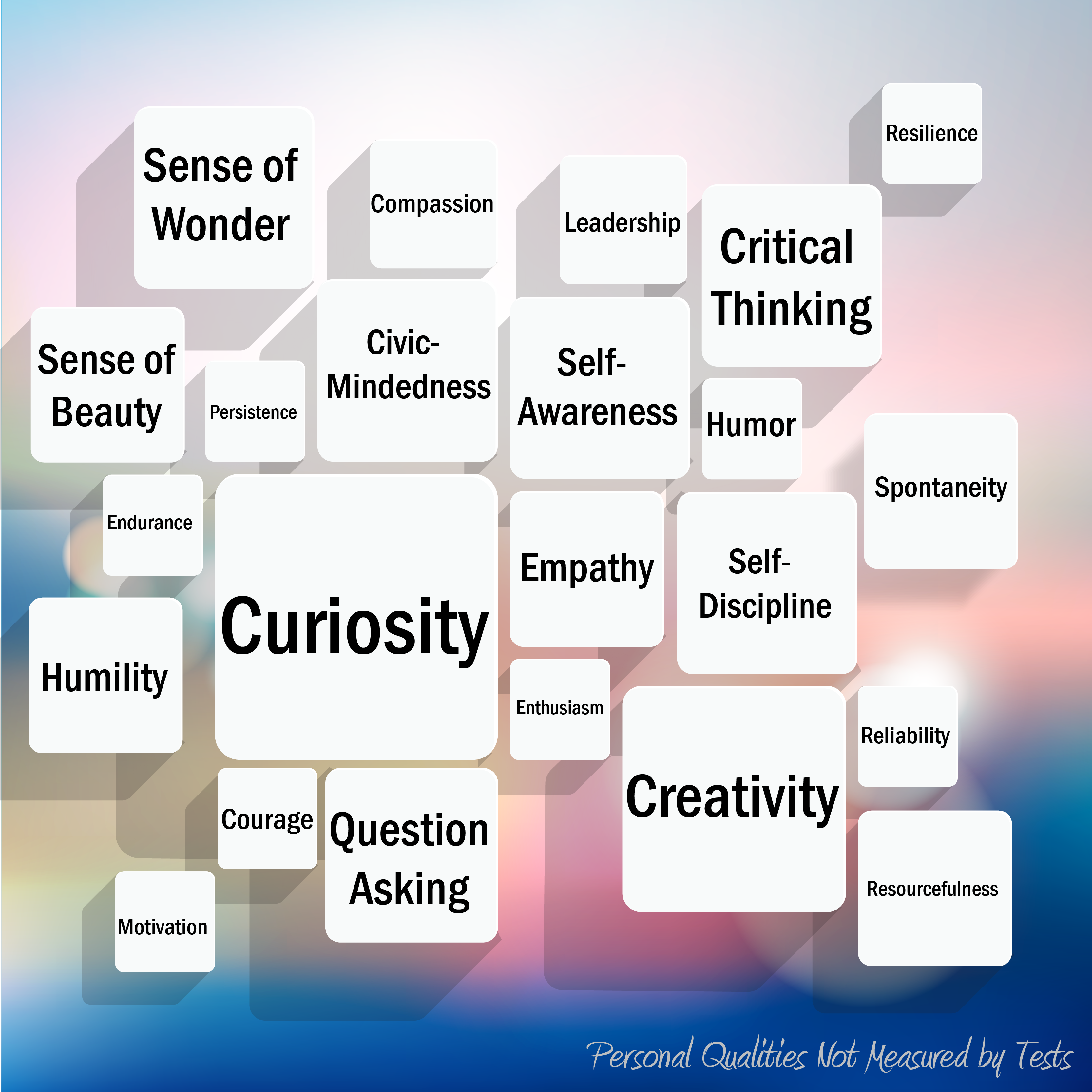
-The emphasis on testing precludes more careful thought about the purposes of education, mandating that schools cultivate students who score well on standardized tests, rather than raising students who are curious, civic-minded, original thinkers, have a larger range of job skills, or other potential educational goals.


"Personal qualities not measured by tests," by Technovore. Found at https://www.flickr.com/photos/krillion/
“Personal qualities not measured by tests,” by Technovore. Found at https://www.flickr.com/photos/krillion/

Museums and Educational Change

ACM’s “Special Town Meeting” defined closing the achievement gap as a “common agenda.” But this is an agenda set by federal and state education departments, not by community members. Large-scale collaboration around a common goal should engage the community in a broader conversation about what a healthy childhood looks like, and what our larger goals are for raising children in our society.

President Dwight D. Eisenhower once said:

I have two kinds of problems: the urgent and the important. The urgent are not important, and the important are never urgent.

The website MindTools defines things that are important as having “an outcome that leads to us achieving our goals, whether these are professional or personal.” Urgent activities, on the other hand, “demand immediate attention, and are usually associated with achieving someone else’s goals. They are often the ones we concentrate on and they demand attention because the consequences of not dealing with them are immediate.”

Ending the achievement gap could potentially prove counter-productive: one could have a group of students who do well on standardized tests but never have the opportunity to develop curiosity or wonder about the world, think or advocate for themselves, or discover what they love to do. Creating a more equal society demands that we think beyond “the achievement gap” and create educational and cultural opportunities for all children that engage them as thinking and feeling individuals who have something to discover from and contribute to the larger world.

When museums focus on the achievement gap they are addressing an urgent problem, but not necessarily an important one. The important problem is equity – how can museums, and all of us individually as citizens, help ensure that all students have the resources and opportunities they need to live happy and productive lives in a truly equal society?


How can museums share progressive ideas with culturally conservative visitors?

This past week I attended a lecture by Professor John Jost of NYU on the psychology of political orientation. His presentation led me to wonder about museums and the psychology of cultural liberalism vs. cultural conservativism. How do we share new and progressive ideas with culturally conservative visitors? How do we even get them in our doors? Are there things that we know about the psychology of these visitors that might be useful?

I am imagining the art museum visitor with little art background who sees “Untitled,” by Felix Gonzalez-Torres, and immediately rejects it. Or the history museum visitor who stumbles into an exhibit about the history of the LGBTQ movement and gets angry or upset. How can museums reach these visitors? Is there anything that we can do that can attract culturally conservative visitors to learn about what they might define as “liberal” topics? Are there methods of presentation that help bridge these gaps?

IMG_3997
Untitled, Felix Gonzalez-Torres

The Psychology of Political Orientation

John Jost’s work assumes that political ideology serves a psychological need, and that, generally speaking, there are core psychological differences between left-wing or liberal, and right-wing or conservative, voters. Most prominently, conservatives support authority and are interested in maintaining the status quo, while liberals are open to change, and prioritize social and economic equality. Therefore, if someone is psychologically motivated to reduce uncertainty, and has a preference for stability, he or she is likely to be a political conservative.

Jost shared an Ipsos/Reuters poll that asked people whether they found various entities (countries, leaders, organizations, and phenomena) threatening. Republicans found nearly all of these more threatening than did Democrats. For example, 67% of Republicans find illegal immigration threatening, while only 36% of Democrats found illegal immigration threatening. Similarly, 18% of Democrats and 33% of Republicans feel threatened by Atheism; 30% of Democrats and 58% of Republicans feel threatened by Islam.

Apparently there is evidence of a genetic component to political orientation, from studies conducted with identical and fraternal twins separated at birth. And one fascinating study found that researchers who looked at nursery school students could predict their later political orientation: children who were characterized as “developing close relationships, self-reliant, energetic, somewhat dominating, relatively under-controlled, and resilient” grew up to be liberals; children who were characterized as “feeling easily victimized, easily offended, indecisive, fearful, rigid, inhibited, and relatively over-controlled and vulnerable” grew up to be conservative.

Jost also looked at the personality characteristics called “the Big Five”: Openness, conscientiousness, extraversion, agreeableness, and neuroticism or emotional stability. Liberals tend to score higher on tests of openness, and on compassion, which is a subcategory of agreeableness. Conservatives score higher on conscientiousness and on politeness, another subcategory of agreeableness. Another study conducted by Jost’s team demonstrated that conservatives have neater, more organized, and more conventional working spaces than do liberals. More recent studies find differences in language – conservatives use more nouns than liberals – and in the physical structure of certain areas of the brain.

Museum encounters with new or threatening ideas

I am making a number of assumptions in even considering the questions in this post. These assumptions include:

  1. Jost’s research is valid. His work includes a number of meta-studies, and to the best of my understanding Jost is very well respected in his field.
  2. Cultural leanings have the same or similar psychological underpinnings as do political orientation. In some areas they overlap (for example, responses to minority groups.) Regarding responses to contemporary art or other unfamiliar objects, I do not have any evidence to support this, but it makes sense to me.
  3. Museums skew toward the liberal end of the cultural spectrum, often displaying new and novel art, or sharing new theories of science or history. There are certainly conservative-leaning museums, but my sense is that as a field we are at least culturally, if not also politically, liberal.
  4. When a museum displays a Felix Gonzalez-Torres work, or a history of the LGBTQ movement, one goal is to engage visitors who might not begin as sympathetic or knowledgeable, and help engage their interest and sympathy. This relates to the current interest in empathy in museums.
Jerusalem_Museum_of_Tolerance_construction_site
The Museum of Tolerance is one example of a museum that explicitly aims to convince visitors to think in potentially new ways.

Museums, like political candidates, often draw like-minded people. But how do we present information, or draw in, those who are not already convinced? And, to restate the question posed earlier, how do we share new and progressive ideas with culturally conservative visitors?

Here are a few initial thoughts drawn from my understanding of Jost’s research:

  • Conservatives are drawn to authority figures. There is a movement afoot in museums to share authority with visitors. It seems likely that this repels visitors who want a clear source of authority. In fact, this likely relates to Jackie Delamatre’s recent exploration of adult learning styles in this blog. Can museums be participatory while drawing audiences that yearn for clear authority?
  • If cultural conservatives respond to authority, are there interventions such as audio tours scripted and read by respected and well-known authority figures that might make visitors feel more comfortable in an exhibition of new or politically uncomfortable material?
  • Would acknowledging the sense of threat presented by new ideas help some people feel more comfortable with them? Instead of assuming that all visitors should, for example, recognize Gonzalez-Torres as an accomplished and established artist, what happens if visitors have access to a tour guide, or a brochure, that meets them in the place that they are starting from?
  • Navigating exhibits can sometimes feel disorienting or confusing, because of the many choices visitors must make in what to look at first or second, and which direction to turn. While many visitors appreciate the choices offered by informal learning, this may make visitors who prefer clear structure and organization uncomfortable. Are there ways to offer some visitors are clearer path without compromising the experience for others?

What can we learn from Jost and other psychologists that helps us to reach visitors, especially those who might disagree with us, in a meaningful way?

What is the relationship between “community need” and museums?

In December, I asked readers “What are your museum questions?” One colleague, Andrea Jones, emailed me to say that she has been thinking about questions around “community need.” That email grew into an exchange between the two of us, that turned into this post. This is very much the beginning of a conversation. Andrea and I invite you to join the conversation by commenting on this post!

Andrea is the Director of Programs and Visitor Engagement at the Accokeek Foundation in Accokeek, Maryland, and previously contributed this interview to Museum Questions.


Andrea Jones: I’ve had a couple of topics rambling around in my head the last couple of days. One of them is about “community need.” At Accokeek Foundation, we have a farm (“Ecosystem Farm”) that we are transitioning from a production farm (selling vegetables at a farmers market) to a demonstration or agricultural exhibit space. The farmers came up with a vision for showcasing sustainable agriculture and our Director of Development asked if they could show “community need” for the kinds of themes they want to explore. I’m hearing this phrase a lot lately, and I think it means, “Will people come to this installation, program, exhibit etc.?” But it could mean something else. No one in the community has actually asked for an agricultural exhibit space.  Does that mean we shouldn’t pursue it if there is no proven need?

accokeek
Ecosystem Farm volunteers help out during the farm’s “production” era. The new plan is to create agricultural exhibits. Photo: Accokeek Foundation

Rebecca Herz: What’s the difference between a community needing something, and a community asking for it? If a program or exhibition is successful, is it successful because it already has an audience, and it is addressing an existing need for a museum to address this topic? Or is it successful because it raises something new, in which case it might take a while to catch on, but it has the potential to spark new dialogue?

Andrea: Yes – that’s exactly what I’m asking. Should museums be creating exhibits, programming, etc. in response to the community, or should they be fulfilling a need that visitors didn’t know they had?

There is research (see links at the end of this post) to support the fact that people are notoriously bad at predicting what will happen in the future, or what they may actually want. They may think that they need someplace that sells fresh fruit and veg, but then the fruit stand opens up and no one buys.

My former employer, The Atlanta History Center, was able to procure the donation of a huge collection of Civil War artifacts in the late 1990s. I wasn’t working there then, but I doubt if they asked the community if they felt that they were solving the problem of “not enough Civil War education.” The museum just said YES and became one of the top 5 places to see Civil War artifacts and (I think) created its own need.

Rebecca: Randi Korn taught me that in a formative evaluation you never ask the visitors what they want to learn about the topic. Because if they haven’t learned it, they don’t know about it.

The Atlanta History Center didn’t ask the community in part because this decision was not about “community needs” – it was about a need of the museum field and historians, the need to preserve these artifacts, and the need to share an important collection and information with the public.

Andrea: So are object-based museums less beholden to community need? Historically, history and art museums were often founded around the donation of a wealthy collector. Preserving and protecting may have been the primary goal — not teaching or filling some kind of need in the community. This is unlike parks, zoos, and children’s museums that traditionally don’t have objects or something to protect. But nowadays, there is a lot of emphasis on responding.  Perhaps this is due to cultural shifts, or possibly because attendance is down at many cultural institutions and we need to find ways to get people in the door. So we say, “What do you want? Tell us and we’ll do it. Or you can help us do it.”

Rebecca: The original goal of museums was to demonstrate and propagate a norm or value. The very mission of protecting objects is related to perpetuating a hierarchy of what is worth protecting. As recently as the 1950s the United States used exhibitions of Abstract Expressionist art to demonstrate that the United States was a vital, creative place, and thus to demonstrate the creative power of the country, and thus argue for the supremacy of the U.S.

Maybe museums are attending to “community need” these days because in the 21st century, communities have something museums need – the power to tweet and facebook their perceptions of a museum, the power of visitor numbers, the power to shape how an institution is seen.

Andrea: Yes. And museums are increasingly collecting in a responsive way, too. I’m wondering how much importance they should give to very current trends. How do you know if something is historically important when you’re still in the midst of events unfolding?

Rebecca: We live in a very fast-paced world, and I think there is both a sense that if we don’t collect something now – for example, “Black Lives Matter” protest signs – they will be gone, and also that the importance of current events is somewhat evident. But that’s not the same as asking people what we should collect or display.

Andrea: Back to the idea of actual community need . . . Last year I had a meeting with two teachers at a high school that has an environmental/agriculture program. We went to the school to drum up business for our new environmental school tour, but one of the needs that we discovered was that their students needed places to do outside projects and internships related to agriculture. Many of them were involved in the Future Farmers of America. Because we could see funding opportunities for an intensive teen summer internship, we created a program called the Agriculture Conservation Corps just for these students. The program turned out to be a huge win for us. We were able to raise a decent amount of money to pay the interns because funders loved the “story” of the museum helping teens, and the clear impact of this program. It was a hit with the press, board members, and other stakeholders because you could really see what a difference the program made in these nine  students’ lives.

I guess with this program, the community didn’t provide the vision, just the need for a space for teens to do projects. We responded while still fulfilling our mission to reconnect the students with nature and the food system.

agriculture conservation corps
Agriculture Conservation Corp teen examines a pepper she helped to grow during a this seven-week internship. Photo: Accokeek Foundation


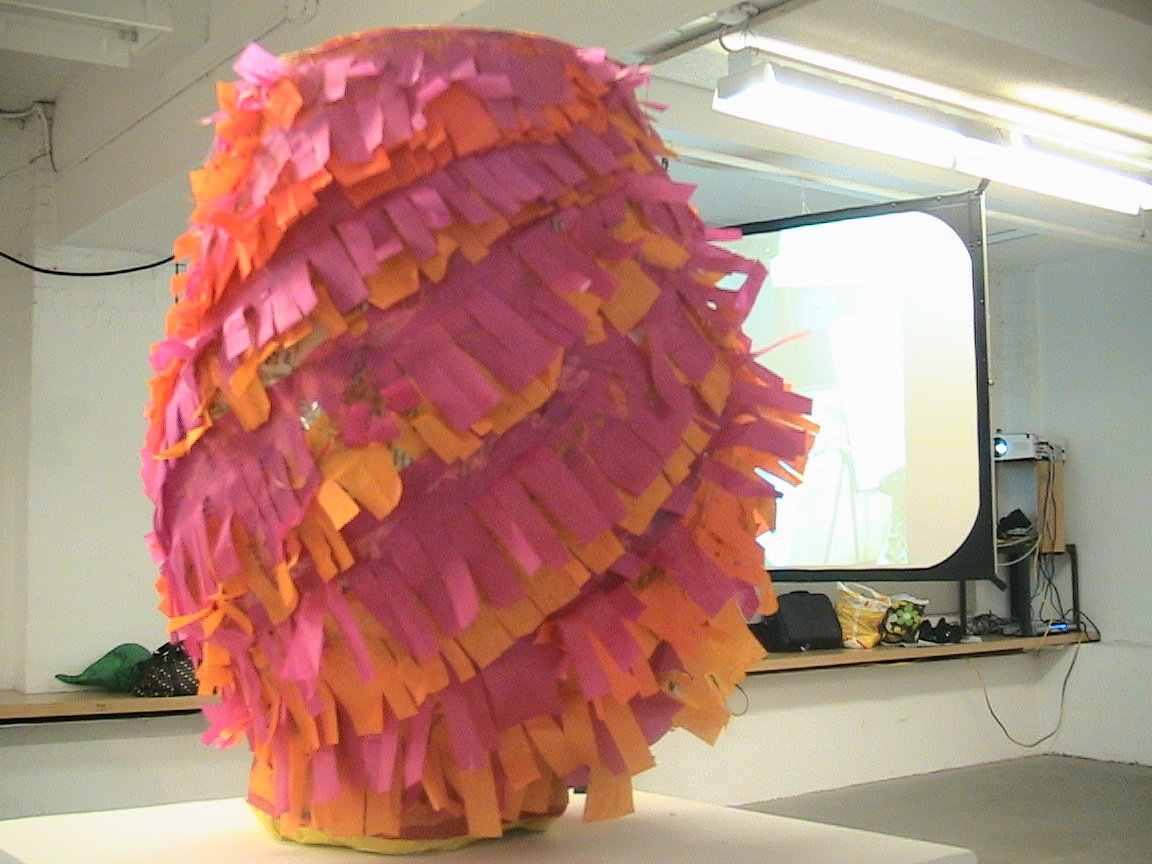
Rebecca: Maybe this is exactly where addressing “community need” works. Rather than a big project, the museum worked closely with a very small group of people and was responsive to them. When I was at The Noguchi Museum we worked with a group of women through a local family literacy center. These women were interested in building skills that might help them earn money, including how to make piñatas. In response, we offered a multi-session workshop that focused on design, abstraction, and culture, and how that might relate to piñata design. This was a very successful collaboration, and took our relationship with the literacy center to a new level.

I think it’s important that we were not asking these eight or ten women to articulate needs that related to or impacted a larger community. We were not asking them to represent anything other than themselves, or to create something that helped a broader group.

pinata
Piñata by a woman participating in a partnership program between the Noguchi Museum and Ravenswood Family Literacy Center, on view in the Education Room of the Noguchi Museum.

Andrea: Do you really even need a proper museum to execute real community engagement? It’s not really about the collections when you’re fulfilling these kinds of community needs. It really makes me wonder if the definition of what a museum is or does is changing. Are we more like community centers?

Rebecca: You are pointing out that museums often don’t make programming decisions based on their collections. They want to be important to people in ways that go beyond their collections, even if they might be seen as compromising their original missions. How much should a collection drive decisions about programs?

Andrea: Well, I think collections will continue to steer the course. But perhaps we need a looser interpretation. Maybe what we’re really talking about here is relevancy. Is your museum relevant to the communities you serve? And when we do execute a deeper level of engagement with a particular audience, how much authority do we give?


Further information about our inability to predict what we will want in the future:

  1. “Affective Forecasting: The Perils of Predicting Future Feelings” by Brett Pelham
  2. “Myth #21: People Can Tell You What They Want” by UXMyths
  3. “The Folly of Prediction” a Freakonomics podcast

What data do we use to define success?

On Tuesday we are hosting a cocktail party for major donors – people who, over the 15 years of building the PlayHouse, have donated $5000 or more. The goal of this event is to thank them for what they helped us to create.

I am struggling with my brief presentation to them. What information or ideas do I share to show them what a success this museum is? What data do I have to demonstrate this success? The easiest numbers to share are the attendance and membership numbers. They are easy because they are accurate (our point of sale system measures them for us), large (we have a lot of visitors and members) and clear (everyone understands what they mean). But they are also limited: They don’t say anything about what the visitor experience is like, or what the museum does for these visitors, or how the PlayHouse is anything other than an expensive indoor playground.

Years ago, while working at the Guggenheim, my colleague Georgia Krantz and I wondered what new measures of success we could create, which the museum directors of the world would care about. The challenge is two-fold. First, how do we want to define success? And second, how do we measure these things?

Perhaps some of you remember the MasterCard advertisements tallying the things that have a price tag, and noting the “priceless” things that don’t:

The numbers through the door are like the price of the glass or the bag in this advertisement: indicators that success is achievable, but not in and of themselves indicators of success. Without the child’s experience, the price of the objects themselves is meaningless.

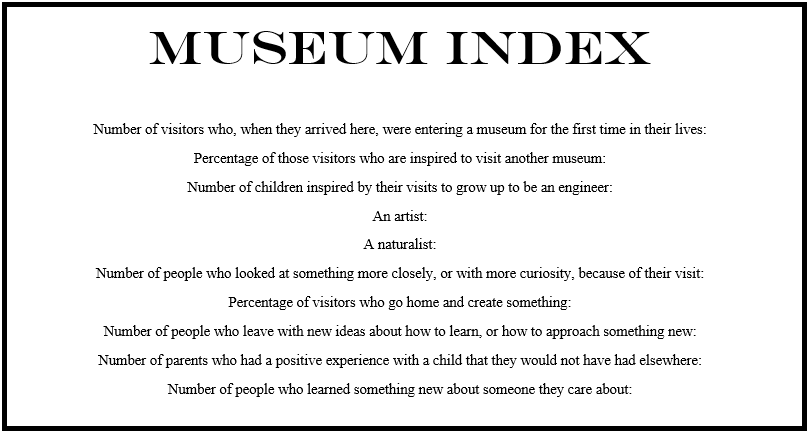
Inspired by Harper’s Index, I put together a list of some of the PlayHouse museum outcomes I would like to measure:

museum index

For now, I will need to substitute stories for numbers. Regular readers of this blog will know that I have strong concerns about storytelling in exhibits, because they are emotional, biased, and persuasive. But storytelling is an excellent tool for development, because they are emotional, biased, and persuasive. And for every one of these index numbers, I have, or can collect, numerous stories demonstrating that this is happening.

But I would like to find ways to collect numbers related to this “Museum Index.” I wonder if this might be done, in partnership with experienced researchers, using clever questions and a limited sample to gather percentages (rather than total numbers). This, after all, is how the sources Harper’s uses often get their numbers, not by speaking with every household in the country, but by identifying a certain sample set and collecting data just from them.

What is your “Museum Index”? What numbers do you collect, or would you like to collect? How can we measure, demonstrate, and identify success according to the “priceless” aspect of a museum visit?


When are education materials good marketing materials?

Two museums are planning a joint marketing campaign around the theme of “exploration.” Both museums promote exploration as part of their mission; one has an upcoming exhibit on the theme of space exploration. The campaign will include a brochure, joint ticketing, and a social media campaign.

Early on in this collaboration, the museums need to decide what the brochure looks like. As the museums’ staff sit together to discuss the brochure, two visions are put forth:

Option 1: The brochure includes a section for each museum, with selected programs that exemplify the idea of exploration. The brochure is focused specifically on museum visitation, and includes incentives such as gift shop coupons.

Option 2: The brochure includes a section for each museum, with selected programs that exemplify the idea of exploration. It also includes a panel on the broader topic of exploration, and suggestions for other sites to explore around the region. It is focused on the larger idea of exploration, and encouraging people to become explorers.

One museum argues for Option 1, putting forth a compelling, clear argument: The goal of the marketing campaign is to get visitors to the two collaborating museums, and so the brochure should focus on these museums and that goal. By “exploration” we mean exploration of the two museums, and there is plenty to explore inside both places.Including other sites around the region complicates the marketing message. In addition, the brochure costs money, and these marketing dollars should directly benefit the two museums putting forth the money.

Another museum argues for Option 2, suggesting a different rationale: If the museums are to promote exploration, than the brochure should offer a larger picture of exploration, what it is, and how readers can explore. In the bigger picture of this campaign, success will mean that visitors become explorers – meaning that they are interested in learning more about the world around them, including visiting new places and learning new things, and that they have ideas of how to transfer these behaviors beyond the two museums. This success is best achieved with materials that support the larger picture. Ultimately, visitors will embrace the museums because they feel that the museums stand for something larger than a museum visit. They will visit, and become members, and even support the museum in other ways if and only if they understand the museum as offering something of value to their lives beyond a fun place to go. The idea of exploration is a wonderful way to promote something of larger value.

Gérard Dicks Pellerin a-1640xl pc065135

Over the past week, I have spoken to a number of people about this, and read articles on both marketing and museums and value. Although I began as a proponent of Option 2, I am finding that marketing professionals, as well as potential visitors, are clearly advocates for Option 1.

I am realizing that Option 2 is less of a marketing piece, and more of an educational piece. But this leaves me wondering – would the educational brochure ultimately be more effective than the marketing brochure? It is more mission focused and more useful, and equally branded. An education piece could be put out in all the same brochure racks as the marketing piece.

So, what is the line between education materials and marketing? When is the better option straightforward marketing, and when is it mission-focused education materials?

How do marketing materials convey value without being complicated? How do you ensure that an idea like “exploration” is a true value, and that the museums deliver on this value, rather than just using it as a marketing tool? What is the role of the marketing piece in the constellation of museum value?

I’m still trying to figure this one out, and hope readers will weigh in!


What does good staff training look like?


At the PlayHouse, we brought on two new managers this week. These managers are responsible for supervising front line, daily operations – things like opening and closing registers, making sure the museum is ready for visitors when we open, and toys and exhibits are cleaned and sanitized at the end of the day, and throughout the day dealing with any visitor concerns or other problems. Their training, developed by our Operations Manager, included five days of conversations and instruction about membership, cleaning policies, staff, and more, as well as time spent getting to know the museum, shadowing employees, and starting to manage while mentored by experienced managers. This was the first time we had hired managers, rather than promoting from within, and I was (and remain) very impressed by the thought the Operations Manager put into training, and the intensity of the training she created.

But as I sat down to write this week’s blog post, it occurred to me that what this training did NOT include was time to engage as visitors, and to absorb our larger goals for visitors in any deep or meaningful way. Which intersects with a question I am constantly grappling with, which is how to effectively achieve museum goals for visitors, especially when they might challenge visitor (and often staff) expectations.

As I thought about this post, I made a drawing of our hoped-for visitor outcomes, to try to think about what we are asking of staff:

march 6 staff map

But it didn’t take long to come back to the answer I already knew: In order for staff to help visitors achieve these outcomes, staff must embody these outcomes. It is impossible for a staff member who is not curious to teach a child to be curious.

This is a problem currently prevalent in K-12 education, which is beset by top-down curriculum design and training. If the goal of K-12 education is for children to know basic math skills, perhaps it makes sense for teachers to implement a standardized curriculum based on “best practices” for teaching these skills. But if the goal is to foster innovation, curiosity, and problem solving – the much-touted “21st century skills” – then teachers must be trained and encouraged to be innovative, curious, and solve problems.  We are compromising the teaching of important aptitudes by training and testing based on discipline-specific skills.

This is true in museums as well. If we want visitors to be curious, and to begin to explore independently, then staff needs to both embrace and be skilled in this approach to the world. (I use the goal of curiosity because I think on some level this is – or should be – a goal across all museum disciplines.)

I want to think this through in staffing in two ways – in a children’s museum context and an art museum context.

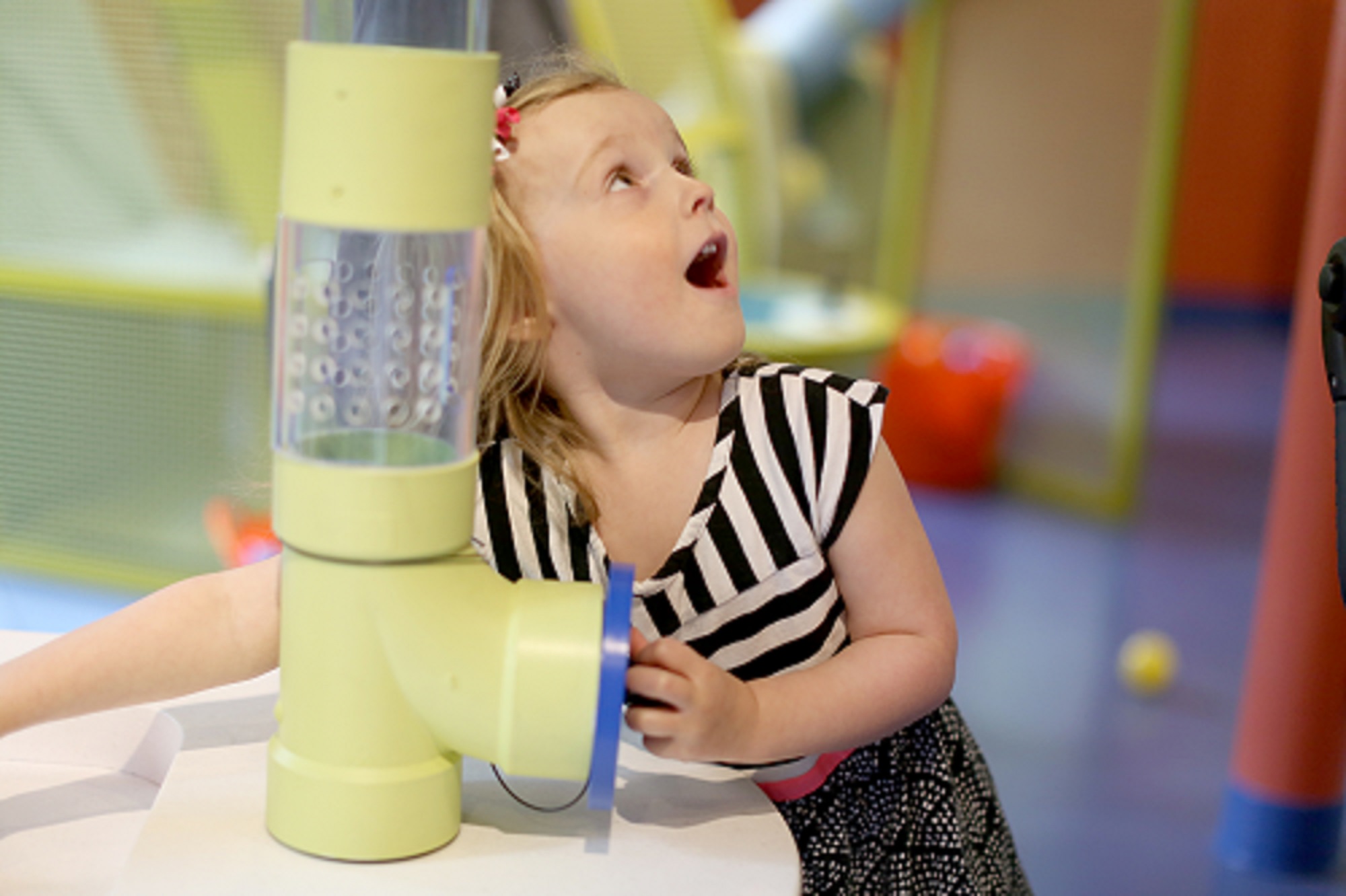
In a children’s museum, this means that when floor staff catch a child using a toy from one area in another area, they need to understand that that the child is likely experimenting (“I notice these wind tubes suck up balls. Will they suck up this plastic food, too?”). Which means they need intervention tactics which stop the child from potentially breaking an exhibit component by sending plastic food up an air tube meant for smooth round balls, while at the same time supporting experimentation generally, and re-directing the child’s curiosity to something that is less harmful to the museum. Which is no small task under the best of circumstances. In order to do this effectively, the staff person needs to embrace and recognize curiosity, to BE curious. To be able to genuinely say to the child, “I love that you are experimenting with things, but this one will break the machine. What are some other things we could try? Maybe we could see if the plastic food floats in the water table? Or if we can get two balls to go up the air tubes at once?”

girl at MC - smaller
A child watching balls travel through air tubes at the PlayHouse

In an art museum, this means that when a visitor gets too close to a work of art, a nearby guard needs to understand this as an act of curiosity. Instead of saying, “You’re too close, move away,” the guard might say, “I’m sorry, we don’t allow visitors this close to the art. I’m curious about what you are looking closely at – is there something here that particularly interests you?” Or when a visitor asks at the Admissions Desk how large the exhibit is, and whether they have time to see it in an hour, the Visitor Services representative might answer, “It isn’t an enormous exhibit, but there is a lot to see and think about. I personally love the work on the 5th floor, and could spend an hour there alone. One strategy we recommend is walking through the entire exhibit and then go back to a few pieces that you love or are curious about.”

This applies to all staff, or at least any staff that encounters visitors in any way, from the admissions staff to curators and exhibit designers; from marketing and public relations staff to museum educators.

What might this training look like?

In a children’s museum, we might challenge staff to come up with their own experiments in the galleries. Spend time at the water table: what are you curious about? How can you experiment and learn more? If one of those experiments endangers the exhibit or visitors, are there other ways to test your curiosity? What is the most exciting experiment you can come up with here? What do you wish you could test, but can’t yet, so that we can tackle this challenge as a staff?

playhouse water table
The PlayHouse water table

In an art museum we might include gallery time in training for all staff, with similar questions: what works are you drawn to, and why? what are you curious about? what are strategies for answering your own questions? how can questions lead to more questions, as well as answers?

Beyond training, we need to encourage staff to ask questions, to challenge the ways we do things; we need to create an environment in which meaningful change comes from the front lines. Which also means creating space for an ongoing dialogue with staff about what is working and how things can be better. It means learning about individual strengths and interests so that staff bring these to the table and use them to think critically about the museum and its visitors. Before we can help visitors ask questions, innovate, and explore, we have to foster the same qualities in staff.


I blog because it helps me think through issues that I might not otherwise attend to or tackle. This post has helped me think more deeply about a challenge that has been sitting at the edges of my consciousness for quite a while. The PlayHouse will be closed for a week in late August for cleaning and touch ups, and this post leaves me with new thoughts about additional uses for that time. I would love to hear ways in which other museums have approached staff training, especially – but not only – in children’s museums, to help staff learn to think creatively, be curious, explore the world, believe in their own power to create change, and celebrate difference.


Adults are Learners, Too

This guest post is by Jackie Delamatre, who also wrote the post “But will YOU be here?” for Museum Questions in January 2015. Jackie Delamatre is a museum educator. She teaches all ages (from babies to senior citizens) and runs a blog with the goal of connecting kids, parents, and educators to museums: Ms. Museum


jackie headshot

For many years now, museum educators have invested heavily in the belief that people learn by constructing their own knowledge through experience and an exchange of ideas, rather than by what Paulo Freire described as the “banking” concept of education – in which educators believe they can pour knowledge into students’ open minds and it will more or less be transferred unchanged.

This strongly held belief in constructivism is, I think, a great strength of museum education, and despite some skirmishes around the edges (the debate about whether or not and when to offer information, the debate about whether to ask questions), it is fairly consistently applied across institutions. That is, it is consistently applied for children.

For adults, on the other hand, it is anybody’s guess what learning theory, if any, will be applied at any given institution or any given moment. In one institution, you may only be offered a straight lecture-based tour – in which not even questions from participants are encouraged. In another, you may find yourself in a highly constructivist model of education one moment and the next, in a traditional lecture-based tour.

Noting this recently, I have begun to wonder why the approach to adult education is so varied within museums, while the approach to education for younger visitors is so consistent, and what, if anything, we should do about it.

There is an argument to be made that if an institution believes very strongly in a theory of learning, it should offer only programs that align with that theory, especially when the theory appears to be supported by research. If we believe it is good for preschoolers through teenagers to engage in dialogue around objects and ideas, why do we then (largely) drop this dialogue at the point of adulthood? Shouldn’t every age group be offered learning opportunities like those described by John Dewey and Freire in which experience or dialogue is the basis for the formation of knowledge and opinions rather than just the delivery of facts? In which social justice, no less, comes about through a shared meaning-making as opposed to facts delivered from on high? Indeed, Freire speaks mainly about adults in his description of his “problem-posing” education, which is often strikingly close to the dialogic methods of museum education:

They call themselves ignorant and say the professor is the one who has knowledge and to whom they should listen. The criteria of knowledge imposed upon them are the conventional ones. ‘Why don’t you,’ said a peasant participating in a culture circle, ‘explain the pictures first? That way it’ll take less time and won’t give us a headache.’ Almost never do they realize that they, too, ‘know things’ they have learned in their relations with the world and with other women and men. Given the circumstances which have produced their duality, it is only natural that they distrust themselves.[1]

What’s most striking to me about this passage is how familiar that first reaction is from the participant: “Why don’t you explain the pictures first?” I have found that unless adult participants have been set up to anticipate participation in a museum experience, they respond exactly this way – or at least they express this through their body language or reluctance to speak. Anything billed in a museum as a tour garners this reaction. More experimental programs, properly marketed, such as Ways of Looking at the RISD Museum in which visitors look at and discuss one object for an hour, allow visitors to come with more open minds in terms of how they will behave as learners. More casual programs, such as the Gallery Guide program at the Guggenheim in which guards double as educators, allow visitors to converse in a less high-stakes, more informal format. I have found these programs to be immensely successful in applying the constructivist theory to adult education within museums.

Ways of Looking at RISD
Ways of Looking program at the RISD Museum. Photography by Erik Gould, courtesy of the RISD Museum.

However, after all these years teaching in this participatory, problem-posing, dialogic way with kids, I do not necessarily believe that for adults, the lecture should have no role in education. After all, an adult may come to a museum with the specific goal of gathering facts on an area of interest, and isn’t the lecture the most efficient way to gather facts, or, even better, an expert’s interpretation of the facts?

Last fall, I followed with great interest a debate that unfolded in the New York Times over just this issue. It began in September with an Op-Ed written by Annie Murphy Paul (the sister of a museum educator!), called “Are College Lectures Unfair?” It begins boldly: “Does the college lecture discriminate? Is it biased against undergraduates who are not white, male and affluent?” And goes on to cite research showing that when the lecture format is compared to the “active learning” approach (involving class discussions, guided reading assignments, frequent quizzes), students over all perform better in the latter. But there’s more: In “active learning” courses, women, minorities, and low-income and first-generation students “benefit more, on average, than white males from more affluent, educated families.” As Paul writes:

The act of putting one’s own thoughts into words and communicating them to others, research has shown, is a powerful contributor to learning. Active-learning courses regularly provide opportunities for students to talk and debate with one another in a collaborative, low-pressure environment.

In other words, the research supports constructivist learning approaches as best for college-age learners and especially the kinds of learners many museums purport to want to attract as new audiences. Surely the college-aged learner is close enough developmentally to our adult visitors…Does this mean the lecture-based tour is outdated? Is this the final nail in its coffin?

A month later, a reply to Paul’s Op-Ed appeared in the Times. In her Op-Ed, “Lecture Me. Really,” Molly Worthen, an assistant professor of history at the University of North Carolina, Chapel Hill, argues that lectures are a way of teaching the art of attention and how to absorb a long, complex argument as it unfolds. Lectures, she writes, are an exercise in mindfulness and careful listening that extends beyond the college classroom.

The articles highlighted the debate that is playing out in both formal and informal education. Recently, my new role as Curator of Education at a historic house museum has made me even more committed to determining the best way forward. I will soon have to train new docents in how to give tours to adults. But what will I tell them?

In my conversations with potential visitors I hear the same debate: some love lectures; some can’t stand them. What is going on here? Is the interest in the lecture just a nostalgic clinging to the ways of the past or are we seeing a true split in the population? Perhaps we are seeing a split in preferences for learning styles? Or perhaps this can all be explained by the varying quality of the lecture-based tours? Are the people who love their classic lecture-based tours responding to docents who are great storytellers – a teaching method that can be extremely entertaining and even educational? Or is there something more going on? Perhaps, as Worthen writes, a lecture feels like an escape from this constantly interactive world? Or, as Freire suggests, the participant who feels disenfranchised would rather hear from an expert: “it’ll take less time and won’t give us a headache”?

Perhaps, instead of hewing to a particular learning theory, museums should be making all programs more varied. We have become so singularly focused on teaching children in a constructivist way that we may have tunnel vision. Perhaps each pedagogical approach is best suited to different learning goals. The constructivist approach helps visitors learn how to look and think for themselves. The lecture-based tour, done well, can help visitors absorb an argument and escape into a moment of mindful concentration. (And I am sure there are other approaches that could address still other goals.) Have we experimented enough with storytelling in the galleries, for instance? Or a Montessorri-type approach in which students choose their own stations to explore the objects?

Whatever approaches we use, museums should be clearer about the learning goals and theories they have for visitors of all ages. We may not have to be accountable to teachers, principals, and school systems when we plan for and report on adult learning, but they are learners, too. Making our learning theories and beliefs more transparent is good for both visitors and educators.

[1] Pedagogy of the Oppressed, pg 63. Another passage offers a more concrete example: “… a group of tenement residents discussed a scene showing a drunken man walking on the street and three young men conversing on the corner. The group participants commented that ‘the only one there who is productive and useful to his country is the souse who is returning home after working all day for low wages and who is worried about his family because he can’t take care of their needs. He is the only worker. He is a decent worker and a souse like us.’… imagine the failure of a moralistic educator, sermonizing against alcoholism…” 118-19