This is a week for reaching out; for me, that includes working on a post for Museum Questions, after a very long absence.
This is a week when, while spending time isolated, we learn we are not alone. This short episode of “The Daily” shares how the tone of the internet has changed over the past week – we are noticeably more virtually supportive and communal. And by “we” I mean the vast majority of human beings. I suspect everyone has now seen the video, widely shared on social media, of Italians serenading each other from their apartments.
This is a week when we are simultaneously worried about whether our friends and colleagues who are not working right now will be able to afford groceries and rent, and whether our museums will be around and sufficiently solvent to re-employ them, as well as those of us still working, when this is over.
This is a week when people are reaching out to make sure neighbors they barely know have food and other essentials, even though a trip to the grocery store feels like a daring and dangerous mission.
So what do we do now?
We’re throwing seeds into the wind and seeing what grows, and learning quickly. Here is what we are doing at the Peoria PlayHouse Children’s Museum, and what we are learning; I’d love to hear what you are doing, and what you are learning, in the comments to this post.
Using social media to share activities to do at home
What we are doing: We schedule posts 2-4 times per day sharing activities, found from other sources, that parents can do with kids. You can see these posts on our Facebook feed.
What we are learning:
A quick look at the PlayHouse Facebook stats tells me that most posts are viewed by 400-600 people, with approximately 8 engagements. This is only about 1/4 of our membership, and 1/10 of our email list or the list of those who like us on Facebook. Starting tomorrow I plan to send weekly emails gathering the activity ideas for the week, since clearly many of our followers are not seeing the social media posts.
Also: Museum educators are ideally suited to creating, collecting, and refining ideas for how individuals and families can keep busy and engaged at home. The PlayHouse is part of the Peoria Park District; often I feel like as a museum professional I have little to contribute to the larger conversations about topics such as recreation revenue, parks maintenance, and local vs travel teams for children. But right now, my skills are in demand!
Creating “Maker Kits” for members to pick up on our porch.
What we are learning: Demand for this is high, and people will drive 30 minutes to pick these up. Within 24 hours we had requests for 275 bags. Due to a technology glitch we did not get these emails for 24 hours; despite telling people to wait for an email from us, lots of individuals showed up on our porch the next morning to get Maker Kits. We compiled as fast as possible, and were able to distribute about 100.
This was Friday morning; we sent out a survey after to learn more about how we could be useful. Of the 27 answers we have received, almost all asked for activity ideas; only a few were interested in video resources or links to resources shared elsewhere. Suggestions include activities for teens and for children with special needs; also a weekly e-blast with activity suggestions for the week.
Also, although we are not actively soliciting donations, we received two small donations on Friday and Saturday, which I believe were in response to these kits.
Providing childcare for children of healthcare professionals associated with OSF HealthCare, one of our local hospitals.
What we are doing: This will start on Monday. We are accepting up to 12 children; children will be kept in two discrete groups of 6. Despite that fact that we are a children’s museum, most activities will take place in classrooms (separate for each of the two groups) or outside, and when children do play in the galleries we will try to contain them in a space that we can thoroughly clean after. So far staff is happy for the work, but I worry that staff will get scared and decide they do not want to work.
What we are learning: I can let you know in a few days…
Staff care and communication
While we are closed (which we have been since Monday March 16) we are not able to employ our part time staff during this time. For us, that is most of our staff – there are three of us full time, and the other 15 or so employees are hourly. Fortunately, Illinois has put emergency unemployment relief in place, but I remain unsure exactly what compensation my employees will receive through this source. And while income is essential, employment also provides people with a purpose and a community.
How do we help employees find purpose and maintain community during this time? I am reaching out to staff by email and through our scheduling software. I am reaching out to some individuals, particularly those for whom I think this will be emotionally difficult. I have been discussing some ideas for volunteer projects that staff can sign up for – tasks that can be done at home, are outside of regular work duties, and allow ongoing teamwork and communication.
And on a personal note, I am…
Trying to reach out to at least one person each day who I have not spoken with in a while, taking advantage of this moment to broaden and deepen my network of personal support.
Watching lots of movies with my teenage kids. Current favorite: Crazy, Stupid Love.
Going for walks with friends. We spread out across the street or the park to stay six feet apart. On Saturday I went for three separate walks, with different friend groups.
Making a cardboard house for my daughter’s hamster. Everyone needs a wacky hobby right now. I was inspired by a Tik Tok video that John Oliver shared on Last Week Tonight (see 11 minutes and 41 seconds into this video):
What are you doing to keep sane, help your staff and community, and continue doing the work of your museum in these difficult times? Please share what you are doing, and what you are learning!
The Peoria PlayHouse Children’s Museum is hiring a Membership and Marketing Coordinator, a part-time (29 hours per week) position with a flexible schedule. This staff member will be in charge of the museum’s membership program, as well as considering data across the museum and coordinating marketing, especially on social media and the museum’s website.
Below is a full description of the job; read more or apply here. Thank you, Museum Questions readers, for helping to spread the word about this job!
PlayHouse staff thinking about the best way to facilitate learning in the museum galleries during a monthly training session.
Peoria PlayHouse Children’s Museum: Membership and Marketing Coordinator
POSITION: Part Time (29 hours per week)
REQUIREMENTS:
Four-year college degree preferred; extensive experiences in a like position with similar duties or responsibilities may be substituted for all or part of the education requirement.
Ability to create and adhere to highly structured calendar of tasks, including weekly, monthly, and annual deadlines
Comfort with / ability to learn and use fluently: Facebook, Instagram, WordPress, and membership databases, as well as Microsoft Office Suite (Word, Excel, Outlook)
Experience using statistical math to inform decision making as well as track budgets; general skill at data analysis
Excellent communication (written and verbal) and customer service skills, in person and over the phone.
Excellent organizational skills and ability to manage multiple tasks simultaneously with a minimal degree of supervisory oversight.
Ability to keep information confidential
High degree of accuracy and close attention to detail.
Ability to establish and maintain good working relationships with co-workers, other park district personnel, and the general public. The interest in and the ability to work as part of a team.
Interest and commitment to the mission of the Peoria PlayHouse and the welfare of local children and families.
DUTIES:
Membership processing, including processing applications, generating cards and communications, maintaining an accurate database, and assisting members in person and by phone.
Assist with transition between membership databases
Manage membership revenue and expense lines
Work with other PlayHouse staff to refine membership structure, benefits, materials and processes.
Prepare monthly, quarterly and yearly reports on a range of data points, as well as creating other data reporting as needed.
Use Microsoft Excel and other mathematical tools for analysis; perform calculations to determine statistical differences between data points.
Coordinate PlayHouse marketing, including creating and maintaining PlayHouse marketing calendar, updating PlayHouse website, and social media posting
Attend office staff and all-staff meetings and assist with training as needed.
Adhere to strict confidentiality requirements.
Follow all safety procedures that pertain to the duties performed and support all aspects of the Park District’s safety program.
Perform all other duties as assigned.
OTHER:
Pay rate is $12.00 per hour.
How to Apply:
Complete an online application at peoriaparks.aaimtrack.com/jobs/ or view Employment Opportunities in the “Join our Team” section at www.peoriaparks.org. Applicants may submit a resume, but to be fully considered for this position an online application must be completed. While we appreciate all submissions, due to high volume, only those applicants who are selected for interview will be contacted. Applications will be reviewed until position is filled.
The Peoria Park District hires without regard to race, religion, sex, age, national origin, ancestry, sexual orientation, marital status, pregnancy, unfavorable discharge from military service, or disability to person the tasks of the job. All qualified individuals are encourages to apply. AN EQUAL OPPORTUNITY EMPLOYER.
Interview with Joel Spencer: Maker Spaces and the Reference Interview
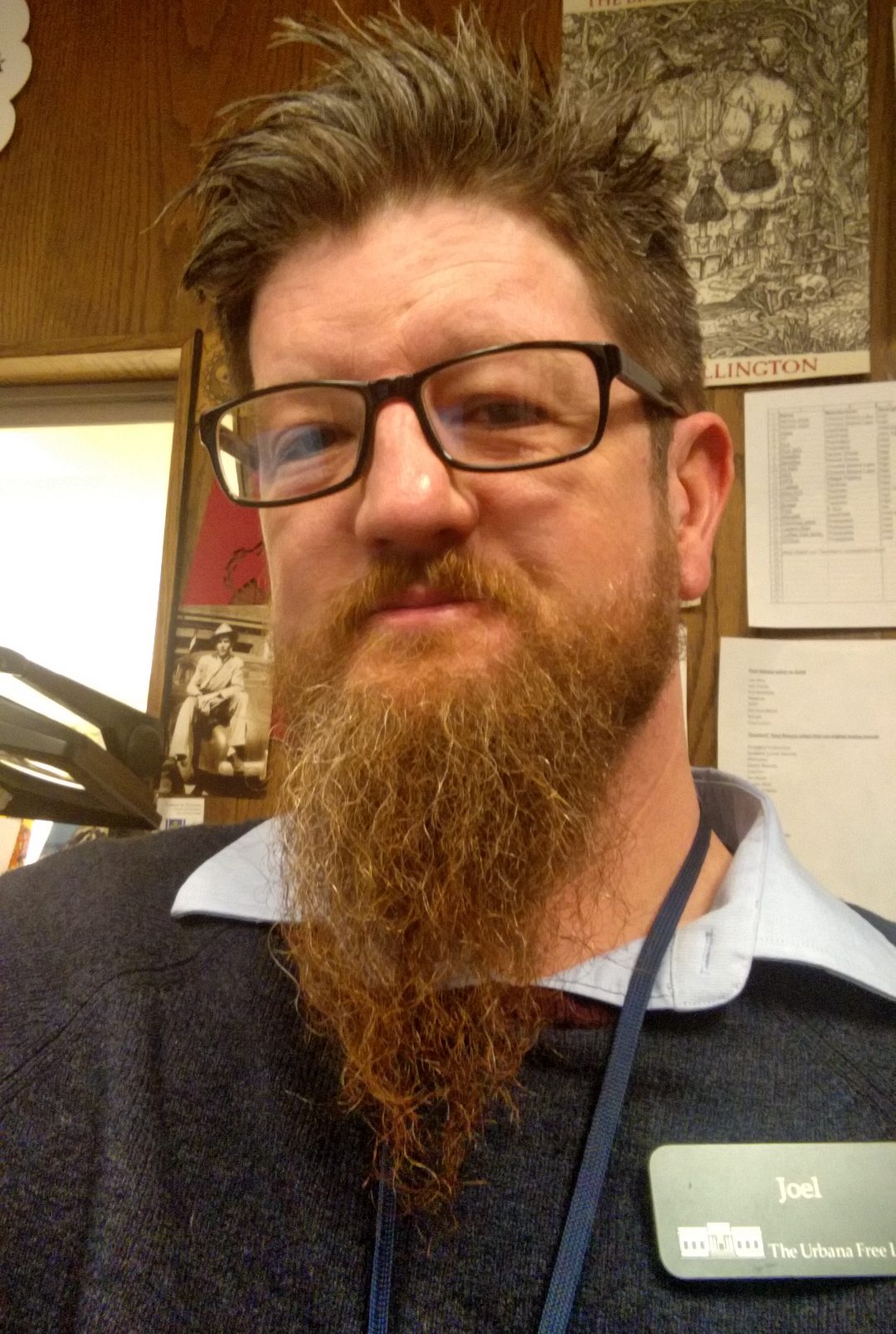
Joel Spencer is a native of Champaign, Illinois. Joel graduated from the University of Illinois with a bachelor’s degree in history in 2008, and a master’s degree in library and information science in 2010. While in library school Joel focused on community engagement and teen services, and is now an Adult and Teen Services Librarian at The Urbana Free Library. A large portion of Joel’s work at the library centers around outreach and engagement, particularly through project based technology instruction.
You have said that the “reference interview,” a tool used by reference librarians, is a useful tool for facilitation in Maker spaces. What is the reference interview?
It’s a tool to help a patron narrow the focus of their inquiry. A lot of times people don’t know exactly what it is they are looking for. If you use questions to gain more information, you will confirm with them if where you think they are going is actually useful to them. You do this until you find what it is that they actually need.
Your readers can find a very broad overview of the reference interview here.
How do you use this in Maker space facilitation?
In the Teen Open Lab I find myself using pretty much the same approach as a reference interview. I use “open” and “closed” (yes or no) questions to help teens find something they want to make, and again as they are working through how to make a certain technology work. You have to stop and narrow down why something may not be working, and think about what you might have just learned.
It’s also an approach to creating the space to begin with, developing the program and what kind of tools you are going to have, when you are going to be open, etc. For example, it may not make sense to have everything a Fab Lab would have. When you are creating the program and building your space it is critical that you make sure it is going to be what people actually want through patron input. This promotes patron ownership and direction. It supports the organic culture you are hoping to foster.
What can maker facilitators learn or borrow from the reference interview?
The idea of narrowing down and clarifying what someone is searching for to make sure you’re starting with the right question. It’s not a series of linear steps. It’s more a group of techniques that you can used together to ensure that you are listening well, and that you understand what people are communicating; give them the opportunity to clarify in their mind what they are looking for.
What if they come in with no ideas about what to make?
I’ve had kids who watched people printing on the 3D printer for months. They didn’t approach us to learn during that time, but they came up with ideas for what you could use a printer to create When they do come to you they’re more likely to have a pretty fully formed idea. This way they are self-motivated, they have direction, and it’s up to us to help them get there. That difference in approach doesn’t seem like that big a deal but it really is what makes the environment what it is.
You have talked about Maker spaces as a place for doing instead of learning – can you talk more about that?
We are an after school space, so our teens arrive just out of school. All day they sit and learn something that they are being taught through a standard curriculum. If we tried to teach the same way we wouldn’t have an audience.
If you focus on solely on a learning outcome then you are going to try to teach to that specific outcome; you are going to be focused on what you want to impart to them. This sets up a relationship in which the facilitator has the power, and is piecing out bits of it to teens. If you focus on making instead of learning then the teens are in charge, they are directing the experience.
Also, if you focus on the tools and the technology rather than the patron and their goal, then you run the risk of losing your audience as well. I’m not interested in following the trend of whatever the newest tool is. If it doesn’t make sense in people’s lives, for what they want to accomplish, then it’s not worth doing.
Learning still happens, it is just a by-product. Especially with teens, if they want to do something, it’s hard to stop them. Allow them to do what they want, and in the process they teach themselves, and usually us, how to do it.
The larger goal is to give kids a safe space in which they can feel some agency, some control. There is also the idea that this is a third space, neither home nor school, and it’s supposed to be fun.
You have referenced Paolo Freire and his seminal work Pedagogy of the Oppressed in relation to your work. What does Freire have to do with Maker spaces?
Freire was interested in changing things in a larger social way. We want to do a smaller version of that, where the teens have a place that they have some control over, we can collaborate with them and come up with the space they want to be in, and they can teach each other and teach us. This allows us to step away from being the authority. It gives them an opportunity to become a community, and all of us an opportunity to communicate better.
Museums with Maker spaces – often children’s museums or science centers – tend to have audiences that are younger, and who visit irregularly. What can we learn from what you are doing?
What you do is different in a pretty fundamental way. It seems to me that in a way museums are presenting technologies in an observational rather than project oriented way. But the approach should be the same. If I were in your position I would contact the schools, talk to the kids about what they are actually interested in. Get as much input as possible from your audience. Let them inform what’s going to be in the space.
I would make the space as hands-on as possible and as well-staffed as possible. Very often we find that no one will come and ask you questions, but if you are walking around and looking someone will raise an eye or sort of raise their hand.
Within the space I would create an informal atmosphere, talking around a table. Start with a conversation. That’s often how great projects get started!
Edward Clapp is an author of Maker-Centered Learning: Empowering Young People to Shape Their Worlds. This book, and the research behind it, are an initiative of the Agency by Design project at the Harvard Graduate School of Education’s Project Zero.
Photo by Angela Mittiga.
One of the challenges in talking about “making” is how big our definition can grow. A table is made, so is a sculpture, so is a system of government. What are the boundaries of making?
We try to be as inclusive as possible when thinking about what counts as making. We like to think we can find making in many places. We hesitate to put a fence around it, but if we we’re going to enclose what we are talking about when we talk about making, we are going to make sure that barrier is as porous as possible.
The systems aspect is one of the most exciting pieces of our framework. All objects are systems, with subsystems, situated within supersystems. If you are going to be a successful maker you have to have a really good understanding of systems.
We want young people to think of themselves as agents of change within systems. Younger children might think about the system of lining up for the bus in the morning, or the lunch line at school. Older children might expand to look at how a system of racism has been designed, and how they might redesign that system.
I keep a bicycle bell on my desk. When you take a bicycle bell apart you see a complex system. This system is composed of subsystems, and when you put the bicycle bell on a bicycle, the bell becomes part of a larger system made up of more subsystems, and then when you use that bicycle to commute to work each day, you situate the bicycle and the bell within a broader transportation system. I hope that by looking at a bicycle bell and seeing a system, one can also look at a social movement like Black Lives Matter and see a system, and see oneself as an agent of change within that system. What we find exciting about maker-centered learning is that when you bring in systems thinking into it, it becomes more impactful. You can apply thinking routines to both systems mentioned above: thinking about the parts of each system, the purposes of those parts, and the ways in which these systems are complex. Once you’ve explored the complexity of these systems in this way, one may then find opportunity to affect change.
Do you find yourself fighting the idea of “making” as a technological endeavor?
Absolutely. I would say that this is a problem related to understanding making as tied to any one technology – writing, for example, or carpentry. There are many ways of making, and maker-centered learning should incorporate tools from different backgrounds, and expand what is at your fingertips. Restricting it in one way is never beneficial.
Making is about being sensitive to the designed dimensions of the world, which are malleable. We want to help children be sensitive to design and see themselves as agents of change.
A third grade student asks a friend for help as she explores the properties and stretching capacity of a new material. Photo by Melissa Rivard.
According to this definition, one could “make” in the social studies or physics classroom. Is your definition of “making” really a project-based approach that works in any curriculum area?
I am working on a new project called “Making Across the Curriculum.” It starts with the premise that the concept of a makerspace is poorly named, because it suggests that making is isolated to a certain environment. Making is something that should happen across content areas and span grade levels, and there are opportunities for maker-centered learning in any curricular area.
We focus on three core capacities related to making: looking closely, exploring complexity, and finding opportunity. If we think of maker-centered learning from the perspective of these capacities, we can see that making is applicable in any content area.
What are great examples of problems or questions to be posed or solved in an educational maker space?
We see a lot of design challenges. But design challenges aren’t the only pedagogical tool. Something that we do is what we call a design hunt: looking at ones environment and identifying design. Helping people become sensitive to the made dimensions of their world has been good for getting the design and maker juices flowing.
At a very young age, just tinkering with materials is a big thing, too. We have seen educators alternate between what we call “messing around” and “figuring it out.” Young people mess around with tools and materials in a tinkering way, without an objective, and then work with an objective in mind and try to figure it out. The objective can be anything – design a better garbage truck or make a ball roll down a track and into a bucket, for example.
Sometimes we give teachers a design challenge and materials to work with in small groups. Then we say switch, and the groups move to work on someone else’s design. We give them the Parts, Purposes, Complexities thinking routine: What are the parts of this design? What are its purposes? What are its complexities? And then we give them the Imagine If… thinking routine: In what ways could this design be made to be more effective, efficient, ethical, beautiful, or more fill-in-the-blank?
The whole idea of becoming sensitive to design and noticing the designed aspects of the world can help young people surface issues they are interested in addressing or problems they are interested in solving. Problem solving starts with nurturing a sensitivity to design.
In your book, you talk about how one of the teachers you worked with talked about how the most important materials are cardboard and a glue gun, needed to prototype.
It’s not just with young children that we heard that cardboard and glue guns are the most important tools in a maker-centered classroom. It’s the more low tech tools and materials that are most helpful in most any maker-centered classroom. They are more affordable, less precious, so you’re more inclined to experiment or prototype with them. You can work more quickly with them. We find this across grade levels. In one college we visited they have a lot of hand tools and really thick housing insulation, which they use to prototype because it’s inexpensive, and can be manipulated it in all sorts of ways.
A whimsical design from repurposed materials. Photo by Melissa Rivard.
In your book, and throughout the work of Project Zero, there is an emphasis on the development of dispositions, as opposed to skills or knowledge. Can you talk about this framework?
Let’s take a 21st century skill like critical thinking, which is thought of as being a skill or capacity in some way. But just because you have that skill doesn’t mean you will be motivated to use it, or know when to use it. Capacity (the ability or skill required to do something), Inclination (the motivation to do something—or enact one’s capacity), and sensitivity (alertness as to when to use a particular skill or capacity) together form what we call a disposition.
It’s this sensitivity piece that is the bottleneck to generative thinking. One explanation for this problem is that young people are so programmed in their school day: During first period you think about math; second period you think about social studies. They are too seldom permitted the space to choose what type of thinking to employ on their own.
Thinking routines are exercises repeated over and over again so that generative thinking becomes a habit of mind. We define maker empowerment as a sensitivity to the designed dimension of objects and systems, along with the inclination and capacity to shape one’s world through building, tinkering, re/designing, or hacking. Our thinking routines support the development of maker empowerment, which we have described as a habit of mind, a way of being in the world, a disposition.
What are your thoughts on making and maker spaces in children’s museums?
The advice I would give is to focus on the core maker capacities: how do we help young people look closely, explore complexity, and find opportunities through working with materials, or perhaps exhibits in the museum?
This week’s guest post is by Nicole R. Rivera, Ed.D. Nicole is an Assistant Professor of Psychology at North Central College. She is also the Academic Research and Evaluation Partner of the DuPage Children’s Museum in Naperville, IL.
For the past two years, I have been working with the DuPage museum to explore what parents and caregivers believe about play and learning. Focus groups and visitor surveys show us that parents highly value play for developing social and emotional skills, fostering cognitive skills, and supporting their children. However, caregivers see play as less associated with academic learning and physical development. In both focus groups and survey responses, caregivers identify a number of barriers to play, including family schedules, concerns about safety, and feeling less confident about facilitating play.
The responses we received from caregivers made us curious about what children believe about play and learning. In order to find out, we began exploring approaches to learning from young visitors to the children’s museum.
Our first study
During the summer of 2016, we began interviewing children on the museum floor. Children were presented with a poster board with pictures of 21 play activities. They were given post-it notes and asked to identify their three favorite play activities by placing the post-its on the pictures. We talked with 100 children on the museum floor. Children carefully considered their options and made their selections. The top three results were kitchen sets, playgrounds, and toy vehicles. Some parents commented that they were surprised by their children’s choices. We were excited to see that children as young a three were carefully discerning their choices and willing to engage in conversation with us on the museum floor.
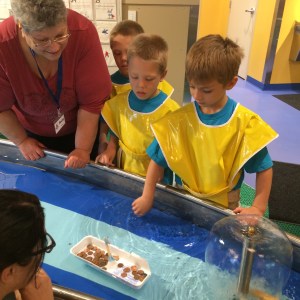
Child engaging in a science activity at the DuPage Children’s Musuem;
The second study
A second study that is currently in process involves direct interviews with children ages 4-10. Children are recruited from the museum floor. Interviews take about 5 minutes and children are asked what they think play is, what they learn from play, and what adults should know about play. Children answer our questions and provide us with insights about what they think about play. We will be completing 100 interviews over the next few months and look forward to learning more about children’s views. Here’s a sneak peek at what children have told us that adults should know about play:
“Kids should get a good amount of play.”
“I think they (adults) should know its fun and they should try it out.”
“It’s really more fun than work.”
“That it’s really fun and anyone can play.”
Adult interviewing a child.
A third study
Our third approach to gathering information from children about play and learning came through a focus group. This past November, we invited a group of 2nd grade Girl Scouts to join us at the DuPage Children’s Museum to work on their Citizen Science Journey. During the program, the girls learned about how social scientists research play and learning at the children’s museum through exhibit evaluation. The girls used adapted observation data collection tools and went out to the museum floor in small groups to collect data. Then they were asked to learn more about science by being participants in a focus group. The focus group questions asked the Girl Scouts about their perceptions of play, learning, and science.
What did we learn from the girls? They talked with us about their preferred play activities and discussed where play is allowed at school (i.e. lunch, recess). When asked what they learn through play, the girls listed creativity, imagination, and mastery. One child described the experience of not feeling like you are very good at something the first time you try it, but how you like it more when you get better at it. The girls were very enthusiastic about science and described different types of experiments they have tried at school. When asked what adult should know about play, the children said that adults should take the time to play with their children. As the discussion continued, the group began to energetically exclaim that adults should “get off their phones” and play!
Girl Scout completing a survey at DuPage.
Children have a lot to teach us. There’s an interesting story to tell when we match up adults’ perceptions of the barriers of busy schedules, safety, and comfort with facilitating play with children’s overwhelming requests to join them in play.
A few months ago, Mike Murawski, in partnership with LaTanya Autry of the Mississippi Museum of Art and The Empathetic Museum, created t-shirts to support a “Museums are not Neutral” campaign. Murawski wrote, “Museums have the potential to be relevant, socially-engaged spaces in our communities. Yet, too often, they strive to remain “above” the political and social issues that affect our lives — embracing a myth of neutrality.” Anabel Roque Rodriguez, contributing to this topic on the same blog (as well as her own), wrote, “There shouldn’t be a confusion about whether museums need to speak up against any form of misinformation… fight any form of hate in its community, protect the values that embrace the integrity of minorities and discuss which narratives need to be enforced.
Since reading these posts I have been struggling to articulate why this campaign, which advocates for the necessity of social engagement which I agree with in the abstract, becomes problematic as a mandate for museums and a counter to the concept of museum neutrality. I have come to believe that there are two problems: first, the assumption that museums or any other institutions can be “neutral,” and second, the places that political engagement on a larger scale might take us.
First, the concept of neutrality. Neutrality is defined as “the state of not supporting or helping either side in a conflict, disagreement, etc.; impartiality.” Thus, it implies that there is a conflict, and that the museum explicitly or implicitly refuses to take sides.
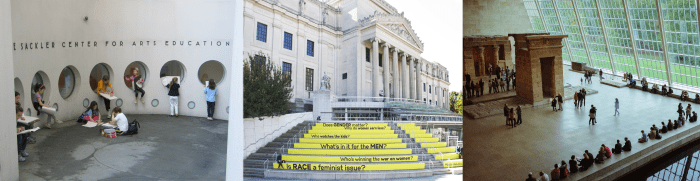
Murawski offers us two choices: museums as neutral – “‘above’ the political and social issues that affect our lives” – or museums as “agents of positive change” (quotes are from this post). But in fact, the role of museums is much more complicated than this. Museums implicitly support systems of hierarchy through their funding structure, which makes museums highly dependent upon the support of the 1%, the “winners” in our capitalist system. Racism, sexism, and injustice of many kinds in the contemporary world are entangled in a system which equates merit with money, and confers advantages to the rich that keep them rich. So museums are not neutral, but instead bulwarks of the system that the “Museums are not neutral” campaign asks us to lobby against. As evidence, see recent press about the Sackler Family, or visit the David H. Koch Plaza at the Metropolitan Museum of Art.
From left to right: Sackler Center for Arts Education at the Solomon R. Guggenheim Museum; an artwork presented by the Elizabeth A. Sackler Center for Feminist Art at the Brooklyn Museum, and the Sackler Wing at the Metropolitan Museum of Art. The Sacklers made their money through OxyContin.
Is there any evidence that this is a problem? The Sacklers may support major art museums around the world, but do they prevent these art museums from being activists? To think through this I considered the American Museum of Natural History (AMNH), which recently made the commitment to address the issue of climate change, resulting in the loss of board member and multi-million donor David Koch. That they made this decision, knowing that a wealthy board member would resign, is admirable.
But what issues does AMNH not address, and how does this impact how we understand the study of science? Joe Graves of BEACON suggests that “for the most part, the scientific enterprise has aided and abetted social injustice.” How might AMNH examine issues such as the use of data to perpetuate racism and classism in education? Or the impact of racism and sexism on medical research? What other causes might AMNH advocate for? And how might programs and exhibitions on these topics alienate additional board members, such as Richard Gilder, a founder of Club for Growth, a Super PAC that wants to “be seen as the tax cut enforcer in the [Republican] party” and which recently supported candidates Ted Cruz, Rand Paul, and Marco Rubio? Or Roberto A. Mignone, whose company Blue Ridge Capital supported Mitt Romney in 2008, and who is a Director at Teva Pharmaceuticals Industry, which was recently accused of price collusion and “a coordinated scheme to artificially maintain high prices for a generic antibiotic and diabetes drug”?
In truth, AMNH has a remarkable board – internet searches for various board members showed scientific credentials and support of many liberal causes. But even this group, which includes billionaires, hedge fund managers, and investors, has, collectively, a vested interest in the status quo. What decisions do all museums consciously or unconsciously make on a daily basis to keep the powerful and wealthy involved and invested? And when does the lack of an exhibit around the ways “the scientific enterprise has aided and abetted social injustice” equal a non-neutral, implicit support for the status quo?
Climate Change exhibit at the American Museum of Natural History. Photo by Karen Horton, from Flickr.
Now, non-neutrality.
What does it mean to be not neutral? Theoretically, one can engage with an issue without taking a position. But the “Museums are not Neutral” campaign proposes an engagement that is intertwined with advocacy, that “fights” and “protects,” and thus requires taking a position on a subject.
When engaging with “the political and social issues that affect our lives” and advocating against racism and hate, what stances does that entail? I would argue that a deep support of anti-racism must engage with economics as well, and the systemic racism and oppression that is embedded in an economic and political system in which where you live impacts the education you receive. Further, the educational advantages of parents, and their comfort operating in the world of the advantaged, has enormous implications for their children. So in order to “fight any form of hate in its community, protect the values that embrace the integrity of minorities and discuss which narratives need to be enforced” museums would need to tackle many of the systems embedded in our daily lives. Neighborhood demographics. The social safety net and how it operates. Educational testing. Implicit biases held by nearly everyone.
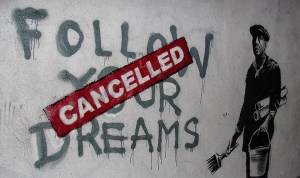
Banksy artwork from Boston. Taken by jiva bludeau, and posted on flickr.
But let’s just try it for a minute… Let’s imagine what museums would look like if they were, as Anabel Rodriguez proposes, institutions dedicated to “protect[ing] the values that embrace the integrity of minorities and discuss[ing] which narratives need to be enforced.” What would it look like if museums were genuinely advocating for social justice?
They would use exhibits to demonstrate the ongoing impact of racism, sexism, and capitalism on art, science, and history. They would likely consider exhibits a central but not sole mechanism for advocacy, taking these ideas outside the museum walls through programming, PR and marketing, and other outreach initiatives. They might support specific local and national political candidates, and take a stance on issues like gerrymandering or prison sentencing.
But if this happens, what is a museum? It is no longer an institution dedicated to the collection and care of objects, or the education and engagement of visitors about a field of study. It is a space that uses objects to lobby for social change — in ways that many of us might agree with, but has little to do with our original missions. And it is an institution so closely aligned with one perspective on the world that it aggressively attacks things that many others believe.
This institution will need to financially stay afloat, so it will end up funded by the Warren Buffets and George Soroses of the world (and thank you to those people), so it better be careful about crossing any line that offends them. And these institutions will need to be limited to hundreds, not thousands, because how many Buffets and Soroses are there, really? So whose museum gets to stay open in this new funding climate, and what communities end up with shuttered buildings due to the lack of a financially viable funding model?
Likely, these politicized institutions inspire a wave of new museums (or should I say “museum-like-institutions”) funded by the David Kochs and Ken Hams of the world. Museums, which are now political advocacy organizations, spring up on both sides of the political spectrum, widening the gap within an already divided citizenry.
Please, share some alternate stories. I recognize that this is a depressing narrative, and that a distopic future is easier to imagine than a utopic future. I want to see a different path for politically engaged museums, because we live in a world that needs all citizens to fight for what’s right and just. But museums are not citizens – they are their own special brand of institution, different from anything else – so do they need to remain “neutral”? Fight to gain greater neutrality by finding new systems of funding and support? Is there another way to play an advocacy role without alienating half of the population, and creating a two-party museum system? Or is there a way to find meaning in the work we already do, without added political and social engagement?
But the cult of failure – and specifically, the understanding of failure as useful and critical to success – is highly problematic, particularly when applied to museum work. Here are some reasons why:
Before labeling something a failure, you need to define success. Often museums assign failure based on the number of visitors who participate. A program that has 5 people attend, when it had a capacity for 100, is likely considered a failure. But is this a programmatic failure or a marketing failure? What did the program achieve for the 5 attendees? What might it have achieved for 100? In order to learn from failure, we first need clearer ideas about what success looks like, and how to get there. This is complicated because it requires us to set goals that are difficult both to achieve and to measure. For example, we like to talk about children’s museums as spaces in which young visitors learn. With this in mind failure should be defined not by number of visitors, but by whether or not children are actually learning in this space.But when we create the exhibit, we rarely invest the resources to measure this type of success.In an art museum this is even more complicated: do we define success as about learning? About individually meaningful experiences with specific works of art?
Without knowing how we define success, how could we possibly know when we have failed?
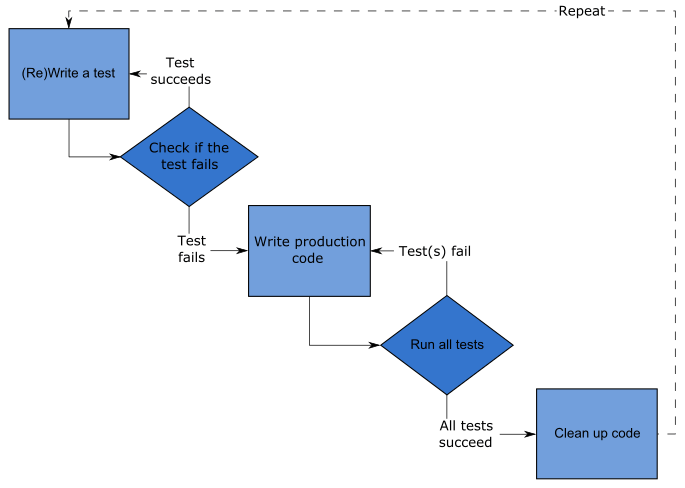
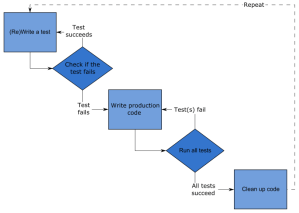
The cult of failure comes to us from tech start ups, which are more nimble than museums. Learning from failure requires repeated trial and error. This is why people talk about “failing fast” – do something, fail, and try again. In the tech world there are whole management systems built up around the idea of incremental improvement through, in part, trial and error. But changing lines of code is very different from making changes to an exhibit or a program. Exhibits, and exhibit prototypes, require a huge amount of work, often starting with significant academic research. Programs are less labor-intensive, but even a new program requires a fair amount of planning.
“A quick overview of the Test-driven development lifecycle” from Wikimedia commons.
Merritt cites IMLS’s Sparks! Ignition Grants as examples of rapid prototyping, but a look at the list of past grant winners shows that development of these projects is far from rapid. Merritt also mentions the San Francisco Opera’s Barely Opera program – an inspiring experiment that I would like to know more about, but one more relevant to design thinking than failure, since after a brief formative evaluation, the program was a huge success.
Most failures don’t lead to successes, they just waste resources. The cult of failure is predicated on the idea that failure breeds success. But according to Forbes, 90% of startups fail. I recently heard the story of a man who created three startups over the past decade, all funded by venture capitalists, all failures. What does he have to show for his past decade of work?
Artist Ernesto Pujol wrote a critique of the cult of failure in art schools, published in the Brooklyn Rail. Although not about museums, his concerns are relevant to museums that serve (or intend to serve) diverse groups of real individuals:
Entitlement to creative failure is part of America’s exceptionalist fantasy about its undeniable right to abundance and waste, even when this includes people. But the world’s poor cannot afford to fail. Far beyond the art world, in the real world, failure is the privilege of the rich. That is why we have a president in the White House who has made a successful career out of regularly filing for bankruptcy. Material and moral bankruptcy of creative and prosaic projects is the privilege of a capitalist aristocracy. But when artists are entrusted with the well-being of communities, ethically speaking, they cannot afford to fail them. Real failure is not a project option….
American art administrators must remain vigilant of the young artists they fund precisely because they may be applying for their first road projects within a diverse, impoverished society with an increasingly fragile democracy.
When programs fail, who are we failing? What resources are we wasting?
When we talk about failure, we are really talking about successes.Elizabeth Merritt suggests that we all “Join the growing number of museums willing to share their failures, as well as what they learned from these “unsuccessful” experiments, in public forums—in print, on blogs, or in conference sessions.” In my experience, however, museum professionals are usually sharing “failures” as stepping stones to specific successes – they are sharing success stories masquerading as failures.
It would be more useful to compile programs that worked and didn’t by category, and then look for indicators of what made one program successful, and another a failure. Essentially, to include failures in field-wide research. As Merritt notes earlier in TrendsWatch, not sharing failed experiments holds back scientific research and understanding. But to do this would not only take a tremendous amount of work, it would, again, require a shared idea of success, as well as a significant research budget.
So how should we think about “failure”? Rather than placing a value on failure in and of itself, we should:
Define success in a more meaningful way than numbers through the door (Read a short meditation on this topic in museums from the Yale School of management here.)
Encourage reflection and research that leads to informed experimentation
Be willing to terminate programs and projects that are not working
Work to understand failure without assigning blame, in order to create a culture that values new ideas and individuals who take risks, and rejects fear as a driving factor.
As we plan for 2018 at the Peoria PlayHouse Children’s Museum, we have decided to reduce the number of programs we offer, holding workshops and home-school programs monthly instead of semi-monthly, and cultural festivals bi-monthly instead of monthly. The goal is to leave more time to ensure excellence of programs, and to build strong systems that might then allow us to build up more effectively.
This has left me thinking: What does it take to create a great education program? What are the things that we often forget, but which are critical to enduring excellence?
Below is a list of 10 statements about programming which I believe to be true and important. Each of these statements in turn leads to its own sets of questions. I welcome readers’ thoughts – are there items here that are new to you, or which often go unconsidered? Are there things I am forgetting? Would a greater exploration of any of these topics be useful?
1. Programs start with an idea.
Where do ideas come from, and which are worth doing? How do you decide when to start a new program, and how to prioritize which idea to try next?
Where do ideas come from?
2. Offer programs that matter.
When is a program worth offering, either because it supports museum mission, makes money, or is a marketing tool? When are these priorities in conflict with each other?
3. Some programs fail.
What does it take to get a program off the ground? How nimbly can we create a pilot program – what is essential and what can we leave out of a pilot? How many years does it take for something to gain traction? And for pilot programs, how do we decide what deserves a second or third chance? How do we “fail fast” with the programs that turn out not to be successful? And how does something move from a pilot phase to something deeper?
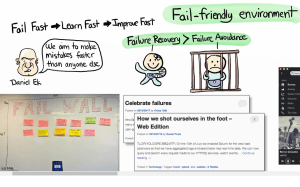
From Spotify video on their engineering culture.
4. Good planning requires starting with evaluation.
How do you leave time to plan with clear implementation objectives and participant outcomes in mind? At what stage in program development can these objectives be articulated? How do you balance objective-based planning with leaving room for visitors to make their own discoveries?
5. Program budgets are bigger than you think they are.
What gets included in a program budget? What are the real costs of a program – not just materials, but staff time and utilities? How do you calculate indirect expenditures, and when do you include them in the program cost? And how much of the cost is passed along to visitors – how do you set fees that allow access, while also ensuring as much revenue as possible?
6. Details matter.
At what point in the process do you begin to visualize and track the tiny details that make a program successful? What tools exist, or can be invented, for remembering the paper cups and the staff to greet volunteers and the name tags and the clear communication with the admissions desk?
7. Good teaching is essential.
What does good teaching look like? What are the varieties of good teaching, and how much variety can be allowed in a single program or institution, and how much does everyone have to follow the same rule book? What does it take to train staff to teach well?
School group at the PlayHouse with a School Programs Volunteer
8. It’s useless to offer a program if no one knows about it.
What does good marketing look like, and whose responsibility is this? In what ways can museums empower and support educators in promoting programs as widely and effectively as possible, to ensure that they are at capacity? When is fee-based marketing worth it, and what free marketing options exist? How do you engage community partners and volunteers in assisting with marketing? How do you capture and use existing data to improve marketing for future programs?And, just as important, how do education staff promote a program internally, in order to ensure that all staff understand the value of this program?
9. Programs are fundraising tools.
What contributed funds can be found to support programs? How can new and ongoing programs be an asset to fundraising, allowing the museum to reach out to new funders, or to museum supporters with additional potential? What grants are available to support programs, and who should take the lead in finding and writing these? And how important are different programs in promoting and fundraising for the museum as a whole?
10. Evaluation is best understood as one piece in a cycle of constant improvement.
How do you know if a program “worked,” and how do you make room for constant improvement? How do you make sure that everyone – visitors, but also staff and volunteers – has the opportunity to share what worked and how the event could be improved? How do you make time to look at and make sense of the data gathered, and who needs to be part of this team? And what is needed to incorporate these findings into the next iteration of the program, to ensure constant improvement?
This post is by Janine Okmin, Associate Director of Education at The Contemporary Jewish Museum, where she develops resources for schools and teachers, and trains museum tour guides. Formerly the Associate Manager of Learning Through Art at the Solomon R. Guggenheim Museum, Janine has led teacher workshops nationwide and in Taiwan.
She has also developed programs for teens at the Center for Arts Education in New York and for college students as the Director of Jewish Cultural and Artistic Expression at Brooklyn College Hillel. Janine holds a BA in Drama from Northwestern University and an MA from Teachers College, Columbia University.
The views expressed here are Janine’s and not necessarily the opinions of The Contemporary Jewish Museum.
Culturally-specific museums are museums that collect or exhibit objects related to a particular ethnic or cultural group, focusing on art or historic objects, but often also highlighting the histories, accomplishments, or struggles of the featured culture. For the purposes of this article, I will use the terms “culturally-specific” and “identity-based” interchangeably. The museum I work at, The Contemporary Jewish Museum, is an culturally-specific museum, as are El Museo del Barrio, National Museum of the American Indian, and the Asian Art Museum in San Francisco, to name a few.
Many, though not all, identity-based museums in the United States were founded during the rise of identity politics in the 1960s and 70s, when the public became increasingly aware of mainstream museums’ exclusion of stories and objects related to cultural and ethnic groups. For people within these cultural groups, these institutions became a source of pride. For those outside these cultural groups, identity museums became educational resources, places where visitors could learn histories of diverse people.
Today, ideas about identity are much more complicated. Given these complications, what is the relationship of the identity-based museum to its “home” culture? What happens when a culturally-specific museum defies the expectations of its “host” community or the community at large? What are the expectations of visitors when they choose to visit a culturally-specific museum and do our museums deliver?
I recently came across an article by Simona Bodo, an Italian researcher focusing on museums and intercultural dialogue. Although the article (featured in the book Museums, Equality and Social Justice), “Museums as Intercultural Spaces,” examines culture as exhibited and explored in European-based non-culturally-specific museums, her introductory paragraphs rang true for my work in an identity-focused space. Bodo discussed the problematic use of words like “heritage,” citing two paradigms for understanding this word (which I interpret broadly to also mean “culture” or “identity”): essentialist and dialogical.
An essentialist approach sees heritage as static, something that an expert (or a museum) can transmit to another person. The dialogical approach sees culture as something that can be transmitted, but also something changeable, that can be “renegotiated. . . and made available for all to share in a common space.” This tension between fixed cultural information to be transmitted and “passed down” versus a messier renegotiation of culture captures the essential debate in contemporary identity-based museums, both internally and between a museum and its visitors.
In the Jewish museum world, this tension might look like an “essentialist” exhibition about the rituals, ritual objects, and traditions associated with Passover (the holiday celebrating the exodus of ancient Hebrews from Egypt) versus a “dialogical” exhibition exploring ways themes of slavery and freedom in the Passover celebration have been used as inspiration for social activism related to issues ranging from farm workers’ rights to women’s rights. A beautiful example of a “dialogical” work from First Nations culture is Nicholas Galanin’s video projectTsu Heidei Shugaxtutaan Part 1 (see video below) andPart 2, which makes visible (and audible) the passing down of native music and dance traditions, as they intersect contemporary youth culture.
Identity museums are negotiating this tension in a variety of different ways.
The National Museum of African American History and Culture
The National Museum of African American History and Culture (which, full disclosure, I have not yet had the opportunity to visit) provides an interesting and recent example. Museum Director Lonnie Bunch recounted the struggles to determine the focus of the museum in an article in Smithsonian Magazine:
One of the biggest challenges we faced was wrestling with the widely differing assumptions of what the museum should be. There were those who felt that it was impossible, in a federally supported museum, to explore candidly some of the painful aspects of history, such as slavery and discrimination. Others felt strongly that the new museum had the responsibility to shape the mind-set of future generations, and should do so without discussing moments that might depict African-Americans simply as victims—in essence, create a museum that emphasized famous firsts and positive images. Conversely, some believed that this institution should be a holocaust museum that depicted “what they did to us.”
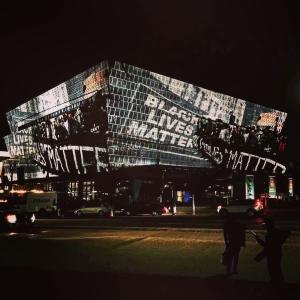
Now that it has opened, the museum is expected to respond to the difficult racial tensions in current day America. As early as 2015, its curators began collecting objects and images related to the Black Lives Matter movement, some of which are displayed in the context of the post-1968 struggle for civil rights. Yet the museum also made a more political statement with this collage of Black Lives Matter imagery on its building’s exterior.
How else might the museum respond to the ever-changing nature of African-American identity through its collections and exhibitions? Given what I have read about attendance, the museum has vast and enthusiastic visitors. I will be watching eagerly to see how the museum is able to both draw from history and navigate the messy waters of the present.
The Japanese American National Museum
The Japanese American National Museum in Los Angeles (JANM), which opened in 1992, conducted a 2009 study that examined the mission of the JANM in light of changing qualities of American ethnic groups. In particular, Japanese Americans – the community it represents – were becoming increasingly identified as multi-ethnic/multi-racial, and were less likely to identify with a particular ethnic or cultural “category.” How would the museum adapt to these changing demographics, engaging new audiences while sustaining its current constituents? Does an increasingly hybridized audience broaden potential visitors or mean there is less of a need for identity-focused institutions?
The JANM research found that the increasingly multicultural population was most engaged by exhibitions focusing on art or popular culture, and only history as it “brings the story to the present,” relating to the viewer and to the present time and place. To respond to these findings, programming has specifically targeted mixed-race visitors, and has expanded to include more popular culture. On TripAdvisor, however, most comments mention the importance of the historical exhibitions as a tool for connecting to one’s own heritage or for learning about an important period in history. Simona Bodo’s tension is apparent–as the museum renegotiates what it means to be a Japanese American, focusing increasingly on expressions of contemporary culture, visitors report “learning more” when presented with the concrete historical information transmitted by the more traditional historical exhibitions.
The Contemporary Jewish Museum
The Contemporary Jewish Museum (CJM) in San Francisco, where I work, often grapples with the disparity between visitor expectations, which are typically “essentialist”, and what the museum presents, which leans toward the “dialogical”. Founded in 1984, our mission states that we “make the diversity of the Jewish experience relevant for twenty-first century audiences.” A non-collecting museum, The CJM does not have a permanent collection of ritual or historic objects, but rather a series of changing exhibitions exploring various aspects of the connections between contemporary life and Jewish art, history, culture, and ideas. This mission has landed on the side of the dialogical approach, focusing on exhibitions and programs that wrestle with changing contemporary identities. In fact, our founders state that they wanted to build a museum to which their Jewish grandchildren would want to bring a non-Jewish friend–a place that does not focus solely on a dark past or ancient traditions, but that looks to the present and the future.
Yet despite this focus, being a Jewish museum, teachers often call us to ask if we have an exhibition about the Holocaust. (We sometimes, but not always, do.) We also occasionally get responses from concerned parents that their children might be preached to at our museum, or apprehension that a Jewish museum is only for Jewish people.
Last year, The CJM conducted some evaluative work in the area of visitor perceptions and expectations of a Jewish museum, most recently with family visitors. Non-visitors associated the museum with history and religion, while visitors described it as art-focused and full of surprises. First-time Jewish visitors were surprised that there wasn’t more historic or religious context, yet non-Jewish visitors (who were unsure if the museum was “for them”) were pleasantly surprised that the Jewish content exhibitions and activities weren’t heavy handed, and they felt welcome. One visitor recounted that he was “seeking a deeper cultural connection that would move him and his children,” wanting to use a museum experience to share his Jewish roots more deeply with his family.
A recent exhibition, for example, highlighted the work of contemporary artists from many cultures exploring memories they inherited from past generations. Although grounded in a Jewish concept of l’dor va dor (“from generation to generation”) and touching on some specifically Jewish memories, the exhibition was a cross-cultural look at memory, examining how the past impacts the future generations of many ethnic and religious groups, from Vietnamese to African American to Armenian. Our visitors, like the JANM’s are increasingly those who claim hybrid identities. (Surveys show that around 50% of our visitors self-identify as Jewish, but even of those who do not identify as Jewish, 15% report they have a Jewish family member or are part of a Jewish household.)
Students encounter Hank Willis Thomas’s Amelia Falling, 2014 in The CJM’s From Generation to Generation: Inherited Memory and Contemporary On view November 25, 2016–April 2, 2017 at The Contemporary Jewish Museum, San Francisco. Photo by Gary Sexton.
Comments from our school groups were overwhelmingly positive. One teacher shared that on the way home “one of my African American students said that he never realized how much his people and the Jewish people have in common.” While this might read as a bit trite, I was moved to think an encounter in our space helped students make connections between their own heritage and that of another–starting dialogue about and renegotiation of the fixed categories of identity. Yet other visitors shared that they encountered “contemporary art that wasn’t really Jewish,” looking for a more traditional or didactic approach to Jewish culture. In our comment book, another visitor noted, “I fail to comprehend the Jewish aspect of the place. . . This place needs context explaining its purpous [sic].
As an educator at The CJM, I am constantly trying to strike this balance. How can we meet the pre-conceived ideas and expectations of our visitors by providing concrete information about history, culture, and tradition, while also serving as meaningful space in which Jewish identity can be explored, examined, and renegotiated, in order to help visitors from all backgrounds enter into a dialogue with their own identities? What are our obligations to provide the concrete information that visitors expect? What happens if we cease to offer it? In light of the state of our country and the current relationship between identity and politics, the question of the “job” of a culturally-specific musuem feels even more important. Are our institutions the transmitters of something concrete (and worthy) to our visitors, or do we perhaps have a more critical role of convening a contemporary renegotiation of culture and identity–connecting, interpreting, and forging new identities for the future? Are both possible?
This mini research project has left me with more questions than answers, which every museum educator knows is where the learning happens.
Please weigh in here to share your experiences. How does your museum navigate these complicated issues? What do your visitors expect and how do you deliver?










 Museum Questions